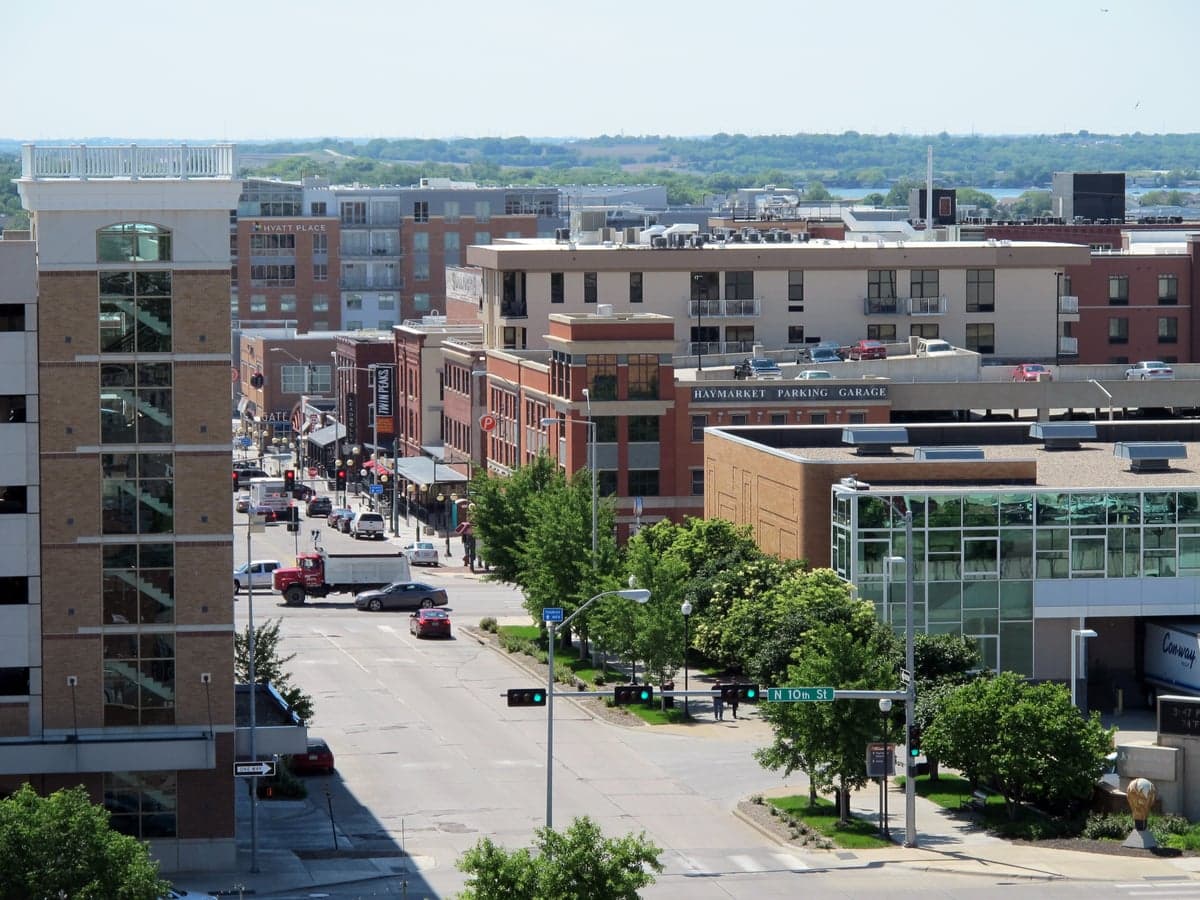
Photo: Wikipedia
Quality of Life in Lincoln, NE
Above-average quality of iife. The area offers a reasonable cost of living, decent mobility, and a mix of neighborhood amenities.
What does Quality of Life tell us?
Quality of Life blends cost of living, nearby amenities, socioeconomic signals, and neighborhood character. City-level scores represent the whole municipality; individual neighborhoods can differ.
What does this tell us?
Quality of Life blends cost of living, nearby amenities, socioeconomic signals, and neighborhood character. City-level scores represent the whole municipality; individual neighborhoods can differ.
Cost of Living
11% below national average
The Real Cost of Living in Lincoln, NE for 2026
| Tier | Individual | Family (4) |
|---|---|---|
| Survival | $17k | $31k |
| Comfortable | $48k | $71k |
| Luxury | $126k+ | $196k+ |
| Elite (Top 5%) | $150k+ | $233k+ |
99%
The Area Signal
A metric tracking the socioeconomic signals of the area.


Hobbies
Explore the areaGroceries
5 within 10 miles
Gas
0 within 10 miles
Hospital
3 within 20 miles
Airport
MCI — Kansas City International
Post Office
USPS — Lincoln, NE
Critical Amenities
Quality-of-Life Analysis
Lincoln, Nebraska, offers a quality of life defined by economic stability and a strong sense of community, attracting a mix of families, university faculty, and young professionals. The city’s cost of living index of 89 (where 100 equals the U.S. average) makes it significantly more affordable than the national norm, while its median household income consistently tracks above the state average. This combination draws residents who prioritize financial security, short commutes, and access to a mid-sized capital city’s amenities without the congestion or expense of larger metros like Omaha or Denver.
Cost of living, housing affordability, and how Lincoln compares to Omaha
Lincoln’s housing market remains one of its strongest draws for newcomers. The median home value sits at $248,200, roughly $50,000 below the national median and about 15% lower than Omaha’s comparable figure. Renters also benefit: the median rent of $1,045 is well under the national average of $1,400, making it feasible for single-income households and graduate students. The overall cost of living index of 89 means everyday expenses—groceries, utilities, and transportation—run about 11% below the U.S. average. Compared to Omaha, which has a COL index near 93, Lincoln offers slightly cheaper housing and similar utility costs, though Omaha edges ahead in retail and dining variety. The average commute of 18.3 minutes is a standout advantage: it is roughly 8 minutes shorter than the national average and 5 minutes shorter than Omaha’s, freeing up significant time for family or leisure activities.
Schools, parks, and the daily rhythm of life in Nebraska’s capital
Daily life in Lincoln revolves around a compact, walkable downtown anchored by the University of Nebraska–Lincoln (UNL) and the State Capitol. The public school system, Lincoln Public Schools, serves over 42,000 students and is consistently rated above state averages in graduation rates and test scores, with standout magnet programs at Lincoln High and the Arts & Humanities Focus Program. For outdoor recreation, the city maintains over 130 parks, including the 600-acre Wilderness Park for hiking and biking, and the 8-mile MoPac Trail connecting to the Platte River. The Haymarket District offers a mix of farm-to-table restaurants, craft breweries, and the Railyard entertainment complex, while the Sheldon Museum of Art and Lied Center for Performing Arts provide cultural anchors. The rhythm is notably unhurried: traffic jams are rare, weekend farmers’ markets are a staple, and the annual Husker football games in the fall create a citywide sense of occasion that defines the local identity.
Lincoln is best suited for those who value predictable affordability, short commutes, and a family-oriented environment over the fast pace or career specialization of larger cities. Young professionals in education, healthcare, or state government will find a stable job market anchored by UNL, Bryan Health, and the State of Nebraska. Families benefit from the low crime rates relative to similar-sized cities and the ease of navigating the city by car or bike. Retirees on fixed incomes can stretch their savings further here than in nearly any other state capital. However, those seeking a vibrant nightlife, extreme geographic diversity, or a hyper-competitive job market in tech or finance may find Lincoln too quiet. For the majority seeking a balanced, low-stress lifestyle with solid public services, Lincoln delivers consistently.

Crime in Lincoln, NE
Crime rates similar to the national median for U.S. locations.
Violent CrimeViolent Crime Analysis
Property CrimeProperty Crime Analysis
Crime Analysis
Lincoln, Nebraska, reports a violent crime rate of 420.3 per 100,000 residents and a property crime rate of 1,907.5 per 100,000. These figures place the city above the national average for violent crime, though property crime rates are closer to the national median. The city's overall safety picture is complicated by a justice system influenced by progressive policies that many analysts argue prioritize offender rehabilitation over public protection, contributing to higher recidivism and a greater number of active criminals on the street.
Crime in context
Compared to the state of Nebraska, which has a violent crime rate of roughly 280 per 100,000, Lincoln's rate is significantly elevated. The city's property crime rate also exceeds the state average of approximately 1,600 per 100,000. While Lincoln is not as dangerous as larger Midwestern metros like Kansas City or Omaha, its rates are notably higher than those of smaller, more conservative Nebraska communities. The presence of progressive judges and a district attorney's office that emphasizes diversion programs and reduced sentencing for non-violent offenders has been cited by local law enforcement as a factor in the city's persistent property crime issues, as repeat offenders cycle through the system quickly.
What residents experience
Residents report that property crime—particularly theft from vehicles, bicycle theft, and package theft—is the most common safety concern in daily life. These incidents are concentrated near the University of Nebraska-Lincoln campus, downtown entertainment districts, and along major corridors like O Street. Violent crime, while less frequent, includes aggravated assault and robbery, often tied to disputes or alcohol-fueled incidents near bars. The progressive approach to prosecution means that many property crime cases are pled down or result in probation, which frustrates victims and neighborhood watch groups who feel the system fails to deter repeat offenders. Lincoln's clearance rate for property crime hovers around 15%, meaning the vast majority of thefts go unsolved, further eroding public confidence.
Neighborhood-level variation
Safety varies sharply by neighborhood. Areas south of O Street and west of 27th Street, including the Country Club and Woods Park neighborhoods, generally report lower crime rates and stronger community policing presence. In contrast, neighborhoods near the university campus, the Near South area, and parts of northeast Lincoln (around 48th and Holdrege) see higher concentrations of theft, vandalism, and occasional violent incidents. Gated apartment complexes and newer developments on the far south and southwest edges of the city offer the lowest crime exposure. Prospective residents should research block-level crime maps and consider that the city's liberal judicial philosophy means even "safe" neighborhoods are not immune to property crime from mobile offenders.
* Values derived from national, state, county, city and local statistics and may differ in a specific area. Last updated: 2026-04-15T23:39:09.000Z
Narrative content on this page is AI-generated and may contain mistakes. Verify any details that matter before acting on them.
ReloMaps may earn a commission from affiliate links at no extra cost to you.

