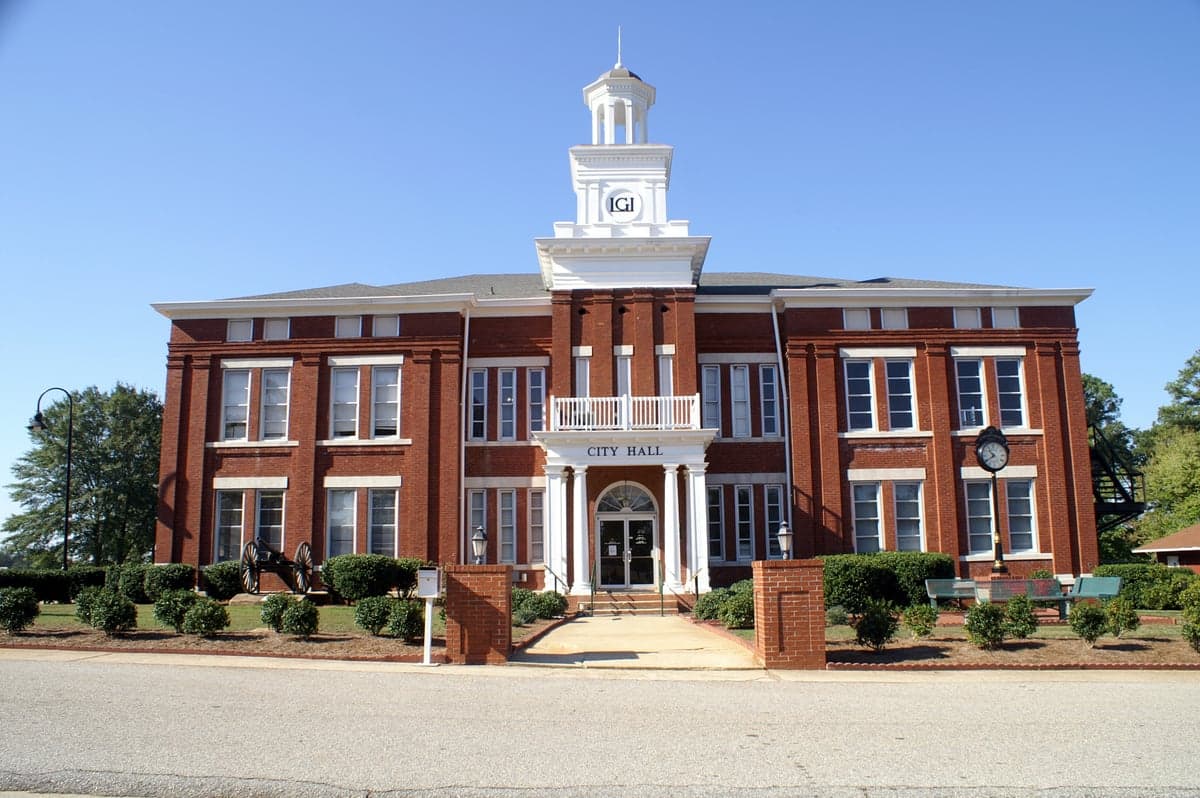
Photo: Wikipedia
Political ClimatePolitical Climate in Locust Grove, GA
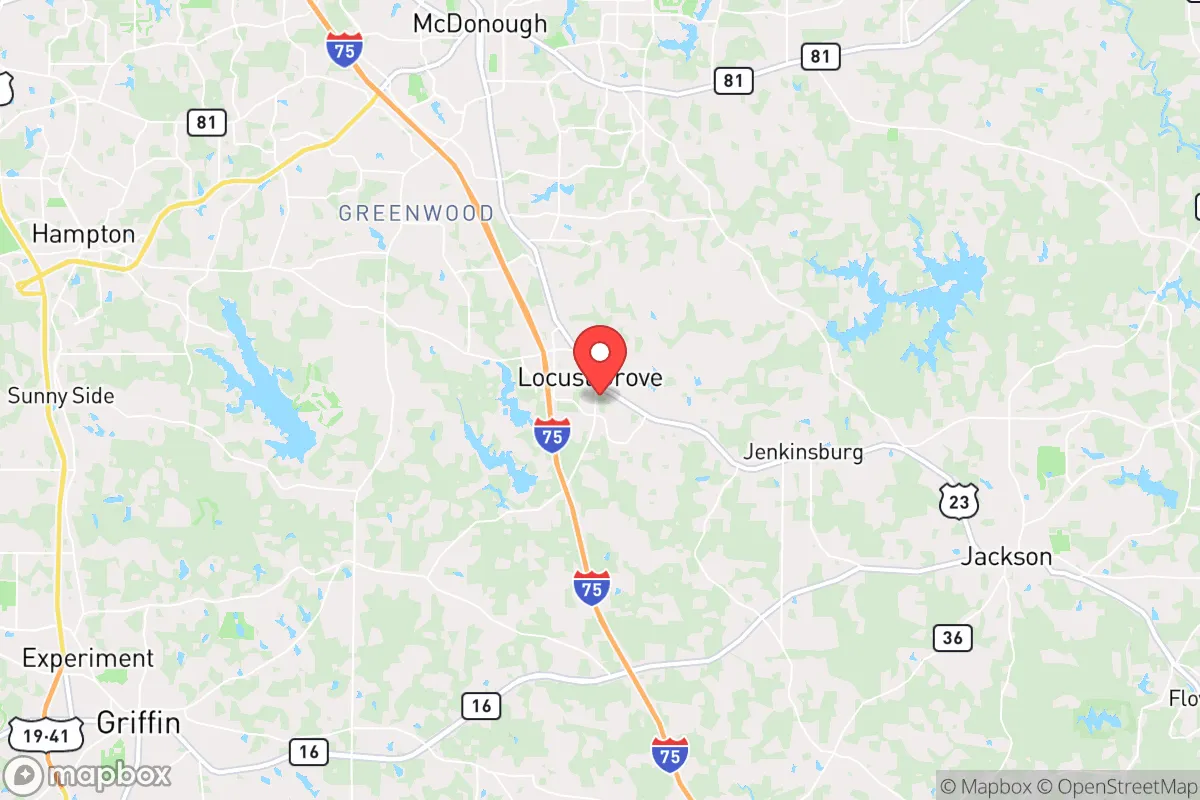
District shown is the primary district for this city’s centroid. Cities may span multiple districts.
Local Political AnalysisPolitical Analysis of Locust Grove, GA
Locust Grove, Georgia, is a reliably conservative community that has only deepened its Republican lean over the past decade. The area’s Cook Partisan Voting Index (PVI) of R+11 means it votes about 11 points more Republican than the national average, a shift that’s become more pronounced as metro Atlanta’s exurban fringe has grown. In the 2024 presidential race, Henry County—where Locust Grove sits—voted for Donald Trump by a margin of roughly 58% to 40%, a stark contrast to the county’s 2020 result of 52% Trump. This isn’t a fluke; it reflects a steady rightward drift driven by new arrivals from more conservative parts of the state and a local economy tied to manufacturing and logistics rather than the tech or creative sectors that pull leftward.
How it compares
Locust Grove’s politics stand out sharply against Georgia’s statewide trend. While Georgia as a whole has become a battleground—flipping blue in the 2020 presidential race and electing two Democratic senators in 2021—Locust Grove has moved in the opposite direction. The town is about 30 miles south of Atlanta, but politically it feels closer to Macon or Warner Robins. Nearby McDonough, the Henry County seat, is slightly more moderate (R+9), while Hampton and Stockbridge lean similarly right. The contrast is most visible in local elections: Locust Grove’s city council and mayor’s office have been held by Republicans for decades, and Democratic candidates rarely break 40% in municipal races. Statewide, Georgia’s Cook PVI is unknown, but its 2024 result (Trump by 2.5 points) shows it’s a true swing state—Locust Grove is anything but.
What this means for residents
For conservative residents, Locust Grove offers a comfortable political environment where their views are the norm. Local policies reflect that: the city has a low property tax rate (about 0.8% of assessed value), minimal zoning restrictions on new housing, and a police department that emphasizes enforcement over reform. School board meetings rarely feature the culture-war debates seen in nearby Clayton County. For liberal residents, the reality is more isolating. You’ll find few like-minded neighbors, and local Democratic clubs are small and meet in private homes rather than public spaces. That said, the area’s growth has brought some diversity—Locust Grove’s population is about 40% Black, and Black voters here lean Democratic, so you’re not alone. But in practice, progressive policy proposals (like a local minimum wage hike or police oversight board) have no traction. The closest liberal enclave is Atlanta’s Eastside, a 40-minute drive north.
Culturally, Locust Grove feels like a slice of rural Georgia that’s been suburbanized. The annual “Locust Grove Days” festival is heavy on church booths and gun raffles, and the local paper’s letters page is reliably conservative. There’s no visible LGBTQ+ community center or activist group, and the city council has declined to pass a nondiscrimination ordinance. For newcomers, the political climate is baked into daily life: you’ll hear Fox News in waiting rooms, see Trump flags on pickup trucks, and find that most neighbors assume you share their views. It’s not hostile—people are friendly—but it’s a place where political assumptions go unchallenged. As one longtime resident put it, “If you’re a Democrat, you learn to keep it to yourself at the barbecue.” That’s the reality of living in an R+11 town in a purple state.

State Political ClimatePolitical Climate in Georgia
State Political AnalysisPolitical Environment in the State
Georgia has transformed from a reliably Republican stronghold into the nation’s premier battleground state, with a partisan lean that now sits at roughly +2 to +3 points Republican in statewide races, down from a +8 to +10 point GOP advantage just a decade ago. The dominant coalitions are a rapidly diversifying, metro-Atlanta-based Democratic bloc—fueled by Black voters, white college graduates, and new transplants—against a deeply entrenched Republican base in the exurbs, smaller cities, and rural counties. Over the last 20 years, the state has gone from solid red (Bush won it by 17 points in 2004) to a dead-even toss-up (Biden won by 0.2 points in 2020, and Trump retook it by 1.2 points in 2024), making it the epicenter of American political realignment.
Urban vs. rural divide
The political map of Georgia is a story of two Georgias. Metro Atlanta—specifically Fulton, DeKalb, Cobb, Gwinnett, and Clayton counties—now delivers roughly 60% of the statewide Democratic vote. Fulton and DeKalb are deep blue, with Biden winning Fulton by 50 points in 2020. The real shift has been in the once-red suburbs: Cobb County (Marietta, Smyrna) flipped from +13 GOP in 2012 to +2 Democratic in 2020, and Gwinnett County (Duluth, Lawrenceville) went from +10 GOP in 2012 to +18 Democratic in 2020. Meanwhile, rural and small-town Georgia remains overwhelmingly Republican. Murray County in the northwest gave Trump 84% in 2020, and Bacon County in the southeast gave him 87%. The divide is stark: the Atlanta metro core and its inner-ring suburbs are now reliably blue, while the rest of the state—from the mountains of Dawsonville to the coastal plains of Waycross—votes red by margins of 30 to 50 points. The only other Democratic strongholds are the smaller cities of Athens (home to UGA), Savannah, Augusta, and Macon, each of which provides a blue island in a sea of red.
Policy environment
Georgia’s policy environment is a mix of conservative governance and pragmatic business-friendly moderation. The state has a flat income tax rate of 5.49% (down from 5.75% in 2024, with a scheduled drop to 4.99% by 2029), and no state-level property tax—though local property taxes vary widely. Sales tax is capped at 8% (state + local). The regulatory posture is decidedly pro-business: Georgia is a right-to-work state, has no state-level minimum wage above the federal $7.25, and offers generous tax credits for film production and data centers. Education policy is a flashpoint: the state has a robust school voucher program (the Georgia Promise Scholarship Act, passed in 2024) that allows students in low-performing schools to use state funds for private school tuition, and it also has a strong charter school sector. Healthcare is a perennial issue—Georgia has not expanded Medicaid under the ACA, leaving roughly 300,000 low-income adults in the coverage gap. Election laws have been heavily contested: the 2021 SB 202 (the Election Integrity Act) added a voter ID requirement for absentee ballots, limited drop boxes, and restricted third-party ballot collection, while also expanding early voting hours in rural counties. The state also has a constitutional carry law (permitless carry, effective 2022) and a six-week abortion ban (HB 481, enacted in 2019, triggered by a fetal heartbeat detection).
Recent policy direction
Georgia’s recent legislative trajectory is a clear push toward conservative cultural and economic priorities, tempered by the realities of a competitive two-party state. On gun and self-defense law, the 2022 permitless carry law (SB 319) allows any legal gun owner to carry a concealed firearm without a license, making Georgia one of the most permissive states in the South. On parental and education rights, the 2024 Georgia Promise Scholarship Act (SB 233) created a $6,500 per-student voucher for families in the bottom 25% of schools, and the state has banned the teaching of “divisive concepts” related to race and gender in public schools (HB 1084, 2022). On speech and privacy, Georgia has no comprehensive data privacy law, but it does have a strict anti-doxxing law (SB 441, 2024) that criminalizes publishing personal information with intent to harass. On medical and bodily autonomy, the six-week abortion ban (HB 481) is the most restrictive in the Southeast, with no exceptions for rape or incest—only for medical emergencies. On property rights, Georgia is a strong “right-to-farm” state, limiting nuisance lawsuits against agricultural operations, and it has no statewide rent control. On taxation, the trend is downward: the flat income tax is scheduled to drop to 4.99% by 2029, and the state eliminated the state-level property tax on motor vehicles in 2013. On voting and ballot access, SB 202 (2021) tightened absentee voting rules but also mandated at least 17 days of early voting, including two Saturdays—a compromise that kept the law from being as restrictive as some critics feared.
Civil unrest & political movements
Georgia has been a focal point for political activism on both sides. The 2020 election aftermath saw massive protests in Atlanta over the killing of George Floyd, with the city experiencing several nights of property damage and a heavy police response. The 2021 election integrity debate sparked a major corporate backlash—Major League Baseball moved the 2021 All-Star Game out of Atlanta in protest of SB 202, which in turn galvanized conservative voters and led to a “boycott the boycott” movement. On the right, the Georgia Republican Party has seen internal battles between establishment figures (like Governor Brian Kemp) and Trump-aligned activists, with Kemp surviving a primary challenge in 2022. On the left, the Stacey Abrams–led voting rights movement (Fair Fight Action) has kept election access at the forefront of state politics. Immigration politics are a live wire: Georgia is not a sanctuary state, and the 2024 HB 1105 (the “Sanctuary City Ban”) prohibits local governments from adopting policies that limit cooperation with federal immigration enforcement. There have been no serious secession or nullification movements, but the state’s role as a swing state means that every election cycle brings intense scrutiny of its voting systems and ballot counting procedures.
Projection
Over the next 5 to 10 years, Georgia is likely to remain a toss-up state, but with a slight rightward drift if current demographic trends hold. The Atlanta metro’s growth is slowing, and the in-migration from other states—which has been heavily Democratic-leaning (from California, New York, and Illinois)—is being offset by a surge of conservative-leaning transplants from Florida and Texas. The rural and exurban counties are growing faster than the core urban counties, and the state’s Black population share is stabilizing rather than increasing. The 2024 election (Trump +1.2) suggests the Democratic ceiling may have been reached in 2020. A new resident moving to Georgia in 2026 should expect to live in a state where control of the governorship and legislature will remain Republican (the GOP holds supermajorities in both chambers), but where presidential elections will be decided by margins of 1-3 points. The policy environment will likely continue its conservative drift on cultural issues (abortion, guns, education) while maintaining a pro-business tax and regulatory posture. The wild card is the Atlanta suburbs: if Cobb, Gwinnett, and Henry counties continue to moderate or shift left, Democrats could become competitive in state legislative races, but if they hold steady or shift right, the GOP’s grip will tighten.
For a new resident, the bottom line is that Georgia offers a low-tax, business-friendly environment with a deeply conservative state government, but with the political energy and cultural amenities of a battleground state. If you lean conservative, you’ll find a state that broadly aligns with your values on guns, taxes, and education, but you’ll also live in a place where every election is a fight. If you lean liberal, you’ll find strong communities in Atlanta, Athens, and Savannah, but you’ll be living under a state government that is actively restricting abortion access, expanding school vouchers, and tightening voting laws. The practical takeaway: Georgia is not a red state or a blue state—it’s a purple state with a red legislature, and that tension defines daily life here.
* Values derived from national, state, county, city and local statistics and may differ in a specific area. Last updated: 2026-08-26T02:26:25.000Z
Narrative content on this page is AI-generated and may contain mistakes. Verify any details that matter before acting on them.
ReloMaps may earn a commission from affiliate links at no extra cost to you.

