

Photo: Wikipedia
Political ClimatePolitical Climate in Lorain, OH
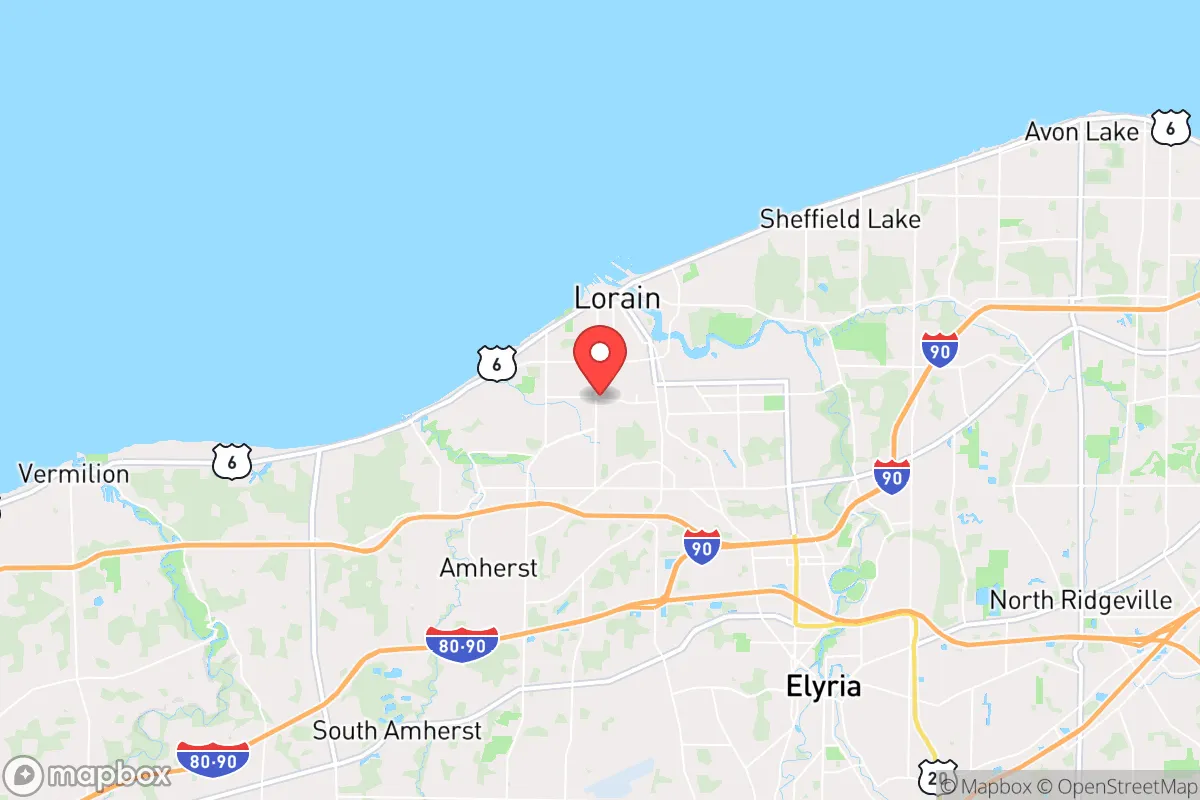
District shown is the primary district for this city’s centroid. Cities may span multiple districts.
Local Political AnalysisPolitical Analysis of Lorain, OH
Lorain, Ohio, has a political climate that’s shifted significantly over the past decade, and if you’re looking at it from a conservative perspective, the trend is concerning. The area now carries a Cook PVI of R+14, meaning it leans Republican by a solid 14 points compared to the national average, but that doesn’t tell the whole story of what’s happening on the ground. For a long time, Lorain was a blue-collar Democratic stronghold, tied to union jobs at the steel mill and shipyards, but those days are fading fast. Today, you’ll find a mix of old-school conservative values and a growing progressive push that’s trying to reshape local government and schools, and that’s where the real tension lies.
How it compares
When you look at Lorain compared to its neighbors, the political contrast is stark. Just a few miles east, Elyria leans more moderate, but still has a strong Republican base in the rural parts. Head south to Oberlin, and you’re in a completely different world—that’s a college town where progressive policies are the norm, with a city council that’s pushed things like sanctuary city status and heavy-handed zoning rules. Meanwhile, Lorain itself is a battleground: the older, working-class neighborhoods still vote Republican, especially on issues like taxes and Second Amendment rights, but the waterfront redevelopment and new housing projects are drawing in younger, more liberal transplants. The surrounding Lorain County as a whole has been trending purple, but Lorain City proper has seen a noticeable uptick in progressive activism, particularly around school board elections and local ordinances. It’s a real split—you’ve got folks who remember when the city was a manufacturing hub and want to keep things simple, and others who are pushing for more government involvement in daily life.
What this means for residents
For residents who value personal freedoms and limited government, the shift in Lorain is something to keep a close eye on. The local school board has been a flashpoint, with debates over curriculum and library books that feel like they’re straight out of a bigger city’s playbook. Property taxes have crept up, and there’s been talk of new fees for small businesses that could squeeze the mom-and-pop shops that are the backbone of the community. The city council has also flirted with rental inspection programs and noise ordinances that feel like overreach, especially for folks who just want to be left alone. On the flip side, the R+14 lean means there’s still a strong conservative base that shows up at the polls, and that’s kept things like a county-wide sales tax hike from passing. But the long-term trajectory is worrying: as older residents move out or pass away, the younger demographic is more open to progressive ideas, and that could tip the balance in the next few election cycles.
Cultural and policy distinctions
One thing that sets Lorain apart is its strong sense of community identity, which has historically been a buffer against the kind of top-down government overreach you see in places like Cleveland or Columbus. The city’s ethnic heritage—Polish, Hungarian, Puerto Rican—still shows up in local festivals and church events, and that’s where you’ll find the real resistance to progressive policies. There’s a deep skepticism of any new regulations that feel like they’re coming from outside, whether it’s state mandates on energy or local rules about short-term rentals. The steel mill and port are still major employers, and the workers there tend to vote their pocketbooks, which means they’re wary of anything that raises costs or adds red tape. But the cultural battle is real: you’ll see “Keep Lorain Safe” signs next to “Black Lives Matter” banners, and the city’s response to the 2020 protests was a microcosm of the national divide. For now, the conservative voice is still loud, but it’s fighting an uphill battle against a tide of change that feels like it’s being pushed by outsiders and special interests.

State Political ClimatePolitical Climate in Ohio
State Political AnalysisPolitical Environment in the State
Ohio has long been the quintessential swing state, but over the past decade it has shifted decisively to the right, voting for Donald Trump by 8 points in both 2016 and 2020 and by a similar margin in 2024. The state’s political center of gravity now sits firmly in the conservative camp, driven by a coalition of working-class voters in small cities, exurbs, and rural areas who have abandoned the Democratic Party over cultural and economic issues. This trajectory is not a fluke—it’s the result of a 20-year realignment that accelerated after the 2008 financial crisis, and it shows no signs of reversing.
Urban vs. rural divide
The political map of Ohio is a study in stark contrasts. The three major metros—Cleveland, Columbus, and Cincinnati—are the Democratic strongholds, but their influence is shrinking relative to the rest of the state. Cuyahoga County (Cleveland) still delivers massive Democratic margins, but its population has declined by nearly 20% since 2000. Franklin County (Columbus) is growing and increasingly blue, but it’s an island of progressivism in a sea of red. Hamilton County (Cincinnati) is a genuine battleground, with the city proper trending left while the surrounding suburbs like West Chester and Mason vote heavily Republican. The real story is in the exurbs and rural counties that have flipped hard. Delaware County, just north of Columbus, went from a swing county in 2000 to +30 Republican by 2024. Similarly, counties like Warren (north of Cincinnati) and Medina (between Cleveland and Akron) are now reliably red. The Appalachian counties in the southeast—places like Belmont, Monroe, and Washington—were once union Democrat strongholds; now they vote Republican by 20-30 points. The rural northwest, including counties like Mercer and Auglaize, is deeply conservative and culturally aligned with Indiana. The only blue areas outside the big cities are a handful of college towns like Athens (Ohio University) and Oberlin, plus the industrial Mahoning Valley around Youngstown, which is still purple but trending red.
Policy environment
Ohio’s policy environment is a mixed bag for conservatives, but the trend is positive. The state has a flat income tax rate of 3.5% (down from 4.8% in 2020), and the legislature is actively working to phase it out entirely. Property taxes are moderate, but local school levies can be high in suburban districts. The regulatory climate is business-friendly, with right-to-work laws on the books and a tort reform system that limits lawsuit abuse. On education, Ohio has a robust school choice program: the EdChoice scholarship allows students in underperforming districts to attend private or charter schools, and the state has over 300 charter schools. In 2023, the legislature expanded EdChoice eligibility to nearly all families, regardless of income or district performance. This is a major win for parental rights. On healthcare, Ohio did not expand Medicaid under the Affordable Care Act until 2014 (under Republican Governor John Kasich), but the program remains in place. There is no state-level individual mandate. Election laws have been tightened: voter ID is now required (with a free state ID option), drop boxes are limited to one per county, and early voting hours are standardized. These reforms were passed over fierce Democratic opposition, but they have held up in court. The state also has a constitutional amendment process that has been used by both sides—most recently to enshrine abortion rights in 2023, which was a setback for conservatives.
Trajectory & freedom
On personal liberty, Ohio is moving in the right direction, but it’s not a libertarian paradise. The biggest win for freedom in recent years was the passage of constitutional carry (permitless concealed carry) in 2022, which eliminated the requirement for a license to carry a concealed firearm. Ohio is now a “shall issue” state with no duty to retreat in self-defense situations. This was a major victory for gun rights activists. On medical freedom, Ohio passed a law in 2021 prohibiting employers from mandating COVID-19 vaccines as a condition of employment, though it was later blocked by a federal court. The state also banned vaccine passports for government services. Parental rights were strengthened with the 2023 “Parents’ Bill of Rights,” which requires schools to notify parents of any changes to a student’s health or well-being and prohibits instruction on sexual orientation or gender identity in grades K-3. Property rights are generally strong, with no state-level rent control and limited eminent domain abuse. However, the state has a high sales tax (up to 8% in some counties) and a gas tax that was raised in 2019. The biggest concern for freedom-minded residents is the growing influence of local government overreach in blue cities—Cleveland and Columbus have passed paid sick leave mandates and “just cause” eviction laws that preempt state law, leading to ongoing legal battles.
Civil unrest & political movements
Ohio has seen its share of political flashpoints. The 2020 protests in Columbus and Cleveland over George Floyd’s death were large but mostly peaceful, though there were instances of looting and property damage. The state’s response was generally restrained compared to Portland or Seattle. More recently, the 2023 abortion rights amendment campaign saw intense grassroots organizing on both sides, with pro-life groups outspent but still mobilizing significant turnout. Immigration politics are less visible than in border states, but there is growing tension in smaller cities like Springfield, where a surge of Haitian immigrants has strained social services and schools. In 2024, Springfield became a national flashpoint after local officials reported that the immigrant population had overwhelmed the city’s resources, leading to a heated debate about federal immigration policy. Election integrity remains a hot-button issue: the 2020 election in Ohio was widely considered secure, but activists on the right continue to push for further reforms like hand-counting ballots and eliminating drop boxes. There is no serious secession or nullification movement in Ohio, but the state has passed laws asserting its sovereignty under the Tenth Amendment, particularly regarding federal gun control and environmental regulations. A new resident would notice that political signs and flags are common in rural areas, and that local news is heavily focused on state-level politics rather than national drama.
Projection
Over the next 5-10 years, Ohio will likely become more conservative, but not uniformly. The in-migration pattern is favorable: people are moving from blue states like California and Illinois to Ohio’s exurbs and smaller cities, drawn by lower housing costs and a business-friendly climate. Delaware County is projected to grow by another 15% by 2030, cementing its status as a Republican stronghold. The urban cores will continue to shrink or stagnate, reducing the Democratic vote share. However, the 2023 abortion amendment showed that progressive ballot initiatives can still win statewide, especially when they tap into suburban women’s concerns. The Republican legislature is likely to respond by making it harder to amend the constitution via ballot initiative—a move that would be controversial but could pass. On economic freedom, expect the income tax to be fully phased out by 2030, making Ohio even more attractive to remote workers and businesses. The wild card is the cultural war over education: if the school choice program continues to expand, it could accelerate the decline of traditional public schools in urban areas, leading to further political polarization. A new resident moving to Ohio today should expect a state that is increasingly red, with a strong emphasis on local control and individual rights, but with persistent blue enclaves in the cities that will continue to fight state-level policies.
For a conservative individual or family considering a move, Ohio offers a compelling package: a low and falling tax burden, strong gun rights, school choice, and a political trajectory that favors personal freedom. The trade-offs are the cold winters, the declining urban cores, and the need to be strategic about which county you settle in—stick to the exurbs and rural areas for the best alignment with conservative values. The cities are not lost causes, but they require vigilance against local overreach. Overall, Ohio is a state where your vote matters, your rights are expanding, and your dollar goes further than in nearly any other Midwestern state.
* Values derived from national, state, county, city and local statistics and may differ in a specific area. Last updated: 2026-04-21T19:05:19.000Z
Narrative content on this page is AI-generated and may contain mistakes. Verify any details that matter before acting on them.
ReloMaps may earn a commission from affiliate links at no extra cost to you.

