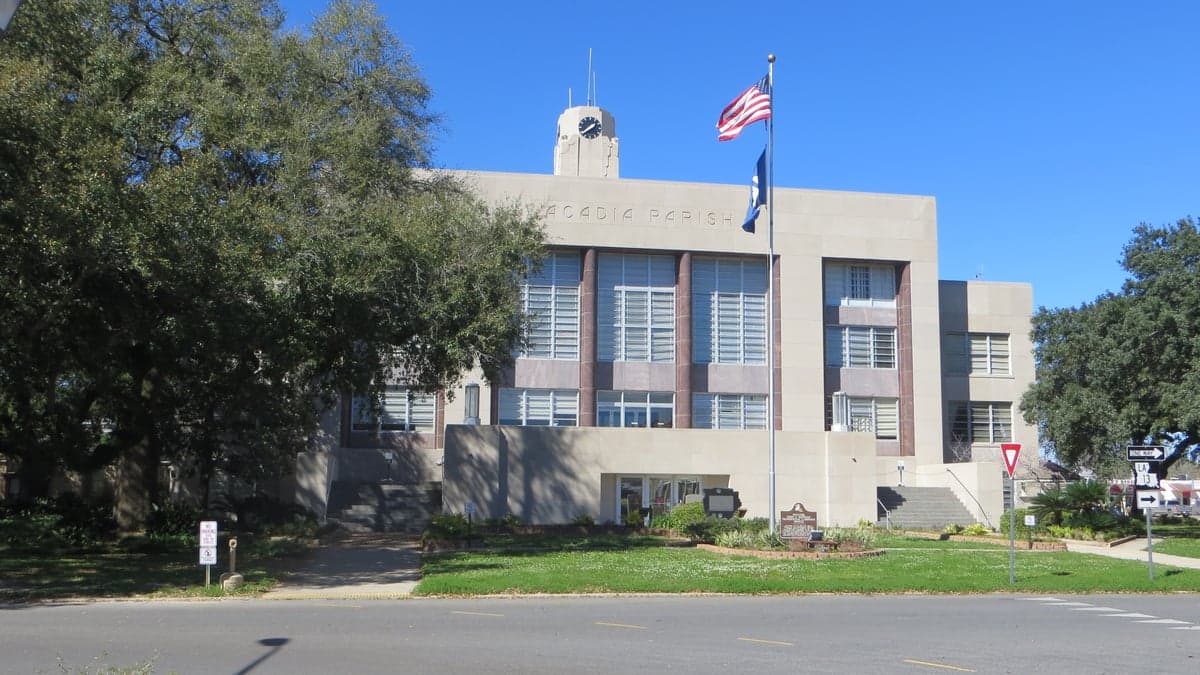
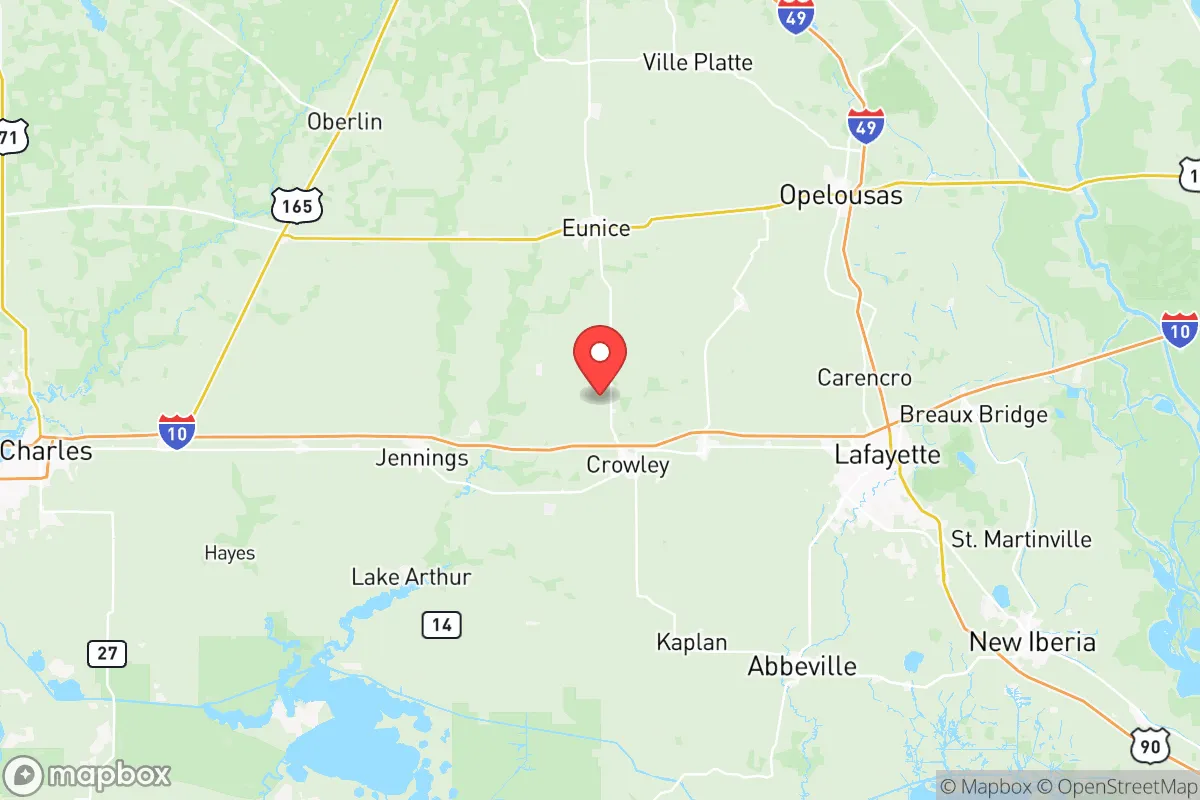
Photo: Wikipedia
Demographics of Acadia County
Affluence Level in Acadia County
A low-income area with significant economic hardship. Household wealth and educational attainment are well below national averages.
People of Acadia County
Today, Acadia County, Louisiana, is home to 57,218 residents, a population that remains predominantly white (76.8%) with a significant Black minority (15.7%) and a very small Hispanic (3.1%) and foreign-born (0.4%) presence. The county’s character is deeply rooted in its rural Cajun and Creole heritage, with a strong agricultural economy centered on rice, soybeans, and crawfish. Its people are known for a distinct cultural identity tied to French Catholic traditions, zydeco and Cajun music, and a tight-knit, family-oriented community life. With only 13.4% of adults holding a college degree, the population is largely working-class, and the county’s demographic profile reflects limited recent immigration and a slow, steady outmigration of younger residents seeking opportunities elsewhere.
Settlement & growth (pre-1960)
The land that is now Acadia County was originally inhabited by the Atakapa and Chitimacha Native American peoples, who lived along the bayous and Gulf Coast for thousands of years before European contact. French and Spanish explorers passed through the region in the 17th and 18th centuries, but permanent European settlement did not begin in earnest until after the Louisiana Purchase in 1803. The area that would become Acadia County was part of the larger Attakapas District, a sparsely populated frontier of French-speaking settlers and their enslaved African laborers.
The defining population event for Acadia County was the arrival of Acadian exiles—Cajuns—beginning in the late 1760s and continuing through the early 1800s. These French-speaking Catholics, expelled from Nova Scotia by the British, were granted land by Spanish authorities in south Louisiana. They settled along the Mermentau River and its tributaries, founding communities like Rayne (originally called Poupeville), Crowley, and Iota. The Cajuns brought with them a distinctive dialect, cuisine, and music that still defines the region’s cultural identity today. By the mid-19th century, the population was overwhelmingly French-speaking and rural, with families living on small farms and working the fertile prairie land.
After the Civil War, the economy shifted toward large-scale rice farming, which attracted a wave of Anglo-American settlers from other parts of the South, as well as a small number of German and Italian immigrants who came to work as tenant farmers or open businesses in towns like Church Point and Morse. The railroad arrived in the 1880s, connecting Crowley and Rayne to national markets and spurring modest growth. The Black population, descended from enslaved people brought to the region before the Civil War, remained concentrated in rural areas and small communities like Estherwood and Mermentau, working as sharecroppers and later as wage laborers on rice plantations. By 1900, the county’s population was roughly two-thirds white and one-third Black, a ratio that has remained relatively stable for over a century.
The early 20th century saw little new immigration. The oil boom that transformed much of south Louisiana in the 1920s and 1930s largely bypassed Acadia County, which remained agricultural. The Great Depression hit the rice economy hard, but the county’s population continued to grow slowly through natural increase. World War II brought some economic diversification, with the establishment of the Crowley Naval Air Station, which brought a small number of military families to the area temporarily. By 1960, Acadia County was still overwhelmingly rural, white, and French-speaking, with a Black minority living under Jim Crow segregation.
Modern era (post-1965)
The post-1965 era brought little demographic change to Acadia County compared to the rest of the United States. The Hart-Cellar Act of 1965, which dramatically increased immigration from Asia, Latin America, and Africa, had almost no impact here. As of the most recent data, only 0.4% of the county’s population is foreign-born, and the Asian (East/Southeast Asian) and Indian (subcontinent) populations each stand at just 0.1%. The Hispanic share, at 3.1%, is the only non-white group to have grown measurably since 1965, but it remains far below the state average of roughly 6% and the national average of 19%.
Domestic migration patterns have been more significant. Since the 1970s, Acadia County has experienced a steady outmigration of young adults, particularly college graduates, who move to larger cities like Lafayette, Baton Rouge, or Houston for jobs. This brain drain has kept the county’s college attainment rate low (13.4%) and contributed to an aging population. At the same time, a small but steady inflow of retirees and second-home buyers from other parts of Louisiana and Texas has settled in rural areas around Rayne and Crowley, drawn by the low cost of living and the region’s Cajun culture.
The Black population, which stood at 15.7% in the most recent data, has remained stable as a share of the total, though many Black families have also left for urban areas. The civil rights movement ended legal segregation in the 1960s, but de facto residential separation persists, with Black residents concentrated in specific neighborhoods in Crowley and in rural communities like Branch and Egan. The Hispanic population, while small, has grown modestly since the 1990s, primarily through the arrival of Mexican and Central American laborers who work in agriculture, particularly in rice and crawfish farming around Iota and Morse.
Suburbanization has been limited. Crowley, the parish seat and largest town, has seen some new housing development on its outskirts, but the county has not experienced the rapid exurban growth seen in other parts of Louisiana. The population has remained relatively stable, hovering around 57,000 for the past two decades, as outmigration has roughly balanced natural increase.
The future
Acadia County’s population is projected to remain flat or decline slightly over the next 10-20 years, barring a major economic shift. The county’s low birth rate, aging population, and continued outmigration of young adults will likely lead to a modest decrease in total population. The white share will probably remain dominant, though the Hispanic share may continue to grow slowly as agricultural labor needs persist. The Black share is expected to remain stable, while Asian and Indian populations will likely stay negligible.
The county’s cultural identity is likely to remain strongly Cajun and Catholic, though the French language, once widely spoken, continues to fade with each generation. New residents, whether retirees or remote workers, will find a community that is welcoming but insular, with a strong sense of place and tradition. The county is not becoming more diverse in the way that much of the Sun Belt is; instead, it is slowly becoming more homogeneous as younger, more diverse residents leave and are not replaced by immigrants.
For someone moving in now, Acadia County offers a deeply rooted, family-oriented community with a low cost of living and a rich cultural heritage, but also limited economic opportunity and demographic stagnation. The kind of place it is becoming is a quieter, older version of itself—a rural Louisiana parish where tradition holds strong and change comes slowly.

* Values derived from national, state, county, city and local statistics and may differ in a specific area. Last updated: 2026-08-08T15:01:42.000Z
Narrative content on this page is AI-generated and may contain mistakes. Verify any details that matter before acting on them.
ReloMaps may earn a commission from affiliate links at no extra cost to you.

