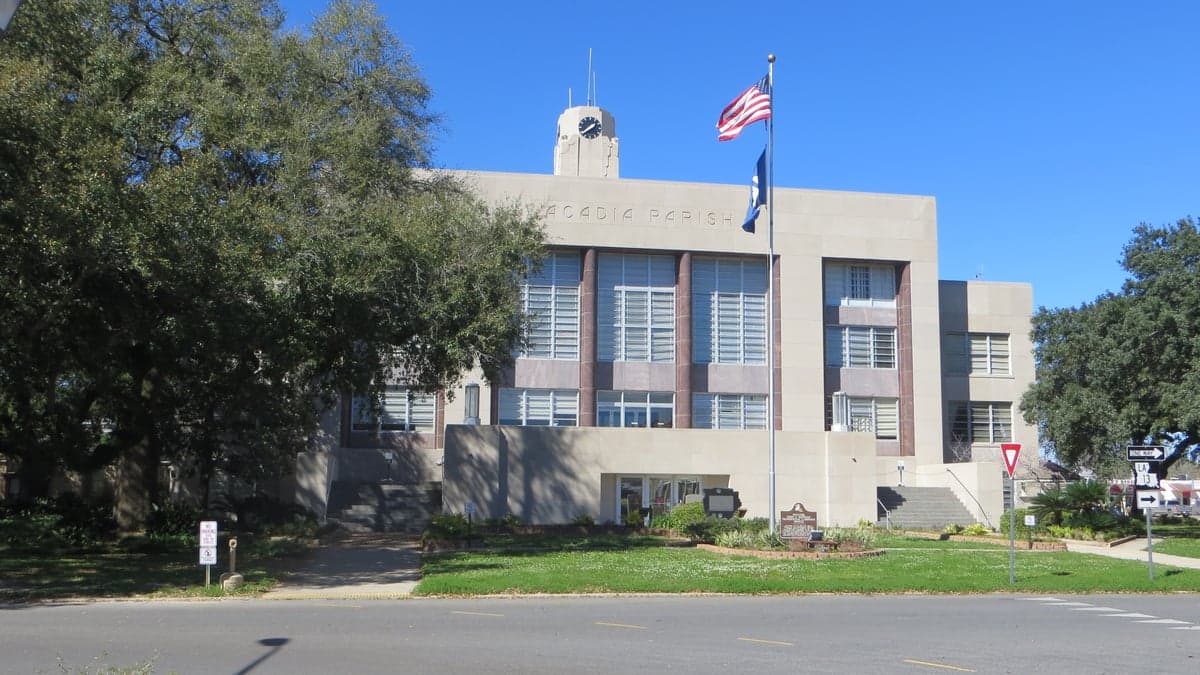
Photo: Wikipedia
Political ClimatePolitical Climate in Acadia County
Showing district-level results — no local-only data available.
Local Political AnalysisPolitical Analysis of Acadia County
Acadia County, Louisiana, is a deeply conservative stronghold with a Cook Partisan Voting Index (PVI) of R+22, meaning it votes about 22 percentage points more Republican than the national average. This isn't a recent shift; the area has been reliably red for decades, though the margin has widened in the last two presidential cycles as rural, white, working-class voters have solidified their allegiance to the GOP. The county's political center of gravity is in Crowley, the parish seat, where you'll find the most consistent Republican turnout, while the smaller, more isolated communities like Rayne and Church Point also lean heavily red, though with occasional pockets of Democratic resistance tied to older, union-aligned families.
How it compares
Compared to Louisiana as a whole, Acadia County is noticeably more conservative. The state itself is a reliably red state, but it contains significant blue islands in New Orleans, Baton Rouge, and Shreveport, which pull its overall PVI closer to R+12 or R+14. Acadia County lacks any such urban counterweight. The only real political variation within the county is between the small towns themselves: Crowley and Rayne are the most reliably Republican, with precincts routinely delivering 70-75% of the vote for GOP candidates. Meanwhile, the rural precincts around Estherwood and Mermentau can swing slightly more moderate, sometimes hitting 60-65% Republican, due to a higher concentration of older, Cajun-French voters who historically voted Democrat before the party's national shift. There are no precincts in Acadia County that lean blue; the closest thing to a swing area is the precinct around the University of Louisiana at Lafayette's satellite campus in Crowley, where younger voters occasionally push the GOP margin down to the low 60s.
What this means for residents
For conservative residents, Acadia County offers a political environment where their values are the default. Local government, school boards, and law enforcement are overwhelmingly Republican, and policy debates tend to focus on tax cuts, oil and gas development, and Second Amendment rights. For liberal residents, the reality is more isolating. There is no organized Democratic Party presence in the parish, and progressive candidates rarely appear on local ballots. Socially liberal views on issues like abortion or LGBTQ+ rights are a clear minority position, and those who hold them often keep their opinions private to avoid social friction. Practical consequences include limited access to reproductive healthcare (the nearest Planned Parenthood is over 60 miles away in Lafayette) and a school curriculum that emphasizes conservative Christian values. On the flip side, the low cost of living and strong sense of community are genuine benefits that transcend politics.
Culturally, Acadia County is distinct from the rest of Louisiana in its deep Cajun heritage, which influences everything from local politics to daily life. The annual Crowley Rice Festival and Rayne's Frog Festival are more than just tourist draws; they're expressions of a community that values tradition and self-reliance. Policy-wise, the parish is a stronghold for oil and gas interests, with local officials consistently opposing state-level environmental regulations. This creates a tangible difference from more urbanized parts of Louisiana, where environmental concerns and coastal restoration get more political airtime. For anyone moving here, the political climate is straightforward: you'll find a welcoming, neighborly community that expects you to respect its conservative norms, and you'll have little trouble fitting in if you share those values. If you don't, you'll find the area pleasant but politically lonely.

State Political ClimatePolitical Climate in Louisiana
State Political AnalysisPolitical Environment in the State
Louisiana has been a reliably Republican state in federal elections since 2000, but its political reality is far more complex than a simple red-state label suggests. The state leans roughly 15-20 points Republican in presidential races, yet it maintains a deeply entrenched Democratic presence at the local and state level, particularly in New Orleans and Baton Rouge. Over the past two decades, the shift has been dramatic: in 1996, Bill Clinton carried the state; by 2004, George W. Bush won it by 15 points, and Donald Trump carried it by nearly 20 points in both 2016 and 2020. The trajectory is a steady march rightward, driven by white suburban and rural voters abandoning the Democratic Party, while Black voters (roughly one-third of the electorate) remain overwhelmingly Democratic, creating one of the most racially polarized electorates in the country.
Urban vs. rural divide
The political map of Louisiana is a study in contrasts. New Orleans (Orleans Parish) is the state's deep-blue anchor, delivering 80%+ of its vote to Democratic presidential candidates. Baton Rouge (East Baton Rouge Parish) is more of a purple battleground, with the city proper leaning Democratic but the surrounding suburbs—like Prairieville in Ascension Parish—voting heavily Republican. Lafayette and Shreveport are mixed: Lafayette's core is moderately conservative, while Shreveport's majority-Black population pushes it Democratic, though the surrounding Caddo Parish suburbs are red. The rural parishes—like Winn, Franklin, and Beauregard—routinely vote 75-85% Republican. The Northshore region (St. Tammany Parish, centered on Covington and Mandeville) has become a Republican stronghold, with St. Tammany voting 65-70% Republican in recent cycles. The only reliably Democratic parishes outside of Orleans are a handful of majority-Black rural parishes like Madison and East Carroll in the Mississippi Delta region.
Policy environment
Louisiana's policy environment reflects its conservative lean, but with unique local twists. The state has no personal income tax on most retirement income, and the corporate tax rate is a flat 7.5%, though the state's overall tax burden is moderate due to high sales taxes (state rate 4.45%, but local add-ons can push it over 10% in some parishes). The regulatory posture is business-friendly, with a right-to-work law and a tort reform package passed in 2020 that capped damages and limited lawsuit venues. Education policy is a mixed bag: Louisiana has a robust school choice program (the Louisiana Scholarship Program) and a thriving charter school sector in New Orleans, but overall K-12 outcomes rank near the bottom nationally. Healthcare policy is notably conservative: the state did expand Medicaid under the Affordable Care Act in 2016 under Democratic Governor John Bel Edwards, but the legislature has resisted further expansion and has passed restrictions on abortion and transgender care. Election laws are moderately restrictive: voters must show photo ID, and early voting is limited to 7 days, though no-excuse absentee voting is available.
Recent policy direction
The last five years have seen a sharp rightward shift in state policy, accelerated by the election of Republican Governor Jeff Landry in 2023. Gun and self-defense law: Louisiana passed constitutional carry (permitless carry) in 2024, and the state has a strong "stand your ground" law. Parental and education rights: The 2023 "Parents' Bill of Rights" (Act 468) requires schools to notify parents of any curriculum involving sexuality or gender identity, and the state banned transgender girls from participating in K-12 female sports (Act 442, 2022). Speech and privacy: There is no broad state-level privacy law, but the legislature has debated restrictions on social media platforms' content moderation. Medical and bodily autonomy: Abortion is banned at conception (trigger law effective 2022), with no exceptions for rape or incest, only for the life of the mother. Property rights: Louisiana is a "buyer beware" state for real estate, and property taxes are relatively low (average effective rate around 0.55%), but the state's unique Napoleonic Code-based civil law system can complicate inheritance and property disputes. Taxation: The state is moving toward a flat income tax; in 2024, the legislature passed a bill to reduce the top individual rate from 4.25% to 3% by 2026. Voting and ballot access: The state has closed primaries for federal elections, and a 2024 law (Act 125) tightened voter ID requirements and limited ballot drop boxes.
Civil unrest & political movements
Louisiana has a history of political flashpoints, though large-scale civil unrest is less common than in some other states. The most notable recent event was the 2016 Baton Rouge protests following the shooting of Alton Sterling, which included clashes with police and a subsequent ambush that killed three law enforcement officers. The state has a small but vocal secessionist movement, particularly in the Acadiana region, where some Cajun activists advocate for an independent "Republic of Louisiana," though this has no serious political traction. Immigration politics are relatively muted compared to border states, but the legislature passed a 2024 law (Act 318) requiring local law enforcement to cooperate with federal immigration authorities and penalizing "sanctuary" policies. Election integrity has been a recurring theme: the 2020 election saw no major controversies in Louisiana, but the legislature has since passed multiple bills tightening voting procedures, citing concerns about fraud (though no evidence of widespread fraud has been found). Organized activist movements include the Louisiana Progress Action Fund on the left and the Louisiana Family Forum on the right, both of which are active in legislative lobbying.
Projection
Over the next 5-10 years, Louisiana is likely to become more uniformly Republican, but with important caveats. The state's population is aging and slowly declining (it lost a congressional seat after the 2020 census), and in-migration is modest compared to Sun Belt peers like Texas or Florida. The Democratic base is shrinking as rural white voters continue to realign, and the Black population is slowly declining as a share of the total. However, New Orleans and Baton Rouge are seeing modest in-migration of younger, more diverse residents, which could keep those cities blue. The biggest wild card is the state's vulnerability to climate change: rising sea levels and stronger hurricanes could trigger population shifts from coastal parishes (like Plaquemines and Terrebonne) inland, potentially reshaping the political map. Expect the legislature to continue moving right on cultural issues (education, gender, abortion) while maintaining a business-friendly tax and regulatory environment. A new resident moving in now should expect a state that is reliably Republican in statewide and federal elections, but with a vibrant Democratic minority concentrated in a few urban centers, and a policy environment that is increasingly aligned with conservative priorities on most fronts.
For a new resident, the practical takeaway is straightforward: if you lean conservative, you'll find Louisiana's political climate broadly welcoming, with low taxes, strong gun rights, and a legislature that shares your values on education and social issues. If you lean liberal, you'll find a small but resilient community in New Orleans and Baton Rouge, but you'll face an uphill battle on most policy fronts, and you should expect the state's cultural and legal environment to become more conservative over time. Either way, the state's unique blend of Southern conservatism, Cajun culture, and Napoleonic legal quirks means that politics here is never quite what it seems from the outside.
* Values derived from national, state, county, city and local statistics and may differ in a specific area. Last updated: 2026-08-08T15:01:42.000Z
Narrative content on this page is AI-generated and may contain mistakes. Verify any details that matter before acting on them.
ReloMaps may earn a commission from affiliate links at no extra cost to you.

