
Photo: Wikipedia
Personal Sovereignty in Acadia County
Strong independent fundamentals that actively favor personal liberty and low regulation.
What does Personal Sovereignty tell us?
Personal Sovereignty measures your capacity for self-reliance and independence with minimal government friction. Higher scores mean fewer barriers between you and the way you want to live... but it assumes you have the space you need and good neighbors.
What does this tell us?
Personal Sovereignty measures your capacity for self-reliance and independence with minimal government friction. Higher scores mean fewer barriers between you and the way you want to live... but it assumes you have the space you need and good neighbors.
State Policy
Energy independence: Net exporter (280% of energy produced in-state)
Personal Liberty
Homesteading

Personal Liberty Analysis
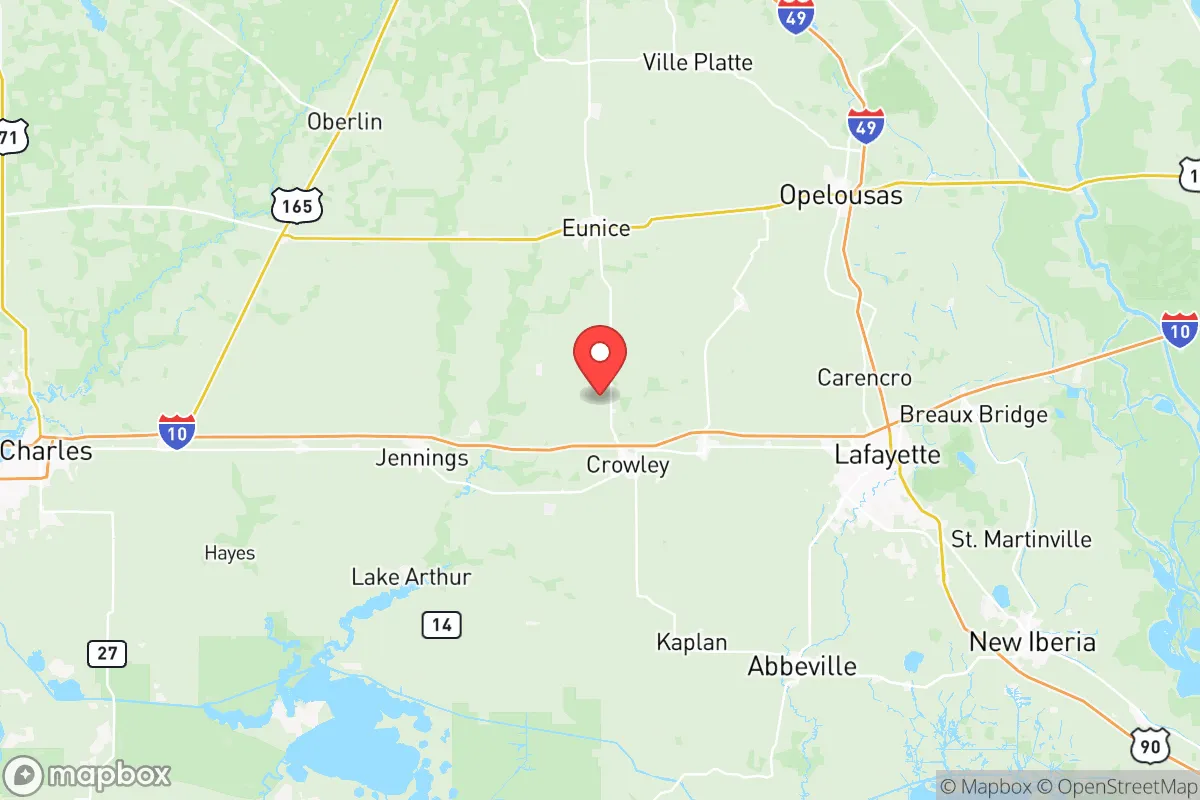
Acadia County, Louisiana, offers a notably high degree of personal sovereignty, grounded in Louisiana’s strong property rights, permissive self-defense laws, and a light-touch regulatory environment that appeals to those prioritizing independence. Unlike the more restrictive coastal parishes or the urban corridors of Baton Rouge and New Orleans, Acadia County—anchored by the towns of Crowley, Rayne, and Church Point—operates under a distinctly rural, hands-off governance model. The area’s legal and cultural framework supports self-reliance, from firearm ownership to homesteading, while maintaining a tax burden that is moderate by national standards but low relative to other parts of the state.
Tax burden and regulatory posture in Acadia County
Acadia County’s tax structure is favorable for those seeking to keep more of their earnings and property. The combined state and local sales tax rate in Crowley and Rayne hovers around 9.45%, which is typical for rural Louisiana but higher than some neighboring parishes due to local school and infrastructure millages. Property taxes are a standout advantage: the effective property tax rate in Acadia County is approximately 0.45% of assessed value, among the lowest in the state and well below the national average. This means a $200,000 home carries an annual tax bill of roughly $900. The regulatory posture is equally light. Acadia County does not impose county-level building codes outside of unincorporated areas, and towns like Iota and Estherwood have minimal zoning ordinances, allowing residents to operate home-based businesses, keep livestock, or build workshops without the permitting hurdles common in more urbanized parishes. Louisiana’s homestead exemption shields the first $75,000 of a home’s value from parish property taxes, further reducing the burden for owner-occupants.
Self-defense and gun law specifics in Acadia County
Louisiana is a “shall-issue” state for concealed carry permits, and Acadia County’s sheriff’s office processes applications efficiently, with typical turnaround times of 30 to 60 days. In 2024, Louisiana enacted constitutional carry, allowing any law-abiding adult 18 or older to carry a concealed firearm without a permit. This law applies uniformly across Acadia County, including within the city limits of Crowley, Rayne, and Church Point. The state’s “Stand Your Ground” statute, codified in Louisiana Revised Statute 14:20, removes any duty to retreat before using deadly force in self-defense, provided the individual is lawfully present. Castle Doctrine protections extend to vehicles and workplaces, not just homes. Local gun culture is robust: Acadia Parish has one of the highest firearm ownership rates in Louisiana, and shooting ranges like the Acadiana Gun Club near Crowley are well-used. There are no county-level firearm restrictions beyond state law, and open carry is legal without a permit for those 18 and older. For a reader prioritizing self-defense autonomy, Acadia County presents minimal legal friction.
Self-reliance and homesteading viability in Acadia County
Acadia County’s rural character makes it a strong candidate for homesteading and off-grid living. Minimum lot sizes in unincorporated areas are typically 1 to 5 acres, though parcels as small as half an acre can be found near Mire and Branch. Zoning is minimal: most of the parish outside town limits is zoned for agricultural use, allowing livestock, poultry, and crop cultivation without special permits. Off-grid feasibility is high, though not without practical considerations. Louisiana’s building code does not mandate grid connection for new construction in unincorporated Acadia County, so solar panels, rainwater catchment, and composting toilets are legally permissible. However, the parish does require a septic system permit from the Louisiana Department of Health, which involves a soil test and percolation test—a one-time cost of roughly $200 to $400. The water table is high in much of the parish, particularly near the Mermentau River basin, so raised-bed gardening and French drains are common. Towns like Evangeline and Maxie are particularly popular for small-scale homesteading due to their low land prices (often under $3,000 per acre) and proximity to Crowley for supplies. The climate supports a long growing season (March through November), but humidity and pests require diligent management. For those seeking to minimize reliance on municipal utilities, Acadia County offers a permissive environment with few bureaucratic obstacles.
Personal liberties in Acadia County: parental rights, medical autonomy, and property
Louisiana law provides strong protections for parental rights, and Acadia County’s school system—including the Acadia Parish School Board—generally defers to parents on educational and medical decisions. The state’s “Parental Bill of Rights” (Louisiana Revised Statute 17:411) guarantees parents the right to direct their child’s education, access school records, and opt out of sex education or other curricula. Homeschooling is straightforward: parents file a simple notice with the Louisiana Department of Education and provide a portfolio review annually. Medical autonomy is similarly robust. Louisiana does not mandate COVID-19 or other adult vaccinations, and the state’s 2022 law prohibits vaccine mandates by public entities, including schools and local governments. In Acadia County, this means no county-level vaccine passport or mask mandate has been enacted. Property rights are protected by Louisiana’s “private property rights” statute, which limits eminent domain to public uses and requires just compensation. The parish’s planning and zoning board is known for approving variance requests with minimal delay, particularly for agricultural structures or home-based businesses. Free speech is protected under both the U.S. and Louisiana constitutions, and Acadia County has no local ordinances restricting signage, political expression, or public assembly beyond standard noise and traffic regulations.
Overall, Acadia County ranks among the more sovereignty-friendly areas in Louisiana, particularly when compared to the regulatory density of East Baton Rouge Parish or the coastal restrictions of Jefferson Parish. The combination of constitutional carry, low property taxes, minimal zoning, and strong parental rights creates an environment where personal autonomy is the default rather than the exception. For a single individual or family seeking a place where self-reliance is respected and legal barriers to independence are low, Acadia County—especially the rural stretches around Iota, Estherwood, and Evangeline—offers a practical and legally permissive foundation.

* Values derived from national, state, county, city and local statistics and may differ in a specific area. Last updated: 2026-08-08T15:01:42.000Z
Narrative content on this page is AI-generated and may contain mistakes. Verify any details that matter before acting on them.
ReloMaps may earn a commission from affiliate links at no extra cost to you.

