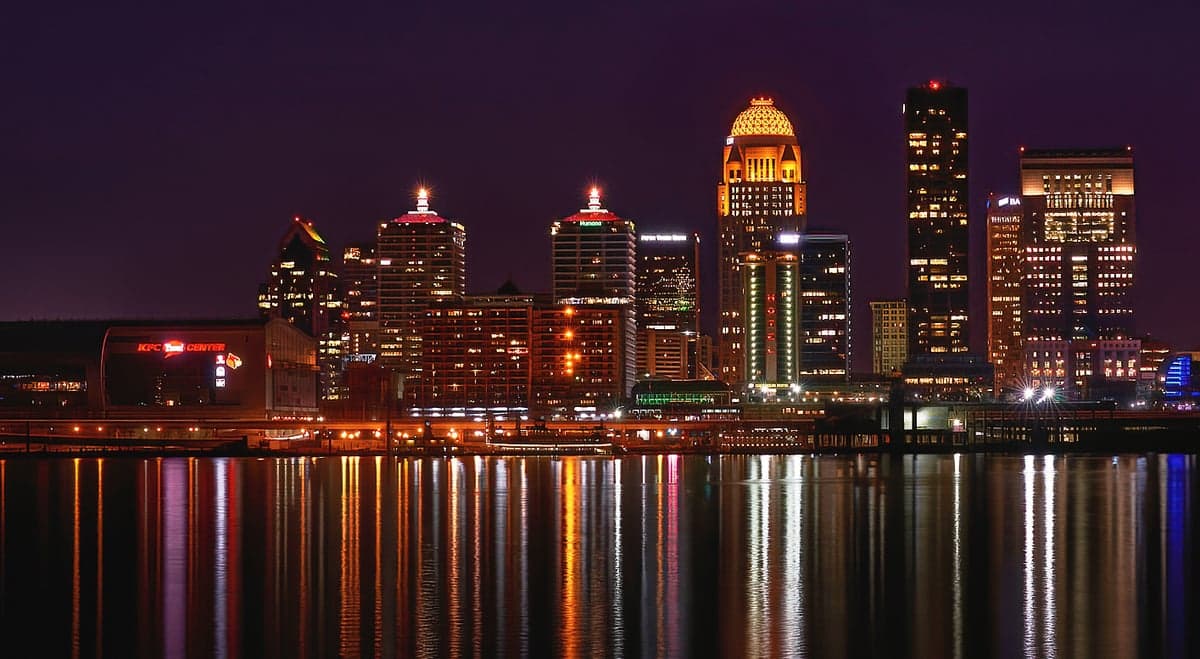
Photo: Wikipedia
Demographics of Louisville, KY
Affluence Level in Louisville, KY
A middle-class area roughly in line with national averages across income, home values, education, and employment.
People of Louisville, KY
The people of Louisville today form a city of 627,210 that is notably more stable and less transient than many peer metros, with a strong native-born character reflected in its low 5.5% foreign-born share. The population is majority White (61.0%) with a substantial Black community (23.4%) and a growing Hispanic presence (8.6%), while East/Southeast Asian residents (1.6%) and Indian-subcontinent residents (0.9%) remain small but visible clusters. Louisville retains a distinct Southern-meets-Midwestern identity, shaped by its history as a border city, a major Ohio River port, and a manufacturing and logistics hub that has drawn successive waves of internal migrants rather than international ones.
How the city was settled and grew
Louisville was founded in 1778 on the falls of the Ohio River, the only natural navigational barrier on the entire river, which forced boats to portage and made the site a natural trading post. The original settlers were largely English, Scots-Irish, and German pioneers moving west from Virginia, Pennsylvania, and Maryland, drawn by land grants and the promise of river commerce. By the 1830s, German and Irish immigrants arrived in significant numbers to work in the growing distilling, pork-packing, and steamboat industries, settling in neighborhoods like Butchertown (German butchers and brewers) and Irish Hill (Irish laborers). The city's Black population grew dramatically during and after the Civil War, as enslaved people fled Kentucky's border-state slavery and free Blacks migrated from the Upper South, forming a strong community in Russell and Smoketown — neighborhoods that became cultural anchors for Louisville's Black middle class. The late 19th and early 20th centuries brought a smaller wave of Jewish immigrants from Eastern Europe, who settled in Germantown and later the Highlands, contributing to the city's commercial and professional class. By 1950, Louisville was a classic industrial river city, with a population that was roughly 85% White and 15% Black, and a manufacturing base centered on bourbon, tobacco, and General Electric's Appliance Park (opened 1951).
Modern era (post-1965)
The post-1965 period reshaped Louisville's population primarily through domestic migration and suburbanization, not international immigration. The 1968 Fair Housing Act and subsequent white flight emptied many historic urban neighborhoods: between 1960 and 1980, the city's White population fell by roughly 30% as families moved to Jeffersontown, Middletown, and eastern Jefferson County, while the Black population remained concentrated in the West End (Russell, Shawnee, Parkland). The Hispanic population began a slow, steady growth in the 1990s, driven by Mexican and Central American workers in construction, warehousing, and food processing, settling primarily in South Louisville (Iroquois, Beechmont) and Okolona. The East/Southeast Asian community (1.6%) is small and largely composed of Vietnamese and Chinese families who arrived after 1975 as refugees and later as professionals in healthcare and engineering, concentrated in the Highlands and eastern suburbs. The Indian-subcontinent population (0.9%) is a more recent, highly educated cohort drawn by jobs in healthcare (Norton Healthcare, UofL Health) and IT, with no single dominant neighborhood but a visible presence in Fern Creek and Middletown. The city's foreign-born share (5.5%) is roughly half the national average, underscoring that Louisville remains a city shaped far more by internal migration — particularly from the South and Midwest — than by global immigration.
The future
Louisville's population is slowly diversifying, but the pace is modest compared to fast-growing Sun Belt metros. The Hispanic share (8.6%) is the fastest-growing segment, projected to reach 12-14% by 2040, driven by both births and continued labor migration into logistics and manufacturing. The Black population share (23.4%) is stable, with some out-migration of middle-class families to suburban counties (Oldham, Bullitt) offset by natural increase. The White population (61.0%) is aging and declining slightly as younger White professionals move to the Highlands, Clifton, and NuLu (the East Market District), while families continue to favor eastern suburbs. The East/Southeast Asian and Indian communities are growing slowly from a small base, primarily through professional recruitment rather than chain migration. The city is not tribalizing into sharply divided ethnic enclaves — most neighborhoods remain predominantly White or Black, with Hispanic and Asian populations dispersed rather than concentrated. For a new resident, Louisville offers a relatively stable, low-cost, and socially moderate environment where the population is neither rapidly homogenizing nor fragmenting into isolated ethnic blocs. The city's character as a rooted, native-born, manufacturing-and-logistics hub will likely persist, with gradual diversification rather than dramatic transformation.
For someone moving in now, Louisville is a city where the population is stable enough to offer predictability but diverse enough to avoid stagnation — a place where a newcomer can find a clear sense of community without the upheaval of rapid demographic change.

* Values derived from national, state, county, city and local statistics and may differ in a specific area. Last updated: 2026-04-22T01:29:46.000Z
Narrative content on this page is AI-generated and may contain mistakes. Verify any details that matter before acting on them.
ReloMaps may earn a commission from affiliate links at no extra cost to you.

