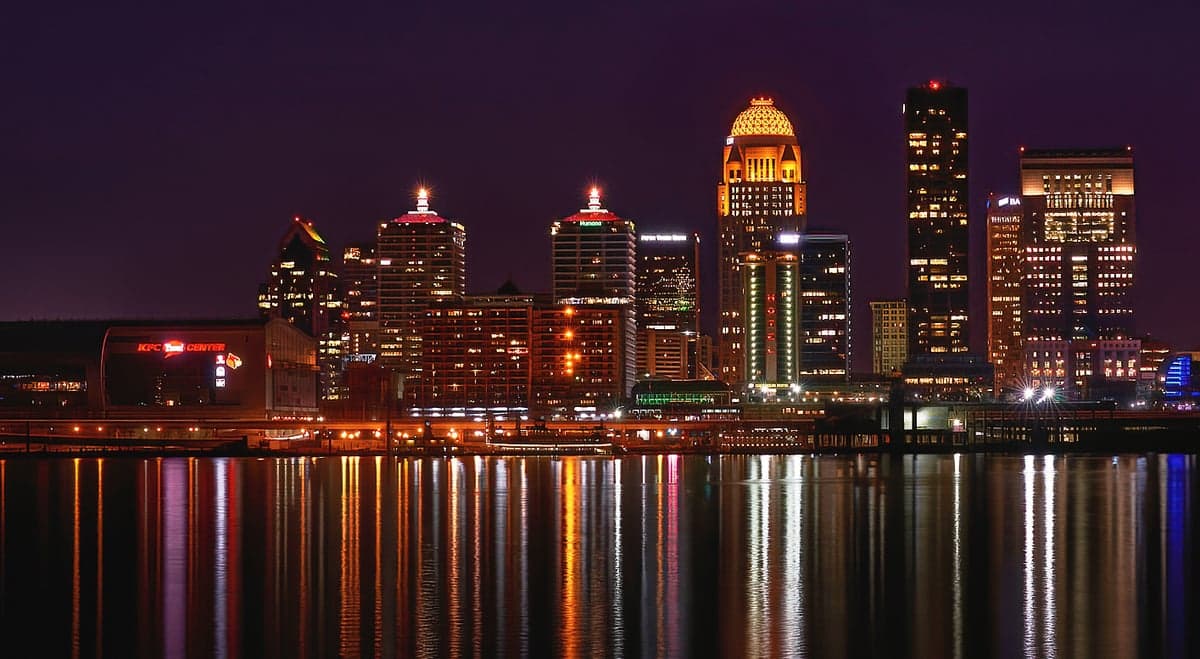
Photo: Wikipedia
Political ClimatePolitical Climate in Louisville, KY
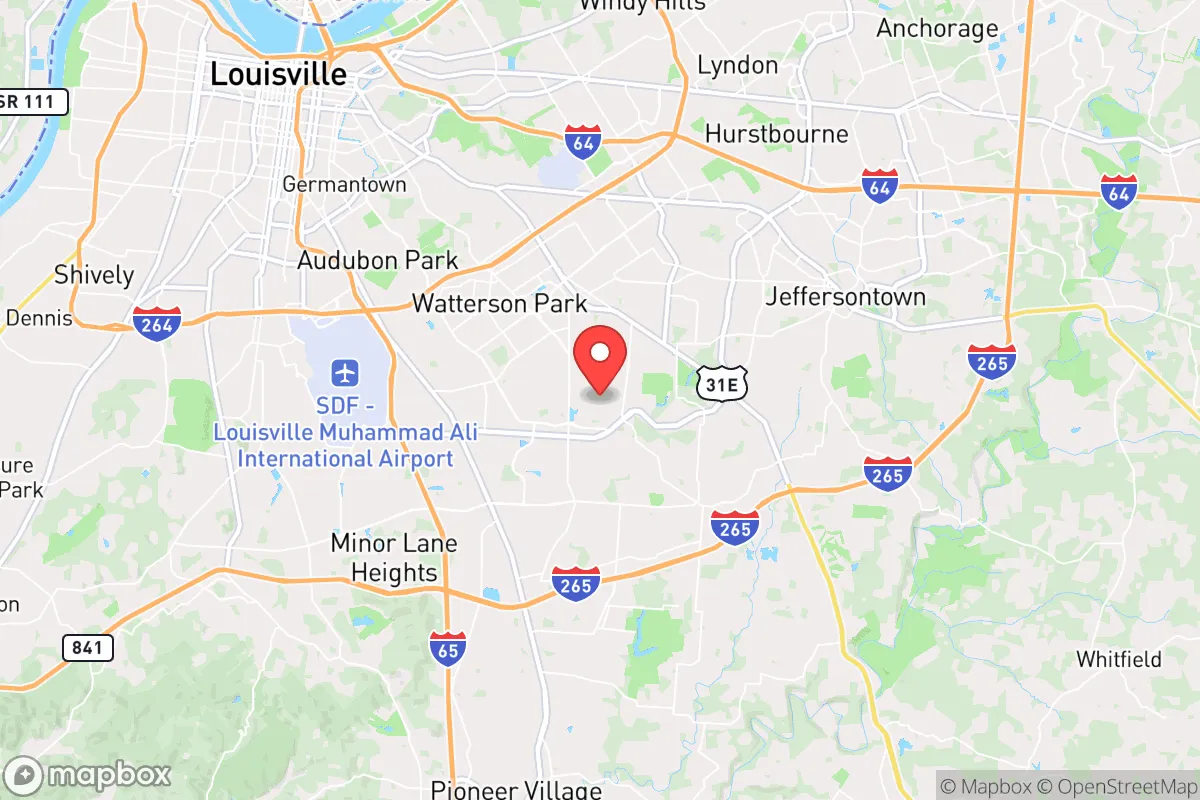
District shown is the primary district for this city’s centroid. Cities may span multiple districts.
Local Political AnalysisPolitical Analysis of Louisville, KY
Louisville has long been a deep blue island in a sea of red Kentucky, and that's only gotten more pronounced over the last decade. The Cook PVI of D+10 tells you the math: Jefferson County reliably delivers 10 points more Democratic than the national average, which in a state that went +26 for Trump in 2024 means you're looking at a city that votes more like Chicago or St. Louis than anything else in the Commonwealth. The trajectory has been steadily leftward since the early 2000s, and the last few election cycles have accelerated that shift, with progressive candidates winning city council seats and the mayor's office pushing policies that would have been unthinkable even 15 years ago.
How it compares
Drive 30 minutes in almost any direction and you're in a completely different political universe. Oldham County to the northeast voted +44 Republican in 2024, Shelby County to the east was +38, and Bullitt County to the south came in at +45. Even neighboring Clark County, Indiana, just across the bridge, leans about +12 Republican. The contrast is stark: you can live in a Louisville suburb like Anchorage or Prospect and feel like you're in a moderate enclave, but the city proper—especially inside the Watterson Expressway—is where the progressive energy concentrates. The surrounding towns like Shepherdsville, La Grange, and even parts of Fern Creek are where folks who feel priced out of the city's politics have moved to find more common-sense governance.
What this means for residents
If you value personal freedoms and limited government, Louisville's current direction is something to watch closely. The Metro Council has passed ordinances that expand the city's regulatory reach into areas like rental property inspections, paid sick leave mandates, and restrictions on firearm possession in public parks. Property taxes in Jefferson County have crept up faster than surrounding counties, and the city's response to public safety concerns has been to shift funding away from traditional policing toward social service programs—a move that's left many neighborhoods feeling less secure. The school board has also embraced progressive curriculum changes that have driven enrollment declines in JCPS as families opt for private schools or move to Oldham and Shelby counties. For a long-time resident like me, the biggest change is the feeling that the city government is more interested in social engineering than in fixing the potholes and keeping the streets safe.
On the cultural side, Louisville still has its charms—the bourbon trail, Churchill Downs, and a surprisingly good food scene—but the policy drift is real. The city's embrace of "sanctuary city" rhetoric, even if not fully codified, sends a signal that local law enforcement won't fully cooperate with federal immigration authorities. The push for higher minimum wages and expanded benefits sounds good on paper, but small business owners I know say it's squeezing margins and forcing them to raise prices or cut hours. If you're considering a move here, I'd recommend looking at the eastern suburbs or even across the river into Indiana if you want to stay close to the city's amenities without being subject to its political experiments. The long-term trend suggests Louisville will continue moving left, and for those who value individual liberty over collective mandates, that's a real concern worth weighing carefully.

State Political ClimatePolitical Climate in Kentucky
State Political AnalysisPolitical Environment in the State
Kentucky has long been a reliably red state in federal elections, but its political landscape is more nuanced than a simple partisan label suggests. The state has voted Republican in every presidential election since 2000, with Donald Trump carrying it by over 25 points in both 2016 and 2020. However, down-ballot races tell a different story: Democrats still hold a significant number of local offices, and the state legislature only became fully Republican-controlled in 2017. Over the last 10-20 years, the dominant trend has been a steady rightward shift, driven by rural voters abandoning the Democratic Party and suburban areas around cities like Louisville and Lexington becoming more competitive, though not yet flipping entirely.
Urban vs. rural divide
The political map of Kentucky is a textbook example of the urban-rural split. The two major metros—Louisville (Jefferson County) and Lexington (Fayette County)—are Democratic strongholds, consistently voting blue by double digits. Louisville’s urban core and inner-ring suburbs lean heavily left, while the surrounding exurbs like Shelbyville and La Grange are reliably red. Lexington, home to the University of Kentucky, has a similar dynamic, with the city itself voting Democratic but the surrounding rural counties in the Bluegrass region—like Nicholasville and Georgetown—voting strongly Republican. The rest of the state is overwhelmingly rural and conservative. Eastern Kentucky, once a Democratic stronghold due to unionized coal miners, has flipped hard to the GOP, with counties like Pike and Harlan now voting Republican by 40-50 points. Western Kentucky, including areas around Bowling Green and Owensboro, is also solidly red, though Bowling Green itself is a bit more purple due to its growing college population and manufacturing base. The only other notable blue dot is Frankfort, the state capital, which leans Democratic due to state government workers.
Policy environment
Kentucky’s policy environment has shifted decisively rightward in recent years, which is a major draw for conservative relocators. The state has a flat income tax rate of 4%, down from 6% in 2018, with a scheduled phase-down to zero by 2030 if revenue targets are met. Property taxes are low, and there is no tax on Social Security benefits. The regulatory posture is business-friendly, with right-to-work laws and a tort reform system that caps non-economic damages. On education, the state has expanded school choice through charter school legislation (though implementation has been slow) and a robust homeschooling community. Healthcare is a mixed bag: Kentucky expanded Medicaid under the Affordable Care Act, but the state has since imposed work requirements (currently tied up in court). Election laws have tightened: voter ID is required, absentee voting was restricted after the pandemic, and the state purges inactive voters regularly. Gun laws are among the most permissive in the nation: constitutional carry (permitless carry) was enacted in 2019, and there are no red-flag laws. Abortion is effectively banned after six weeks, with no exceptions for rape or incest, following the trigger law that took effect after Dobbs.
Trajectory & freedom
Kentucky is moving in a direction that expands personal freedom for conservatives, but there are warning signs. The most significant recent legislation is the 2021 law banning critical race theory in public schools, which also prohibits teaching that any race is inherently superior or that individuals bear responsibility for past wrongs based on race. Parental rights were strengthened with a 2022 law requiring schools to notify parents of any medical or mental health services offered to students. On gun rights, the 2019 constitutional carry law was a landmark, and the state has preempted local gun ordinances. However, there are concerning trends: the state’s Medicaid expansion remains in place, and the Louisville Metro Council has passed local ordinances on paid sick leave and anti-discrimination that conflict with state law, creating a patchwork of regulations. Property rights are generally strong, but the state has seen some eminent domain battles over pipeline projects. The biggest freedom concern is the growing influence of federal money in state budgets, which could create long-term dependency and pressure to adopt federal mandates.
Civil unrest & political movements
Kentucky has seen its share of political flashpoints. The most notable was the Breonna Taylor protests in Louisville in 2020, which led to months of demonstrations, property damage, and a heavy police presence. The city became a national symbol of the racial justice movement, and the aftermath included a federal consent decree on police reforms that is still ongoing. This has created a palpable tension in Louisville that you don’t feel in the rest of the state. On the right, the Kentucky Freedom Coalition and local Tea Party groups are active, pushing for school board transparency and election integrity. There have been election integrity controversies in counties like Fayette and Jefferson, where Republican observers have raised concerns about ballot processing, though no widespread fraud has been proven. Immigration politics are less heated than in border states, but there is a growing sanctuary city debate in Louisville, where the city council has resisted cooperating with ICE. Secession or nullification rhetoric is minimal, though some rural counties have passed resolutions declaring themselves “Second Amendment sanctuaries.”
Projection
Over the next 5-10 years, Kentucky is likely to become more Republican at the state level, but with growing friction in its urban centers. In-migration is picking up, particularly from blue states like California and Illinois, with people moving to areas like Bowling Green and Richmond for lower costs and a more conservative culture. This will likely reinforce the state’s red lean, as these newcomers are often fleeing progressive policies. However, the urban-rural divide will widen: Louisville and Lexington will continue to drift left, while the rest of the state hardens right. The flat tax phase-out will make Kentucky even more attractive to businesses and high-income earners. The biggest wildcard is education funding: if the state continues to underfund public schools, it could spark a backlash from suburban parents who want more local control. A new resident moving in now should expect a state that is broadly conservative and getting more so, but with two blue cities that will feel increasingly out of step with the rest of the state.
For a conservative individual or family, Kentucky offers a strong alignment with traditional values, low taxes, and a government that generally respects personal liberty. The main practical takeaways: choose a location carefully—avoid Louisville’s urban core if you want to avoid progressive local policies, and look at suburbs like Prospect or Anchorage if you need to be near the city. The state’s trajectory is positive for those seeking freedom from government overreach, but stay engaged locally, especially on school board and city council races, where the real battles over your rights will be fought.
* Values derived from national, state, county, city and local statistics and may differ in a specific area. Last updated: 2026-04-22T01:29:46.000Z
Narrative content on this page is AI-generated and may contain mistakes. Verify any details that matter before acting on them.
ReloMaps may earn a commission from affiliate links at no extra cost to you.

