
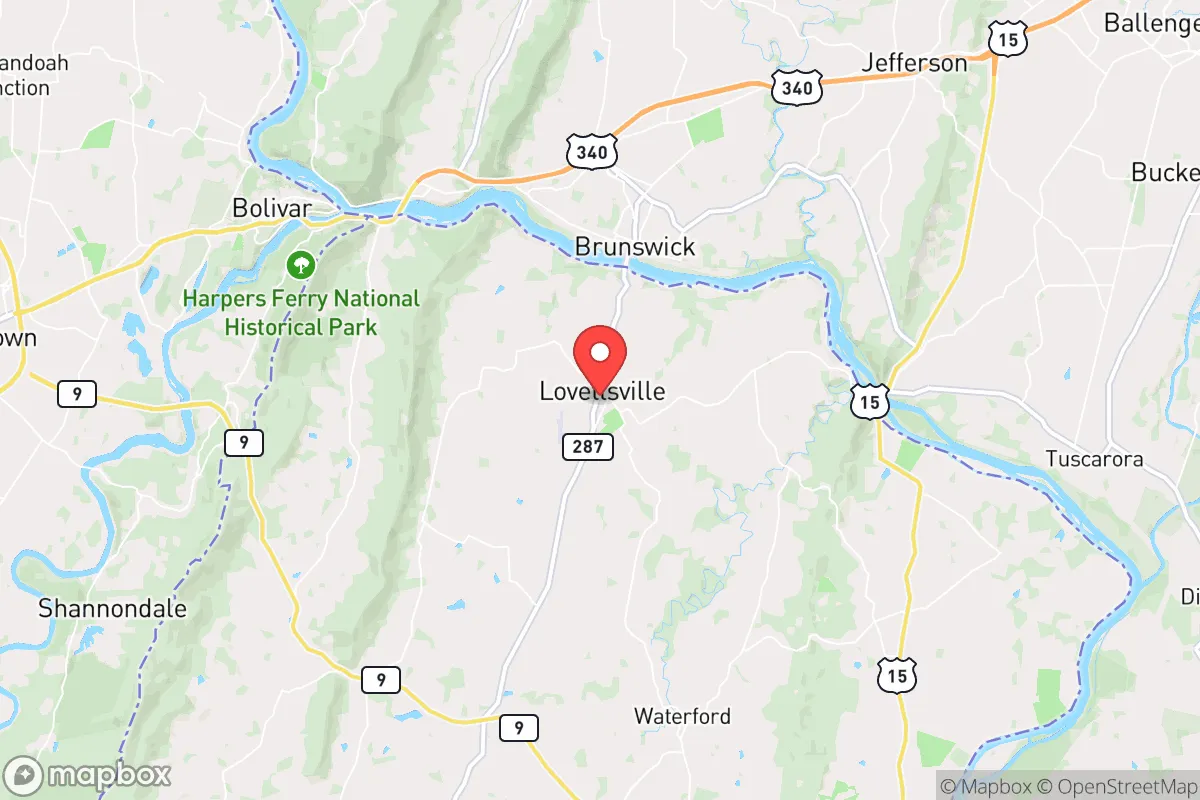
Photo: Wikipedia
Political ClimatePolitical Climate in Lovettsville, VA
District shown is the primary district for this city’s centroid. Cities may span multiple districts.
Local Political AnalysisPolitical Analysis of Lovettsville, VA
Lovettsville, Virginia, leans solidly Democratic, with a Cook PVI of D+6 that places it about two points more liberal than the state of Virginia as a whole (D+4). That gap might sound small, but in practice it means Lovettsville has been trending blue faster and more consistently than the rest of the commonwealth, especially over the last decade. If you’ve been around here since the 2000s, you’ve watched the town shift from a quiet, rural-leaning outpost into a reliably progressive pocket—driven largely by an influx of D.C. commuters and young families who’ve reshaped the local electorate.
How it compares
To understand Lovettsville’s political character, you have to look at its neighbors. Just a few miles east, Leesburg and Ashburn are also Democratic-leaning, but they’re more moderate—think D+2 or D+3 in precinct-level results. Head west into Purcellville or Round Hill, and you’ll hit R+5 or R+6 territory, where Trump flags still fly on front porches and local GOP candidates routinely win. Lovettsville sits right on that fault line, but it’s firmly on the blue side. The town’s D+6 PVI means a Democratic presidential candidate would be expected to win here by about 6 points in a neutral national environment—and in recent cycles, the actual margins have been wider. In 2020, Biden carried Lovettsville precincts by roughly 12-15 points, while statewide he won Virginia by 10. That extra blue tint comes from the town’s demographics: higher-than-average education levels, a growing number of remote workers, and a younger median age than Loudoun County as a whole. Meanwhile, the surrounding state of Virginia, VA, with its D+4 PVI, is pulled rightward by rural counties like Bedford and Augusta, which Lovettsville has little in common with politically.
What this means for residents
For liberal residents, Lovettsville feels like a safe space where progressive policies—like the town’s support for expanded broadband and mixed-use zoning—get traction without much pushback. You’ll find local Democratic committee meetings well-attended, and yard signs for state-level candidates are common. For conservative residents, the reality is more nuanced. You’re not outnumbered to the point of being silenced—there are still plenty of Republican voters here, especially among longer-term residents who remember when the town was more purple. But you’ll likely feel like a minority in local elections, and issues like gun rights or school curriculum debates tend to get less airtime than in western Loudoun. The practical effect is that Lovettsville’s town council and school board representatives are almost always Democrats or left-leaning independents, which shapes everything from budget priorities to land-use decisions. Neither side faces outright hostility, but the political center of gravity is clearly blue.
Culturally, Lovettsville stands out for its blend of small-town charm and progressive governance. The town’s annual Oktoberfest and farmers market feel apolitical, but the local government has been proactive on environmental initiatives—like a community solar program and a push for electric-vehicle charging stations—that reflect its Democratic lean. Policy-wise, you’ll see a stronger emphasis on affordable housing and transit connectivity than in neighboring Purcellville, where tax cuts and property rights dominate the conversation. If you’re moving here, expect a community where political discussions are civil but where the default assumption is that government can be a force for good. That’s not true everywhere in Virginia, and it’s part of what makes Lovettsville feel distinct—even from its own county seat.

State Political ClimatePolitical Climate in Virginia
State Political AnalysisPolitical Environment in the State
Virginia has shifted from a reliably purple swing state to a solidly Democratic-leaning one over the past two decades, with a Cook Partisan Voting Index of D+4. The transformation is driven primarily by explosive growth in the Washington, D.C. suburbs, which now dominate statewide elections, while the rest of the state—particularly rural Southside and Southwest Virginia—has moved sharply in the opposite direction. For a conservative relocator, the practical reality is that state government is controlled by Democrats, but local political environments vary enormously depending on where you land, from deep-red counties in the Shenandoah Valley to purple exurbs like Loudoun County that flipped blue only in the last decade.
Urban vs. rural divide
The political map of Virginia is essentially a story of three regions. The D.C. suburbs—Fairfax, Prince William, Loudoun, and Arlington counties—now cast roughly a third of all votes in statewide elections and vote Democratic by margins of 20 to 40 points. Loudoun County, once a Republican stronghold, flipped to Hillary Clinton in 2016 and has not looked back, now electing a fully Democratic Board of Supervisors. The Richmond metro (Henrico, Chesterfield, and the city itself) has also trended blue, with Chesterfield County—historically a conservative suburban bastion—voting for Joe Biden in 2020. Meanwhile, Southwest Virginia (places like Bristol, Wise County, and Lee County) and Southside (Danville, Martinsville, Pittsylvania County) vote Republican by 40 to 50 points, but their populations are shrinking. The Hampton Roads region (Virginia Beach, Norfolk, Chesapeake) remains a genuine swing area, with Virginia Beach often deciding close races. The net effect is that Democrats can win statewide without carrying a single county west of Richmond, which is exactly what happened in the 2021 governor's race—though Republican Glenn Youngkin won by running up margins in the exurbs and peeling off some suburban moderates.
Policy environment
Virginia's policy environment is a mixed bag that reflects its divided nature. The state has a flat income tax rate of 5.75% and a sales tax of 5.3% (higher in some localities), which is moderate by national standards. Property taxes are set locally and vary widely—Loudoun County's rate is about $1.20 per $100 of assessed value, while rural counties like Grayson are under $0.50. The state has a right-to-work law and is generally business-friendly, with a AAA bond rating. However, under Democratic control, the state has expanded Medicaid (2018), passed the Clean Economy Act mandating 100% carbon-free electricity by 2050, and eliminated the death penalty (2021). Education policy is a flashpoint: Virginia has some of the nation's strongest teacher unions and a history of fierce battles over school curriculum, particularly around critical race theory and transgender policies. Election laws are moderately restrictive—voter ID is required, but same-day registration is not allowed, and no-excuse absentee voting was passed in 2020. Gun laws have tightened significantly since 2020, including universal background checks, a one-handgun-per-month limit, and a red flag law.
Recent policy direction
The last five years have seen Virginia lurch left on several fronts, then partially pull back under Governor Youngkin. On gun rights, the 2020 Democratic trifecta passed a package of restrictions that included a ban on assault weapons sales to people under 21, a red flag law, and a requirement to report lost or stolen firearms. Youngkin has not been able to repeal these, but he has loosened some carry rules. On education and parental rights, Youngkin issued executive orders banning "inherently divisive concepts" in schools and requiring parental notification of any changes to a student's gender identity—policies that have been challenged in court. On abortion, Virginia remains an outlier in the South: abortion is legal up to 26 weeks, with no waiting period or mandatory ultrasound, and state law protects providers from out-of-state prosecution. On voting, the state has expanded early voting and no-excuse absentee voting, but has not adopted same-day registration or automatic voter registration. On property rights, Virginia has relatively weak eminent domain protections compared to Texas, and localities have broad zoning authority—a factor in the state's high housing costs in Northern Virginia. On privacy and surveillance, the state passed a comprehensive data privacy law in 2021, but police use of facial recognition remains largely unregulated.
Civil unrest & political movements
Virginia has been a national flashpoint for political violence and activism. The 2017 Unite the Right rally in Charlottesville—which left one counterprotester dead—remains the most infamous event, and it galvanized the state's shift leftward. Since then, the state has seen sustained activism around Confederate monument removal, with statues coming down in Richmond, Norfolk, and Charlottesville. On the right, the 2021 "Parents Matter" movement in Loudoun County—sparked by a sexual assault case and transgender bathroom policies—helped elect Youngkin and has kept school board meetings contentious. Immigration politics are relatively muted compared to border states, but there have been flashpoints over sanctuary policies: Fairfax County and Richmond have declared themselves "welcoming cities," while the state has a law requiring cooperation with ICE detainers. Election integrity controversies flared after 2020, with some rural counties calling for a "forensic audit" of voting machines, but no widespread fraud was found. The 2020 Second Amendment Sanctuary movement saw over 100 Virginia counties pass resolutions opposing new gun laws, though these have no legal force.
Projection
Over the next 5-10 years, Virginia will likely continue its slow drift leftward, but at a much slower pace than the 2010s. The D.C. suburbs are still growing, but at a decelerating rate, and the exurbs are becoming more competitive—Loudoun County's Democratic margin shrank from 20 points in 2020 to 12 points in 2024. The real wild card is in-migration from other states: Northern Virginia is attracting highly educated, left-leaning professionals, while rural areas are losing population. However, the state's housing costs may eventually slow this trend. A conservative relocator should expect that statewide offices will remain competitive but lean Democratic, with Republicans needing a perfect storm (like Youngkin's 2021 win) to break through. The state's policy direction will continue to be set by the D.C. suburbs, meaning gun restrictions, abortion access, and climate mandates are here to stay. The best bet for a conservative family is to target the exurban ring—places like Spotsylvania, Stafford, or Frederick County—where local government is still Republican-leaning and schools are more traditional, while accepting that state-level politics will not reflect their values.
Bottom line for a new resident: Virginia offers a high quality of life, strong schools, and a diverse economy, but the political climate is genuinely divided. If you're a conservative, you'll find your people in the exurbs and rural areas, but you'll be living under a state government that is actively moving in the opposite direction on guns, education, and social policy. If you're a liberal, the D.C. suburbs and Richmond offer a comfortable political home, but you'll pay for it with high housing costs and traffic. The state is not Texas or California—it's a purple state that has turned light blue, and the tension between those two realities is what defines life here.
* Values derived from national, state, county, city and local statistics and may differ in a specific area. Last updated: 2026-08-24T22:48:36.000Z
Narrative content on this page is AI-generated and may contain mistakes. Verify any details that matter before acting on them.
ReloMaps may earn a commission from affiliate links at no extra cost to you.

