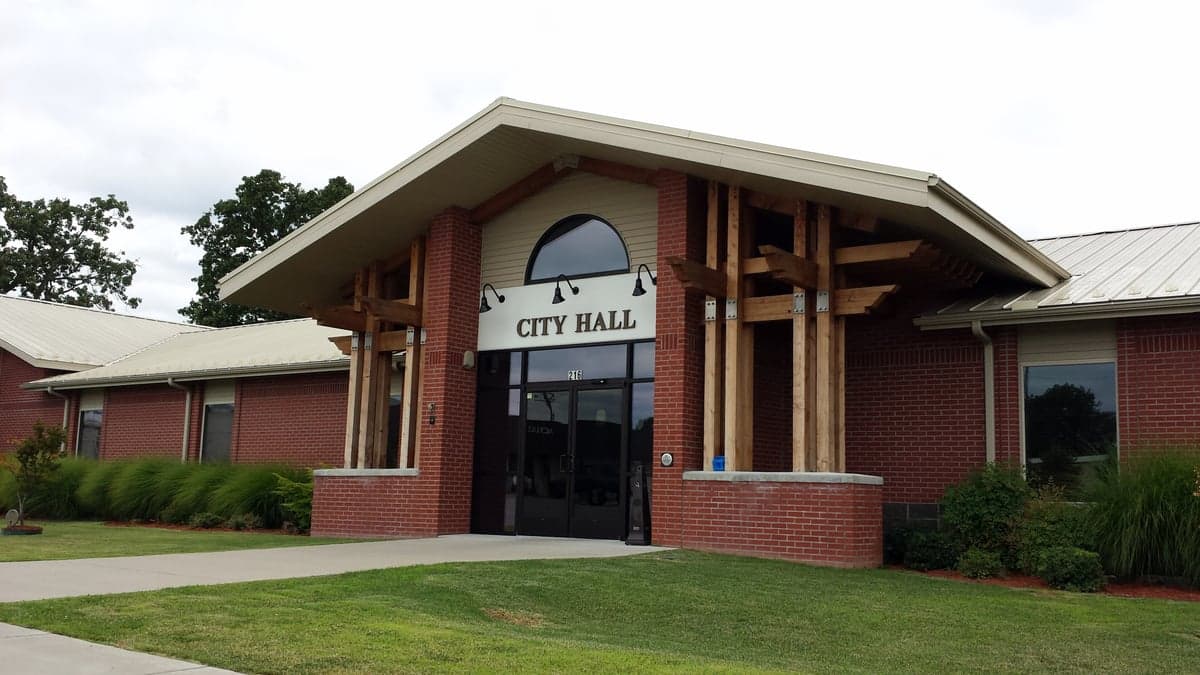
Photo: Wikipedia
Demographics of Lowell, AR
Affluence Level in Lowell, AR
An upper-middle-class area. Household wealth, education levels, and homeownership run ahead of national benchmarks.
People of Lowell, AR
The people of Lowell, Arkansas, today form a rapidly diversifying community of roughly 10,400 residents, characterized by a majority-minority population where Hispanic residents make up over a quarter of the city and East/Southeast Asian communities represent a small but notable presence. The city’s identity is shaped by its position as a working-class suburb of Fayetteville and Springdale, with a foreign-born share of 9.9% that exceeds the national average, yet a college attainment rate of 29.2% that trails the broader Northwest Arkansas region. This is a place where longtime white families, newer Hispanic arrivals, and a scattering of Asian and Black households coexist in a city that feels more like an extended small town than a dense urban center, with distinct neighborhoods reflecting different eras of settlement.
How the city was settled and grew
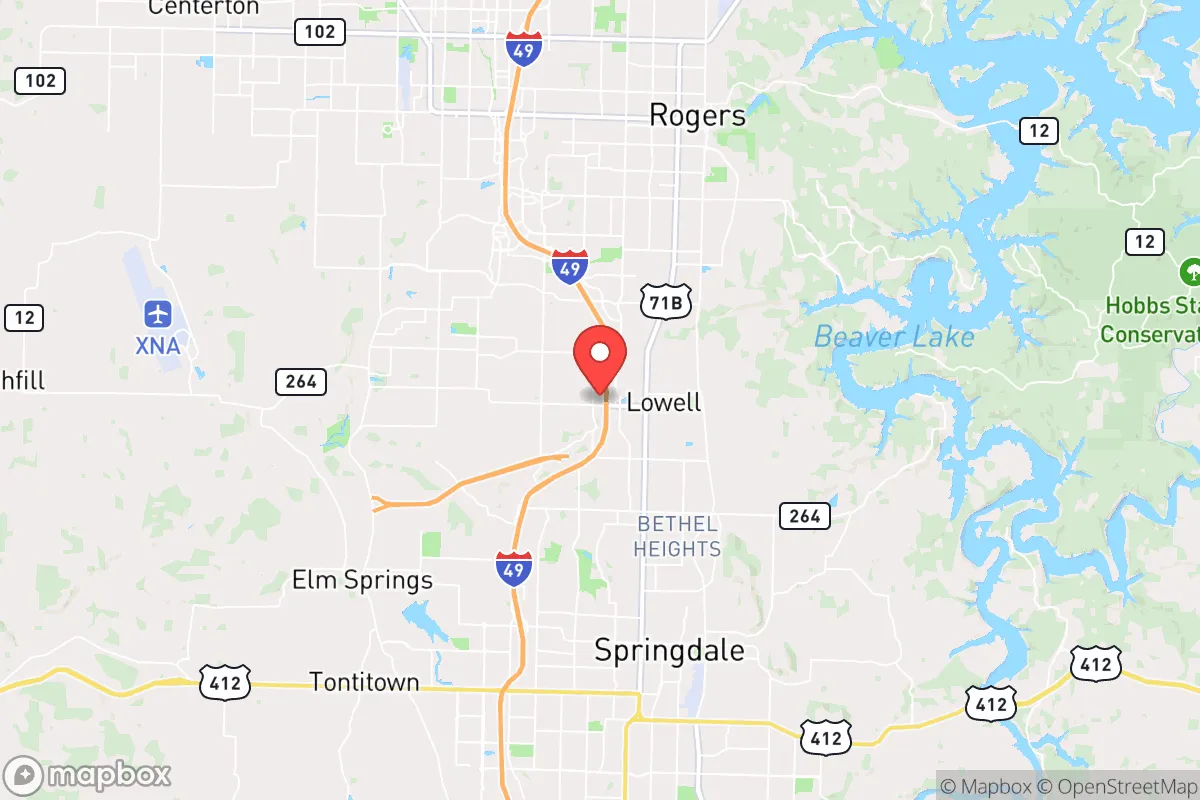
Lowell’s original population was drawn by the railroad in the late 19th century, when the St. Louis–San Francisco Railway established a depot here in the 1880s, attracting a mix of white farmers, merchants, and railroad workers. The city’s early core developed around the Downtown Lowell district, where modest wood-frame homes and storefronts housed the families of those who serviced the trains and worked the surrounding apple and strawberry orchards. Unlike many Arkansas towns, Lowell never saw a large plantation economy or significant Black settlement before 1900; the 1890 census recorded fewer than 20 Black residents in the area. The first half of the 20th century brought a slow trickle of white families from the Ozark hill country, who settled in the West Lowell area along what is now Arkansas Highway 264, building small farms and working at the local canneries. By 1950, the population hovered around 500, almost entirely native-born white, with a handful of Mexican laborers who came seasonally for fruit harvests but rarely stayed year-round.
Modern era (post-1965)
The post-1965 immigration reforms and the rise of the poultry industry in Northwest Arkansas transformed Lowell’s population dramatically. Tyson Foods, headquartered in nearby Springdale, began recruiting Mexican and Central American workers in the 1970s and 1980s, and many of those families settled in Lowell’s South Lowell neighborhoods, particularly along Bloomington Street and around the Lowell Industrial Park. This wave accelerated through the 1990s and 2000s, with the Hispanic share of the city rising from roughly 5% in 1990 to 26.2% today. The Lake Point subdivision, built in the early 2000s, became a mixed-income area where many second-generation Hispanic families bought homes, while newer arrivals often rent in the Briarwood apartment complex near the intersection of Highway 264 and I-49. The white population, which was over 90% as recently as 1990, has fallen to 54.8%, partly due to white flight to newer exurban developments in Benton County and partly due to the city’s annexation of previously rural areas. East/Southeast Asian residents, at 1.6%, are a small but growing group, concentrated in the Pleasant Grove area near the Springdale border, where several Vietnamese and Filipino families have opened small restaurants and nail salons. The Black population remains minimal at 1.3%, with most Black households living in the older Downtown Lowell rental stock. The Indian-subcontinent population is effectively zero, distinguishing Lowell from more diverse parts of Benton County.
The future
Lowell’s population is trending toward further diversification, but the city is not homogenizing into a single melting pot. Hispanic growth is likely to continue, driven by both immigration and higher birth rates among existing families, with the Hispanic share potentially reaching 35-40% by 2040. The white population will continue to decline as a share, though the absolute number of white residents may stabilize as new white families move into the Lake Point and Pleasant Grove subdivisions for the lower home prices compared to Bentonville. East/Southeast Asian communities are growing slowly, primarily through chain migration from existing Vietnamese and Filipino families, but are unlikely to exceed 3% of the population without a major employer shift. The city is tribalizing into distinct enclaves: Hispanic families cluster in South Lowell and Briarwood, white families dominate the newer subdivisions and the older West Lowell farmsteads, and Asian families are scattered but concentrated near the Springdale line. There is little evidence of significant assimilation across these groups; churches, restaurants, and social networks remain largely separate. For a conservative-leaning newcomer, this means Lowell offers a stable, family-oriented environment with low crime and good schools, but one where ethnic enclaves are the norm rather than the exception.
Lowell is becoming a majority-minority working-class suburb where Hispanic families are the primary engine of population growth, while white residents remain the largest single group but are increasingly concentrated in specific subdivisions. For someone moving in now, the city offers affordable housing, proximity to the jobs of Northwest Arkansas, and a demographic reality that is more diverse than the surrounding rural areas but less integrated than the region’s larger cities. The key question for a new resident is not whether Lowell is diverse—it is—but which neighborhood’s character and community best fit their priorities.

* Values derived from national, state, county, city and local statistics and may differ in a specific area. Last updated: 2026-04-30T07:59:41.000Z
Narrative content on this page is AI-generated and may contain mistakes. Verify any details that matter before acting on them.
ReloMaps may earn a commission from affiliate links at no extra cost to you.

