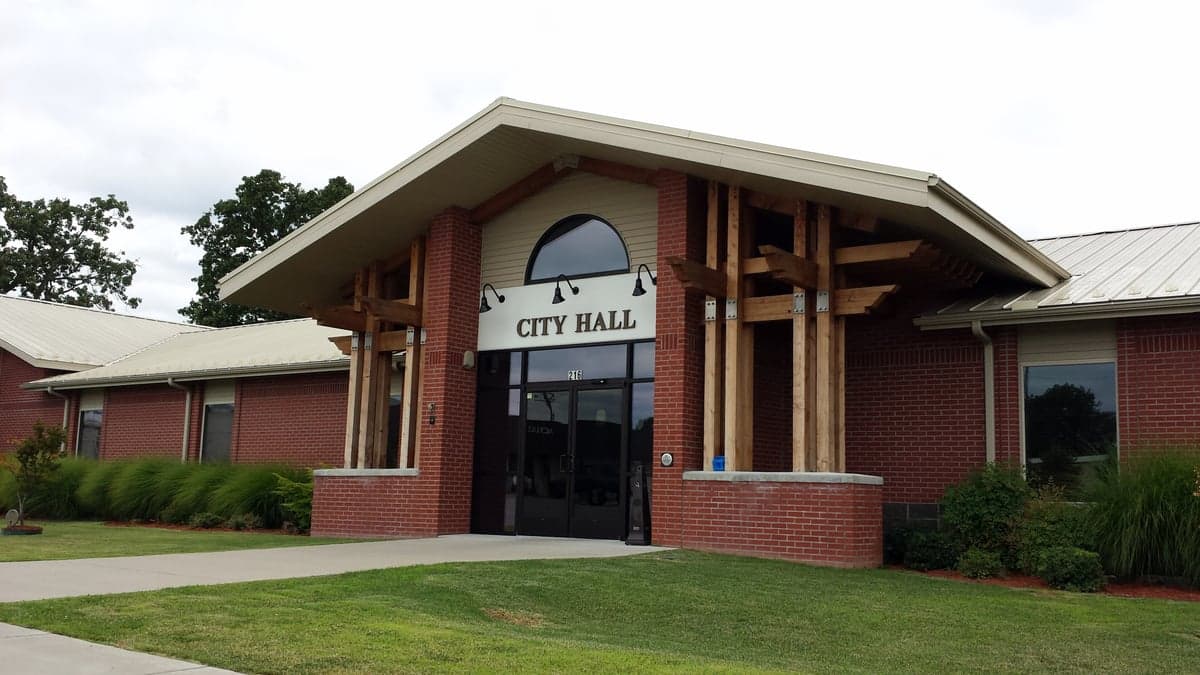
Photo: Wikipedia
Political ClimatePolitical Climate in Lowell, AR
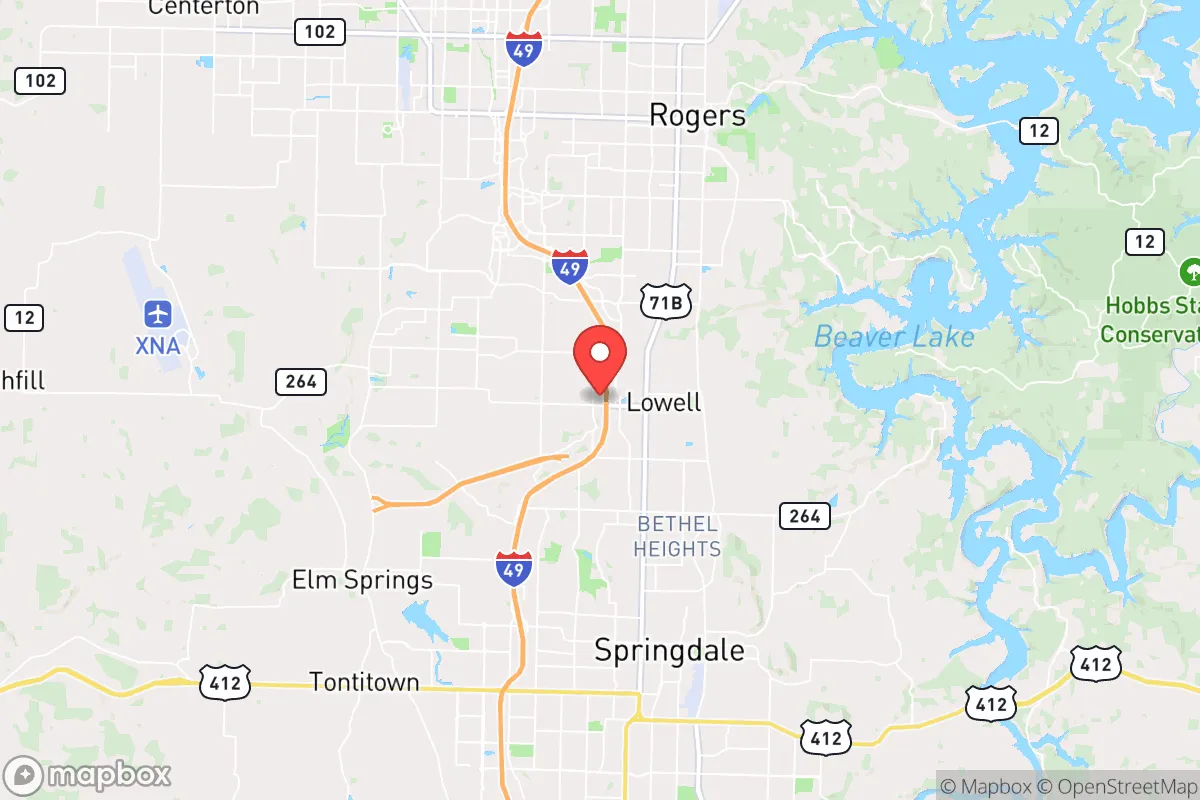
District shown is the primary district for this city’s centroid. Cities may span multiple districts.
Local Political AnalysisPolitical Analysis of Lowell, AR
Lowell, Arkansas, sits squarely in deep-red territory, with a Cook PVI of R+13 that reflects the broader conservative lean of Benton County. This isn't a purple suburb hedging its bets; it's a place where Republican candidates routinely win by double digits, and the local culture has long been built around traditional values, limited government, and personal responsibility. If you've been around here for a while, you've watched the area grow from a quiet crossroads into a bustling corridor along I-49, but the political heart hasn't shifted much—at least not yet. The real story is how that foundation is being tested as new folks pour in from places like California and Illinois, bringing different ideas about what government should do.
How it compares
Drive ten minutes south to Fayetteville, and you're in a different world—Washington County leans blue, with the University of Arkansas pulling the needle left on everything from zoning to social policy. Lowell, by contrast, feels like a bulwark against that drift. Neighboring Rogers and Bentonville lean conservative too, but Lowell's smaller-town character means you're less likely to see the progressive activism that's crept into those larger cities. Benton County as a whole voted +24 points for Trump in 2024, and Lowell's precincts were even more lopsided. The contrast isn't subtle: Fayetteville's city council debates housing density and bike lanes; Lowell's council spends more time on road maintenance and keeping property taxes low. That's the kind of governance that keeps government out of your garage and your wallet.
What this means for residents
For someone who values personal freedoms—especially the freedom to run a business, own a firearm, or raise a family without a bureaucrat's permission—Lowell delivers. There's no city income tax, zoning is relatively light, and the school board hasn't gone down the rabbit hole of critical race theory or gender ideology that's plaguing districts in blue states. You can still buy a house on a half-acre lot without a homeowners' association telling you what color your mailbox can be. That said, the growth is real, and with it comes pressure. Benton County's population jumped nearly 30% between 2010 and 2020, and Lowell has absorbed a chunk of that. More people means more demand for services, and that's where the rubber meets the road: will the county keep taxes low and let the private sector handle it, or will we see the kind of government expansion that erodes the very freedom that brought people here in the first place?
Long-term, the concern is that the influx of out-of-state transplants—many from high-tax, high-regulation states—will slowly shift the Overton window. If even 10% of new arrivals bring their old voting habits, that R+13 could slip to R+8 or R+5 within a decade, and suddenly you're having conversations about light rail, inclusionary zoning, and "equity" initiatives that sound a lot like the policies people fled. For now, Lowell remains a place where the Second Amendment isn't debated, the school board focuses on reading and math, and the biggest political fight is whether to widen a road. But keep an eye on the city council elections—that's where the battle for the soul of this town will be won or lost.

State Political ClimatePolitical Climate in Arkansas
State Political AnalysisPolitical Environment in the State
Arkansas has been a reliably red state for decades, but don’t mistake that for a monolith—it’s a deep shade of crimson with some surprising purple streaks. The state’s overall partisan lean is solidly Republican, with every statewide office held by the GOP and a legislature that’s supermajority conservative. Over the last 10-20 years, the shift has been dramatic: as recently as 2008, Arkansas voted for a Democrat for president (Bill Clinton’s home state effect), but by 2024, Donald Trump carried it by over 30 points. The dominant coalition is a mix of rural traditionalists, evangelical voters, and a growing number of conservative transplants from blue states, while the Democratic base is increasingly confined to the Delta region and a few urban pockets.
Urban vs. rural divide
The political map of Arkansas is a study in contrasts. The state’s two major metros—Little Rock and Fayetteville—are the only real blue dots. Pulaski County (Little Rock) has trended Democratic for years, driven by a growing Black population and white-collar professionals. Washington County (Fayetteville) is a classic college-town anomaly: the University of Arkansas pulls in younger, more progressive voters, making it a purple-to-blue county in an otherwise red region. But drive 20 minutes outside either city, and you’re in deep red territory. Benton County, home to Rogers and Bentonville, is a fascinating case—it’s the heart of the Walmart corporate empire and has seen massive in-migration from California and the Northeast. Despite that, it votes reliably Republican, though the GOP primary there is often more moderate than in rural counties. The real conservative strongholds are the rural counties like Van Buren, Stone, and Newton in the Ozarks, where Trump routinely pulls 80%+ of the vote. The Delta counties along the Mississippi River—Lee, Phillips, St. Francis—are the last Democratic bastions, but they’re shrinking fast as population declines.
Policy environment
Arkansas’s policy environment is aggressively conservative, with a few notable wrinkles. The state has a flat income tax that’s been cut repeatedly—it’s now 4.4% and heading toward 3.9% by 2027. There’s no state property tax on vehicles, and the sales tax is moderate (6.5% state, plus local add-ons). The regulatory posture is business-friendly, with right-to-work laws and minimal zoning in most rural areas. On education, the state passed the Arkansas LEARNS Act in 2023, which created universal school choice—any family can use state funds for private school, homeschooling, or tutoring. That’s a big deal for parents who want out of the public system. Healthcare is a mixed bag: the state expanded Medicaid under the private option (Arkansas Works), but the legislature has resisted further expansion and passed strict abortion laws (a near-total ban with no exceptions for rape or incest). Election laws are solid—voter ID is required, and the state has cleaned up its voter rolls aggressively. No mail-in ballot free-for-all here.
Trajectory & freedom
On the freedom front, Arkansas is moving in a decidedly positive direction for conservatives. The Arkansas LEARNS Act is the biggest expansion of parental rights in the region—it also banned “critical race theory” and prohibited classroom discussion of gender identity before 5th grade. Gun rights are strong: permitless carry passed in 2021, and the state has a “stand your ground” law. The legislature also passed a Second Amendment Preservation Act in 2023, which attempts to nullify federal gun laws—though it’s been tied up in court. Medical autonomy took a hit with the abortion ban, but the state also passed a medical marijuana program (via ballot initiative in 2016) that’s still operational, though it’s tightly regulated. Property rights are solid—no statewide rent control, and eminent domain is rarely abused. The biggest red flag for liberty-minded folks is the state’s sales tax on groceries—it’s one of the few states that still taxes food, though there’s a push to eliminate it. Overall, the trajectory is toward more freedom on education, guns, and taxes, but the state still has a heavy hand in some areas (alcohol sales are still restricted in many dry counties).
Civil unrest & political movements
Arkansas is not a hotbed of civil unrest, but there have been flashpoints. The 2020 Black Lives Matter protests in Little Rock turned violent for a few nights, with property damage and arrests, but they fizzled quickly. The state’s response was swift: the legislature passed a critical infrastructure protection law in 2021 that increased penalties for blocking highways or damaging pipelines. Immigration politics are relatively quiet—Arkansas has a small foreign-born population (about 5%), and the state passed a law requiring all employers to use E-Verify. There’s no sanctuary city movement to speak of. Election integrity controversies have been minimal, though the 2022 secretary of state race saw some noise about Dominion voting machines—the state uses them, but there’s been no major fraud scandal. The most visible political movement is the “Parents’ Bill of Rights” crowd, which has been very active in school board meetings, especially in Bentonville and Conway. On the left, the Arkansas Democratic Party is essentially a shell—they haven’t won a statewide race since 2010. The real action is in GOP primaries, where the Arkansas Freedom Caucus has been pushing the legislature further right, often clashing with the more establishment wing.
Projection
Over the next 5-10 years, Arkansas will likely get redder, but with a twist. The in-migration from blue states—especially to Bentonville and Rogers—is bringing in people who are conservative but not necessarily traditional. They want low taxes and school choice, but they’re less interested in culture war battles over things like library books. That could create a tension between the rural “old guard” and the suburban “new right.” The Delta will continue to shrink and lose political clout, while the northwest corridor (Fayetteville to Bentonville) will grow in influence. Expect the state to keep cutting taxes and expanding school choice. The biggest wild card is the Arkansas River Valley—cities like Fort Smith and Russellville are growing and could become swing areas if the Democratic Party ever gets its act together. But for now, the GOP supermajority is safe. A new resident moving in now should expect a state that’s increasingly conservative on fiscal and education policy, but with a growing suburban population that might moderate some social issues over time.
For someone relocating here, the bottom line is this: Arkansas offers a high degree of personal freedom on the issues that matter most to conservatives—low taxes, strong gun rights, school choice, and minimal government overreach in daily life. The trade-off is that you’ll have to accept a slower pace of life, limited urban amenities, and a state government that’s still figuring out how to handle growth. If you’re looking for a place where your values are reflected in the laws and your kids can get a good education without indoctrination, Arkansas is a solid bet. Just know that the political battles here are fought in GOP primaries, not general elections—so if you want a say, you’ll need to vote in those.
* Values derived from national, state, county, city and local statistics and may differ in a specific area. Last updated: 2026-04-30T07:59:41.000Z
Narrative content on this page is AI-generated and may contain mistakes. Verify any details that matter before acting on them.
ReloMaps may earn a commission from affiliate links at no extra cost to you.

