
Photo: Wikipedia
Political ClimatePolitical Climate in Macon, GA
District shown is the primary district for this city’s centroid. Cities may span multiple districts.
Local Political AnalysisPolitical Analysis of Macon, GA
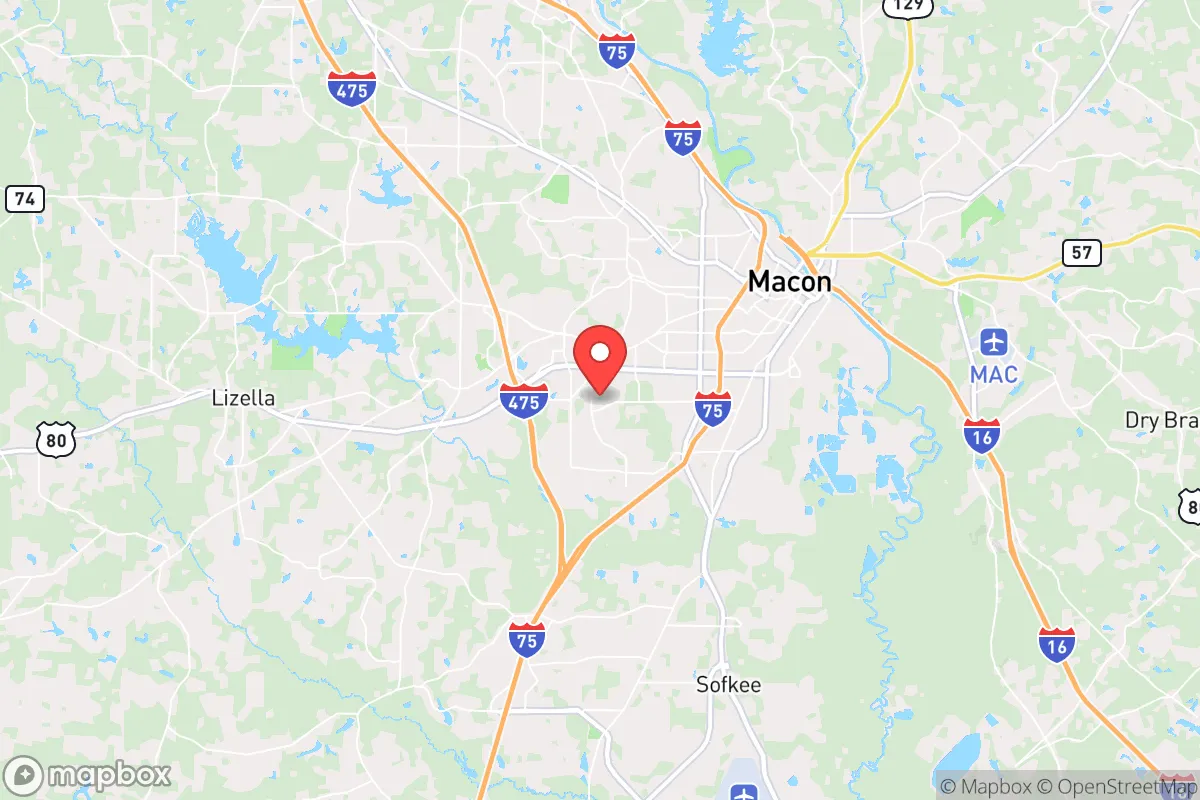
Macon, Georgia, sits in a political landscape that’s shifted noticeably over the past decade, and if you’ve lived here as long as I have, you’ve felt it. The Cook PVI rating of D+4 tells you the city leans Democratic by a modest margin, but that number doesn’t capture the full story—it’s a place where old-school Southern conservatism still has deep roots, especially in the surrounding Bibb County precincts and the rural areas just outside town. The real concern for folks who value limited government and personal freedoms is how the city’s leadership has been drifting toward progressive policies, particularly on local ordinances and spending, while the state-level politics in Georgia remain firmly red. If you’re looking at Macon from a conservative lens, the trajectory is a bit worrying: the old “Macon spirit” of self-reliance is getting crowded out by a growing appetite for government solutions.
How it compares
Drive twenty minutes north to Forsyth or thirty minutes west to Thomaston, and you’ll find communities that vote reliably Republican—places where the tax burden is lower and the local government keeps its nose out of your business. Macon, by contrast, has a city council that’s increasingly comfortable with zoning overhauls, business regulations, and spending on social programs that feel like they’re borrowed from Atlanta’s playbook. The contrast is stark when you look at neighboring Warner Robins, which leans more conservative and has a reputation for keeping taxes in check. Even within Bibb County, the unincorporated areas often vote red, while Macon proper’s urban core drives the D+4 lean. That split means you can live just outside city limits and enjoy a lighter regulatory touch, but if you’re inside Macon’s jurisdiction, you’re dealing with a government that’s more willing to meddle—whether it’s through noise ordinances, business licensing fees, or land-use restrictions that make it harder to run a small operation.
What this means for residents
For the average resident, this political tilt translates into real-life headaches. Property taxes in Macon have crept up faster than in surrounding counties, and there’s a growing push for “equity” initiatives that often mean more bureaucracy and less personal choice. If you’re a gun owner, you’ll be relieved that Georgia’s constitutional carry law still applies statewide, but local leaders have floated symbolic resolutions against it—a sign of where their sympathies lie. The school board has also seen progressive influence, with curriculum debates that make some parents uneasy about what their kids are being taught. On the flip side, the city’s crime rate has been a persistent issue, and the response from City Hall has leaned toward more policing funding, which is a rare win for law-and-order types, but it’s paired with social justice programs that feel like a trade-off. The bottom line: if you value being left alone to live your life without government overreach, Macon’s political climate requires you to stay vigilant and vote in every local election.
Culturally, Macon still holds onto some of its old Southern charm—the Cherry Blossom Festival, the historic districts, and a strong sense of community in neighborhoods like Ingleside. But the policy distinctions are where the rubber meets the road. The city has embraced a “welcoming” stance on immigration, which rubs some conservatives the wrong way, and there’s been talk of creating a local housing authority with more power to regulate rentals. These aren’t deal-breakers for everyone, but they signal a direction that prioritizes collective action over individual liberty. If you’re considering a move here, my advice is to look at the county line—literally. Living just outside Macon’s city limits can save you from the worst of the progressive drift while still letting you enjoy the area’s amenities. The long-term trend? Unless there’s a serious pushback at the ballot box, I’d expect Macon to keep leaning left, while the surrounding counties stay red. It’s a tale of two Georgias, and you’ve got to pick your side.

State Political ClimatePolitical Climate in Georgia
State Political AnalysisPolitical Environment in the State
Georgia has transformed from a reliably red state into a fiercely contested battleground, a shift that has accelerated dramatically over the past decade. The state’s overall partisan lean is now a razor-thin toss-up, with Democrats winning the presidency and both U.S. Senate seats in 2020 and 2021, while Republicans have maintained control of the state legislature and governorship. This 10-20 year arc shows a state that was once a solid Republican stronghold—voting +8 for McCain in 2008 and +5 for Romney in 2012—now defined by a suburban revolt against Trumpism and a rapidly diversifying electorate, creating a volatile political environment that feels anything but settled.
Urban vs. rural divide
The political map of Georgia is a textbook study in urban-rural polarization. The metro Atlanta area, home to roughly 60% of the state’s population, is the engine of Democratic power. Atlanta proper, along with inner-ring suburbs like Decatur and Sandy Springs, vote overwhelmingly blue, often by margins of 70-80%. The real story, however, is the suburban shift. Counties like Cobb, Gwinnett, and Henry—once reliable Republican strongholds—have flipped dramatically. Cobb County, which voted for Romney by 12 points in 2012, went for Biden by 14 points in 2020. This suburban exodus from the GOP is driven by college-educated professionals, particularly women, who have been turned off by the party’s cultural wars and Trump’s style. Meanwhile, rural and exurban Georgia remains deeply red. North Georgia mountain counties like Fannin and Union routinely vote 80%+ Republican, as do the agricultural counties of South Georgia, such as Colquitt and Thomas. The state’s second-largest metro, Augusta, is a microcosm of the divide: the city itself leans Democratic, while surrounding Richmond County’s suburbs and the neighboring CSRA counties are solidly red. Savannah and Macon follow a similar pattern—blue urban cores surrounded by red rural hinterlands. The result is a state where a few hundred thousand suburban votes in metro Atlanta can swing the entire outcome, making every election a nail-biter.
Policy environment
Georgia’s policy environment is a mixed bag that reflects its political schizophrenia. On the plus side for conservatives, the state has a flat income tax rate of 5.49% (down from 5.75% in 2024, with a path to 4.99% by 2029), and no estate or inheritance tax. The regulatory posture is generally business-friendly, with a right-to-work law and a tort reform package passed in 2005 that capped non-economic damages in medical malpractice cases. However, the education landscape is contentious. Governor Brian Kemp signed the Georgia Promise Scholarship Act in 2024, creating a $6,500 education savings account for students in low-performing schools—a win for school choice. But the state’s public school system remains heavily influenced by the teachers’ union and local school boards, many of which have embraced progressive curricula. Healthcare is a sore spot: Georgia did not expand Medicaid under the Affordable Care Act, but Kemp’s Georgia Pathways to Coverage program, which requires work or community engagement, has been slow to enroll and faces legal challenges. Election laws have been a flashpoint. The Election Integrity Act of 2021 (SB 202) tightened voter ID requirements for absentee ballots, limited drop boxes, and reduced the runoff election window—moves that conservatives argue protect ballot security but that progressives decry as voter suppression. The law has survived court challenges, but the fight is far from over.
Trajectory & freedom
On personal liberty, Georgia is a state of contradictions trending in a concerning direction for conservatives. Gun rights are strong: Georgia is a permitless carry state (HB 218, signed in 2022), and there is no state-level red flag law. The state also has a strong castle doctrine and stand-your-ground law. However, the trajectory on medical freedom is alarming. Governor Kemp signed a six-week abortion ban (HB 481) in 2019, which took effect after the Dobbs decision in 2022—a clear win for the pro-life movement. But the state’s medical board has been aggressive in enforcing COVID-era mandates, and there is no broad medical freedom law protecting vaccine choice or treatment rights. Parental rights are a battleground. The Parents’ Bill of Rights (SB 449), signed in 2022, gives parents the right to review instructional materials and opt their children out of sex education, but it has been criticized as weak compared to laws in Florida or Texas. Meanwhile, local school boards in metro Atlanta counties like Fulton and DeKalb have adopted policies that allow students to use preferred pronouns and access bathrooms without parental notification—a direct challenge to parental authority. Property rights are generally respected, with no state-level rent control and relatively low property taxes (average effective rate around 0.87%), but zoning battles in Atlanta and its suburbs are increasingly pitting homeowners against developers and density advocates. The overall trend is a state where freedom is being chipped away at the local level, even as the statehouse holds the line on some key issues.
Civil unrest & political movements
Georgia has been a hotbed of political activism and civil unrest, particularly since 2020. The Atlanta protests following George Floyd’s murder were among the largest and most destructive in the nation, with the city seeing significant property damage and a surge in violent crime that has only recently begun to subside. The Stop Cop City movement—opposing the construction of a police training facility in DeKalb County—has been a persistent source of tension, with activists engaging in arson and vandalism, and the state responding with a controversial anti-racketeering law (RICO) to prosecute organizers. Immigration politics are a flashpoint. While Georgia is not a sanctuary state, Atlanta and several metro counties have declared themselves “welcoming cities”, limiting cooperation with ICE. This has led to clashes with the state legislature, which passed SB 452 in 2024, requiring local law enforcement to cooperate with federal immigration authorities. Election integrity remains a raw nerve. The 2020 election saw intense scrutiny, with Trump allies claiming widespread fraud in Fulton County. The state’s subsequent election law changes have not quelled the distrust, and the Fulton County election board has been a revolving door of partisan fights, with the state election board recently taking over its operations. On the right, the Georgia Republican Party is deeply fractured between establishment figures like Kemp and Trump-aligned activists, leading to bitter primary battles and a lack of unified messaging. A new resident would notice the constant political tension, with yard signs, bumper stickers, and heated social media debates a daily reality.
Projection
Looking five to ten years out, Georgia is likely to become even more competitive, with a slight lean toward Democrats in presidential elections but continued Republican control of the state legislature. Demographic trends favor the left: the state’s population is growing fastest in the diverse, college-educated suburbs of Atlanta, while rural areas are stagnant or declining. In-migration from blue states like California and New York is accelerating this shift, as new arrivals tend to bring their politics with them. However, the state’s legislative maps are gerrymandered to protect Republican majorities, and the state Supreme Court has upheld them. The wild card is the 2026 gubernatorial election, which will test whether the GOP can hold the governor’s mansion without Kemp. If a Trump-aligned candidate wins the primary, the general election could be a toss-up. On policy, expect continued battles over education (school choice vs. public school funding), election laws (more restrictions vs. expanded access), and immigration (state vs. local control). The Atlanta region’s growth will drive housing costs up, potentially pushing conservative families further into exurbs like Jackson County or Coweta County, which could create new red strongholds but also dilute the GOP’s suburban base. A new resident moving in now should expect a state that is politically exhausting but still offers a relatively low-tax, business-friendly environment—provided they are willing to engage in the constant fight to keep it that way.
For a new resident, the bottom line is this: Georgia offers a low-tax, gun-friendly, and business-supportive state government, but you will be living in a political warzone. The statehouse is a reliable conservative check on the increasingly progressive metro Atlanta machine, but local control in the suburbs is slipping away. If you value school choice, parental rights, and election integrity, you will need to be actively engaged in local politics to protect those freedoms. The state is not yet lost, but the trajectory requires vigilance. Choose your county carefully—rural North Georgia or exurban counties like Forsyth or Cherokee offer a more conservative environment, while the Atlanta suburbs are a mixed bag that can change with each election cycle.
* Values derived from national, state, county, city and local statistics and may differ in a specific area. Last updated: 2026-04-30T05:46:22.000Z
Narrative content on this page is AI-generated and may contain mistakes. Verify any details that matter before acting on them.
ReloMaps may earn a commission from affiliate links at no extra cost to you.

