
Photo by TopSphere Media on Unsplash
Political ClimatePolitical Climate in Madeira, OH
District shown is the primary district for this city’s centroid. Cities may span multiple districts.
Local Political AnalysisPolitical Analysis of Madeira, OH
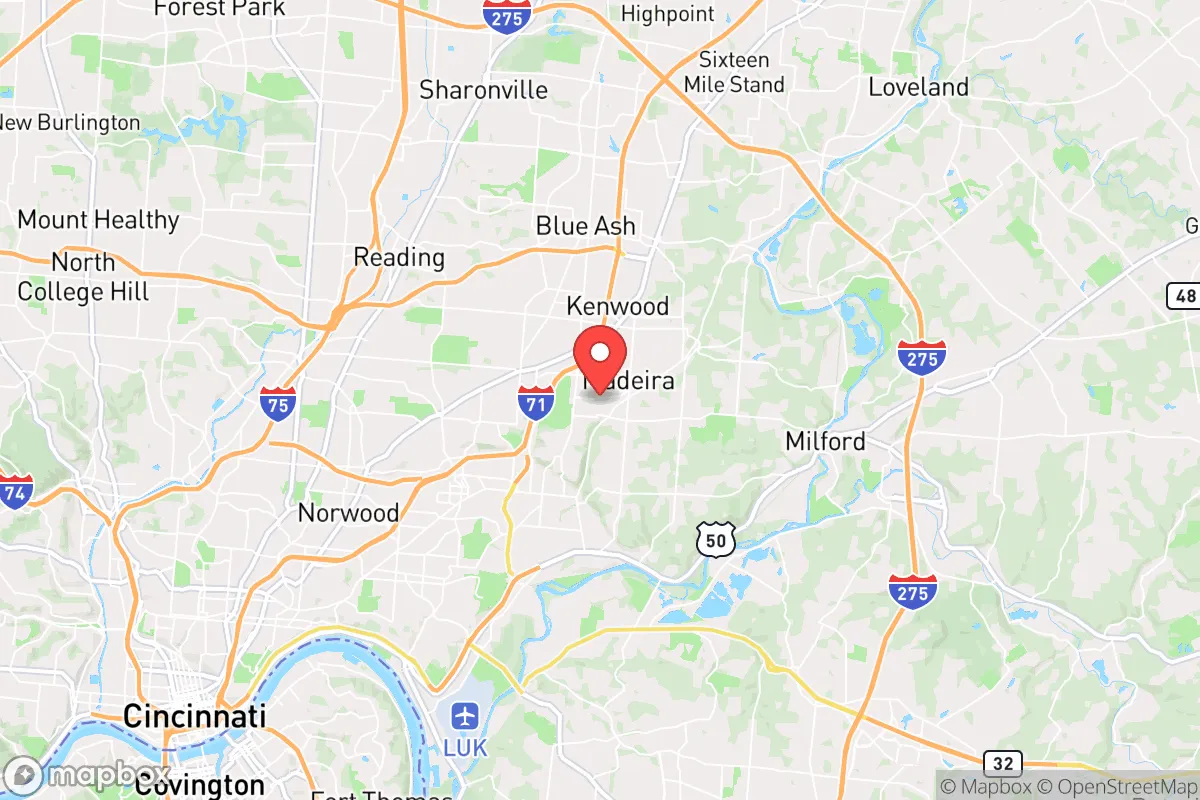
Madeira, Ohio, sits in a bit of a political bubble. While the official Cook PVI for the area is D+3, meaning it leans slightly Democratic compared to the national average, that number doesn't tell the whole story for a longtime resident. This isn't a deep-blue stronghold like downtown Cincinnati; it's a traditionally quiet, family-oriented suburb where the political shift has been gradual but noticeable. The real story is how Madeira's local politics have drifted from a live-and-let-live conservatism toward a more progressive, government-involved approach over the last decade, and that trajectory has a lot of folks like me watching closely.
How it compares
To understand Madeira's current climate, you have to look at the towns around it. Head a few miles south into Indian Hill, and you'll find a place that still votes reliably red—a community that largely believes in low taxes and minimal interference. Go west to Mariemont, and you get a similar story, though with a slightly more independent streak. But Madeira? It's become the outlier in this corner of Hamilton County. We used to track pretty closely with those neighbors, but now you see the city council and school board pushing initiatives that feel more like what you'd expect in Hyde Park or Oakley—neighborhoods closer to the city core where progressive ideas are the norm. The contrast is stark when you realize that just a 10-minute drive can take you from a town that respects your Second Amendment rights without a fuss to one where local ordinances start nibbling at personal freedoms under the guise of "safety."
What this means for residents
For those of us who've been here a while, the biggest concern is the slow creep of government overreach into daily life. It's not about one big policy change; it's the accumulation of small things. You see it in zoning rules that get tighter every year, making it harder to do what you want with your own property. You see it in school board meetings where curriculum debates lean toward a more centralized, top-down approach rather than trusting parents to know what's best for their kids. The D+3 rating feels like it's moving leftward in practice, even if the numbers haven't fully caught up yet. Property taxes have climbed steadily, and while some of that funds good schools, there's a growing sense that the money isn't always spent with the taxpayer's priorities in mind. A lot of us are asking: at what point does "community improvement" become an excuse for telling people how to live?
Looking ahead, the near-term trend doesn't seem to be reversing. The younger families moving in often come from more urban areas and bring those voting habits with them. The long-term picture is uncertain, but if the current path holds, Madeira could become a place where conservative voices feel increasingly out of step with local leadership. That's a shame, because the core of this town—the quiet streets, the strong sense of neighborliness, the freedom to raise a family without a lot of bureaucratic fuss—is worth preserving. The cultural distinction here is that Madeira still has the bones of a great conservative community; the question is whether the political climate will let those bones stay strong, or if we'll keep drifting toward a model where the government's hand feels a little heavier every year.

State Political ClimatePolitical Climate in Ohio
State Political AnalysisPolitical Environment in the State
Ohio has long been the quintessential swing state, but over the past decade it has shifted decisively to the right, voting for Donald Trump by 8 points in both 2016 and 2020 and by a similar margin in 2024. The state’s political center of gravity now sits firmly in the conservative camp, driven by a powerful coalition of rural voters, working-class exurbs, and a growing number of suburbanites fleeing the chaos of nearby blue states. While the state was once a bellwether that could go either way, the last 15 years have seen a steady migration of culturally conservative families from Michigan, Illinois, and even California into places like Delaware and Medina, while the old Democratic strongholds in the Mahoning Valley and along the Lake Erie shore have hollowed out. The result is a state that is now reliably red at the presidential level, though still capable of electing moderate Republicans and the occasional Democrat in state-level races.
Urban vs. rural divide
The political map of Ohio is a textbook study in the urban-rural split. The three major metros — Cleveland, Columbus, and Cincinnati — are all blue-leaning islands surrounded by a sea of red. Cuyahoga County (Cleveland) and Franklin County (Columbus) together account for nearly a third of the state’s population and vote about 65-70% Democratic. But outside those urban cores, the story flips hard. The rural counties of western Ohio — places like Mercer, Auglaize, and Shelby — routinely go 75-80% Republican. The real action is in the suburbs and exurbs. Delaware County, just north of Columbus, is now the most reliably Republican large county in the state, voting 60%+ for Trump in 2024. Meanwhile, Warren County (north of Cincinnati) and Geauga County (east of Cleveland) are similarly deep red. The old Democratic strongholds in the Mahoning Valley — Youngstown and Trumbull County — have been bleeding blue voters for years, with many working-class families shifting to the GOP over cultural and economic issues. The divide isn’t just about geography; it’s about lifestyle. The urban cores are increasingly progressive, with bike lanes, density, and high taxes, while the rest of the state values low regulation, gun rights, and traditional schools.
Policy environment
Ohio’s policy environment has become markedly more conservative over the last decade, especially since the 2022 midterms gave Republicans a supermajority in both chambers of the legislature. The state income tax has been cut from a top rate of nearly 5% to a flat 3.5% as of 2025, with further cuts likely. Property taxes are moderate, and there is no inheritance tax. The regulatory posture is business-friendly, with right-to-work laws still in place (though not a full “right-to-work” state in the union sense) and a strong tort reform environment. On education, Ohio has embraced school choice aggressively: the EdChoice voucher program now covers nearly every family, and charter schools are plentiful. The state also passed a Parents’ Bill of Rights in 2023, requiring schools to notify parents of any changes to a child’s health or well-being. Election laws have been tightened: voter ID is now required, drop boxes are limited to one per county, and early voting windows have been standardized. The state also passed a constitutional amendment in 2023 requiring 60% voter approval for future ballot initiatives, a direct response to the abortion rights amendment that passed earlier that year. For a conservative family, Ohio’s policy environment is a breath of fresh air compared to the overreach seen in states like California or New York.
Trajectory & freedom
Ohio is moving in a decidedly more free direction on most fronts, though not without some concerning bumps. The biggest win for personal liberty was the passage of constitutional carry in 2022, which allows law-abiding adults to carry a concealed firearm without a permit. The state also passed a Stand Your Ground law in 2021, removing the duty to retreat. On parental rights, the 2023 Parents’ Bill of Rights (HB 8) requires schools to get parental consent before any medical or mental health screening, and prohibits instruction on sexual orientation in grades K-3. Medical freedom took a hit during the pandemic, but the state has since banned vaccine passports and prohibited employers from mandating COVID-19 vaccines as a condition of employment. Property rights are strong, with no statewide rent control and a low property tax burden. The one area where freedom has been curtailed is on the ballot initiative front: the 60% threshold for constitutional amendments, passed in 2023, makes it harder for out-of-state money to change the state’s founding document. That said, the state’s abortion rights amendment (Issue 1) passed in November 2023 with 57% of the vote, a clear sign that voters are willing to protect personal medical autonomy even in a red state. Overall, the trajectory is toward more individual liberty, especially on guns, education, and taxes.
Civil unrest & political movements
Ohio has seen its share of political flashpoints, but they tend to be localized and less chaotic than in coastal states. The most visible recent unrest was the 2020 protests in Columbus and Cincinnati following the George Floyd incident, which included some looting and property damage, but were quickly contained by law enforcement. The state has a strong and active Second Amendment sanctuary movement, with over 60 counties passing resolutions declaring themselves sanctuaries for gun rights. Immigration politics are relatively quiet compared to border states, but there have been tensions in Springfield and Dayton over the influx of Haitian and Somali refugees, with local officials pushing back against federal resettlement programs. Election integrity remains a hot topic: the 2020 and 2022 elections saw no major scandals, but the state has since purged voter rolls and tightened ID laws. There is a growing nullification movement in rural counties, with some sheriffs refusing to enforce federal gun laws. The most organized activist groups are on the right: the Ohio Freedom Alliance and local Moms for Liberty chapters are active in school board races and county commissions. On the left, the Ohio Organizing Collaborative pushes for voting rights and criminal justice reform, but their influence is limited outside the urban cores. A new resident would notice that political signs and bumper stickers are common, but actual street-level conflict is rare — most people just want to be left alone.
Projection
Over the next 5-10 years, Ohio is likely to become even more conservative, driven by two powerful demographic trends. First, the continued exodus of blue voters from the urban cores to the suburbs and exurbs is diluting the Democratic base. Second, in-migration from high-tax, high-regulation states like Illinois, Michigan, and California is bringing culturally conservative families who are fleeing progressive policies. The state’s population is aging, but the new arrivals tend to be younger families with children, which will further shift the political balance toward school choice, lower taxes, and gun rights. The one wild card is the growing Hispanic population in places like Lorain and Sandusky, which could lean Democratic if the GOP doesn’t court them effectively. But for now, the state’s political trajectory is clear: more red, more freedom-oriented, and more resistant to federal overreach. The 2026 governor’s race will be a key test, but the Republican primary will likely be a battle between the establishment and the populist wing, with the winner almost certain to take the general election. By 2030, Ohio could easily be as red as Indiana or West Virginia.
For a conservative family or individual considering a move to Ohio, the bottom line is this: you will find a state that respects your right to live your life without excessive government interference. The schools are choice-friendly, the taxes are low and falling, the gun laws are among the best in the Midwest, and the political culture is one of live-and-let-live conservatism. The urban areas are still blue, but they are easy to avoid — and the suburbs and rural areas offer a quality of life that is hard to beat. If you’re looking for a place where your values are respected and your freedoms are expanding, Ohio is a solid bet for the next decade.
* Values derived from national, state, county, city and local statistics and may differ in a specific area. Last updated: 2026-04-27T18:17:25.000Z
Narrative content on this page is AI-generated and may contain mistakes. Verify any details that matter before acting on them.
ReloMaps may earn a commission from affiliate links at no extra cost to you.

