 Popular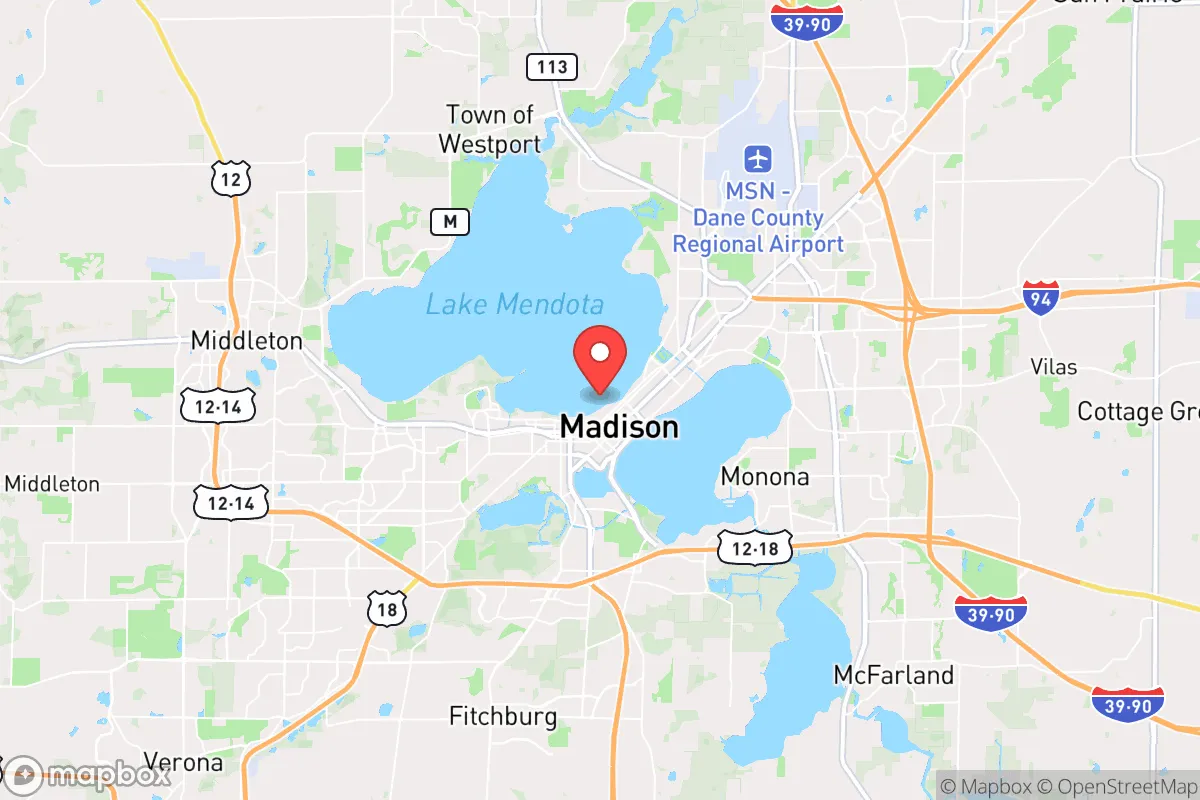
Photo: Wikipedia
Demographics of Madison, WI
Affluence Level in Madison, WI
A middle-class area roughly in line with national averages across income, home values, education, and employment.
People of Madison, WI
Madison, Wisconsin, is a city of 275,568 residents defined by a highly educated, predominantly white population with growing Hispanic and Asian communities. With 59.2% of adults holding a college degree, the city’s character is shaped by the University of Wisconsin–Madison, state government employment, and a progressive political culture. The population is denser and more diverse than the surrounding Dane County, yet remains notably less diverse than peer Midwestern capitals like Columbus or Indianapolis.
How the city was settled and grew
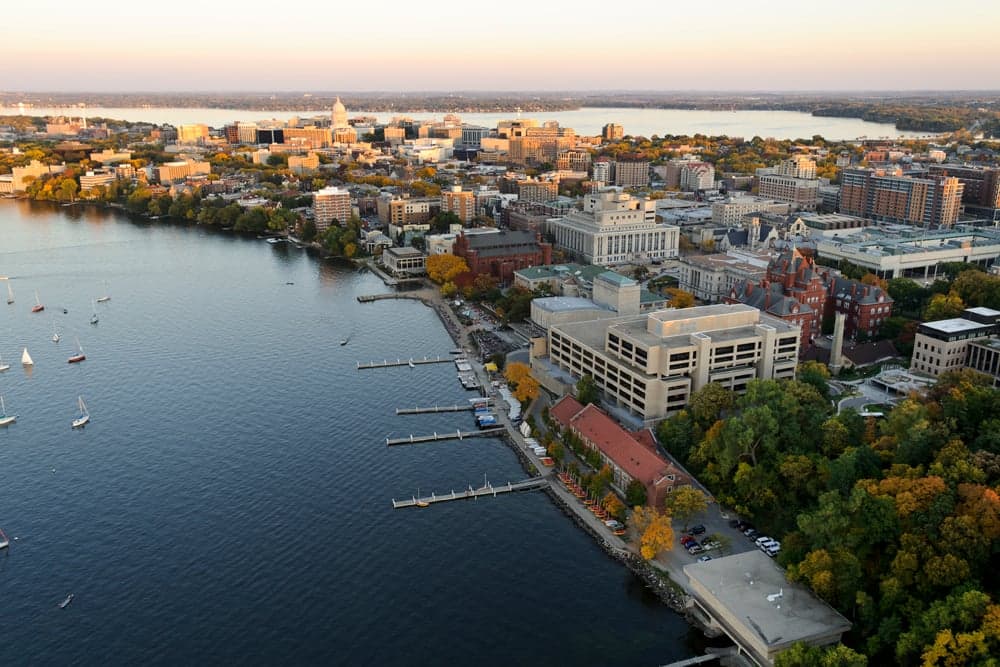
Madison was founded in 1836 as Wisconsin’s territorial capital, deliberately sited on an isthmus between Lakes Mendota and Monona to attract government and commerce. The original population was a mix of Yankee settlers from New England and upstate New York, who dominated the early legal and political class, and German immigrants who arrived in the 1840s–1860s. The Germans settled heavily in the Near East Side and the Greenbush neighborhood (later razed for urban renewal), building breweries, churches, and a strong working-class identity. Norwegian immigrants followed in the 1870s–1890s, clustering in the Willy Street corridor and the Marquette neighborhood, where their influence remains visible in food co-ops and Lutheran congregations. By 1900, Madison’s population was roughly 19,000 and overwhelmingly white, with fewer than 200 Black residents. The university’s expansion after the Morrill Act of 1862 drew faculty and students from across the Midwest, but the city remained a small government-and-education town until World War II.
Modern era (post-1965)
The post-1965 immigration reforms and the Civil Rights movement reshaped Madison’s population. The Black population grew from 2% in 1960 to 7% today, concentrated in the Allied Drive neighborhood on the southwest side and parts of the North Side near the former Oscar Mayer plant. These communities formed around manufacturing jobs that have since declined, leaving higher poverty rates than the city average. The Hispanic population, now 9.3%, began growing in the 1980s, driven by Mexican and Puerto Rican migrants working in construction, food processing, and agriculture. The South Side (especially the Bram’s Addition area) became the primary Hispanic enclave, with a growing presence in the Badger Road corridor. East and Southeast Asian communities (5.4%) arrived in two waves: a 1970s–1980s wave of Hmong refugees from Laos, who settled in the North Side and East Side near the university, and a post-2000 wave of Chinese and Korean graduate students and tech workers, who live scattered across the West Side and Shorewood Hills. The Indian-subcontinent population (2.5%) is almost entirely post-1990, drawn by tech and medical jobs, and clusters in the West Side suburbs like Middleton and the High Point area. The white population, while still 70.3%, has aged and suburbanized, with younger whites moving to the Isthmus neighborhoods (Marquette, Williamson) and older whites remaining in the West Side and Maple Bluff.
The future
Madison’s population is growing at roughly 1.5% annually, driven by domestic in-migration of college-educated workers and international graduate students. The Hispanic and Asian shares are rising steadily, while the white share is declining slowly. The city is not homogenizing; instead, it is tribalizing into distinct enclaves. The Isthmus neighborhoods are becoming whiter and wealthier as longtime Black and Hispanic residents are displaced by rising rents. The South Side and Allied Drive remain majority-minority and poorer. The West Side is diversifying slowly as Indian and East Asian professionals move in. The foreign-born share (6.9%) is below the national average (13.7%) but rising, with Hmong and Indian communities growing fastest. Over the next 10–20 years, Madison will likely become more diverse but also more economically segregated, with the university and tech sectors pulling in high-skilled immigrants while lower-income groups are pushed to the periphery or to suburbs like Sun Prairie and Fitchburg.
For someone moving in now, Madison offers a highly educated, politically progressive environment with strong schools and a growing tech economy. The population is becoming more diverse and more stratified, with clear neighborhood divides by income and ethnicity. Conservative-leaning residents may find the city’s political culture challenging, but the surrounding suburbs provide a more moderate alternative while still offering access to Madison’s jobs and amenities.

* Values derived from national, state, county, city and local statistics and may differ in a specific area. Last updated: 2026-04-21T10:04:44.000Z
Narrative content on this page is AI-generated and may contain mistakes. Verify any details that matter before acting on them.
ReloMaps may earn a commission from affiliate links at no extra cost to you.

