 Popular
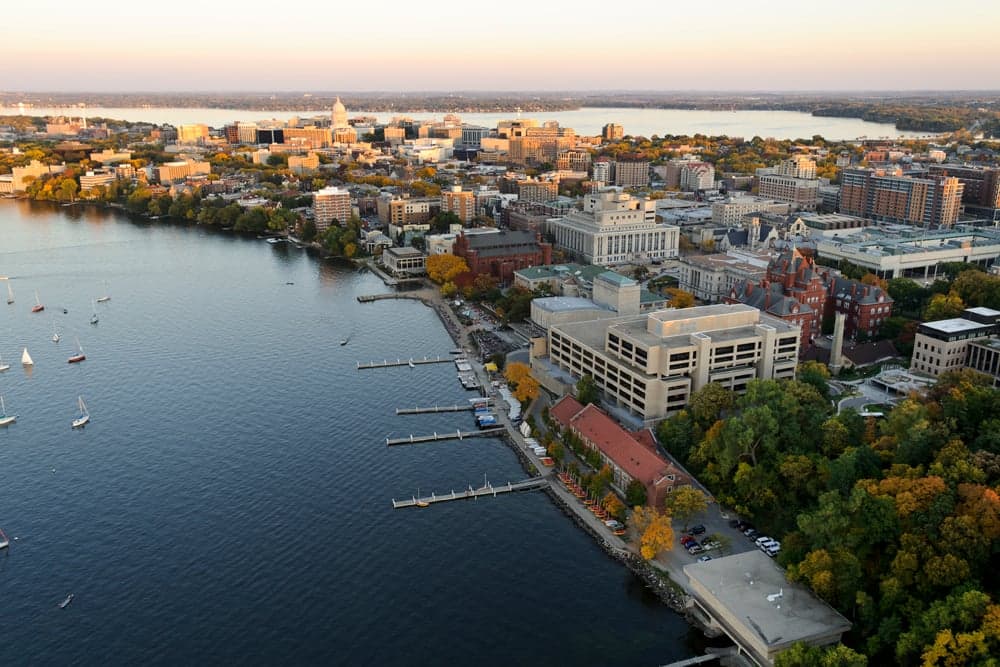
Photo: Wikipedia
Political ClimatePolitical Climate in Madison, WI
District shown is the primary district for this city’s centroid. Cities may span multiple districts.
Local Political AnalysisPolitical Analysis of Madison, WI
Madison, Wisconsin, is about as blue as it gets in the Midwest, with a Cook PVI of D+21, meaning the city votes 21 points more Democratic than the national average. That’s not just a lean—it’s a deep, entrenched political identity that’s been hardening for decades. If you’re looking at the area from a conservative perspective, the trajectory is concerning: what was once a moderate, pragmatic city has shifted steadily toward progressive activism, with local policy increasingly prioritizing ideological goals over individual freedoms and fiscal restraint.
How it compares
Drive 15 minutes outside the Beltline, and you’re in a different world. Suburbs like Middleton and Verona are still purple-ish, with a mix of tech workers and farmers, but they’re getting pulled left as Madison’s influence spreads. Head 30 minutes west to Mount Horeb or Cross Plains, and you’ll find more traditional values—smaller government, lower taxes, less regulation. But the real contrast is with the rest of the state. Dane County, where Madison sits, is a Democratic stronghold, while surrounding counties like Columbia, Dodge, and Sauk voted heavily Republican in 2024. The city’s political machine—anchored by the University of Wisconsin, state government, and a dense network of nonprofits—creates a bubble where progressive orthodoxy is the norm, and dissent is often met with social or professional pressure.
What this means for residents
For a conservative or libertarian-leaning resident, daily life here means navigating a local government that’s increasingly comfortable with overreach. The city council has pushed for stricter rental regulations, higher property taxes to fund social programs, and zoning policies that limit single-family homes—all framed as equity initiatives, but often at the cost of personal property rights and neighborhood character. The school board has embraced curriculum changes that emphasize critical race theory and gender ideology, which has led to friction with parents who want more control over what their kids learn. And the county health department, during the pandemic, imposed some of the strictest lockdowns and mask mandates in the state, with little room for individual choice. The long-term trend is toward more regulation, not less, and the political culture discourages open debate about these trade-offs.
On the cultural side, Madison is proud of its “progressive” identity—think bike lanes, farmers’ markets, and a thriving arts scene. But that comes with a price: a high cost of living driven by property taxes that fund generous public employee pensions and a sprawling city bureaucracy. The state capitol building is a constant hub for protests and rallies, which can feel like a spectacle or a nuisance depending on your view. If you value personal freedom, limited government, and the right to live your life without a city ordinance telling you how to do it, Madison is a tough place to call home. The political climate here isn’t just liberal—it’s actively hostile to conservative ideas, and that’s unlikely to change anytime soon.

State Political ClimatePolitical Climate in Wisconsin
State Political AnalysisPolitical Environment in the State
Wisconsin has long been a classic swing state, but over the past decade it has shifted from a true purple battleground to a state where Republicans hold a narrow but persistent structural advantage in statewide elections, driven by a deep urban-rural split. The state’s political center of gravity has moved rightward since 2010, with the GOP controlling the legislature and key policy levers even as Democrats win occasional statewide races. For a conservative-leaning family or individual, the state offers a mixed bag: strong Second Amendment protections and school choice, but with a Democratic governor who can veto the most ambitious reforms and a growing progressive influence in the Madison-Milwaukee corridor.
Urban vs. rural divide
The political map of Wisconsin is a tale of two worlds. The Democratic stronghold is the urban crescent running from Milwaukee through Madison and down to Kenosha and Racine. Milwaukee County alone delivers roughly 250,000-vote margins for Democrats, while Dane County (Madison) adds another 100,000-plus. These two counties are the engine of the left’s statewide hopes. Meanwhile, the rest of the state—the WOW counties (Waukesha, Ozaukee, Washington) ringing Milwaukee—are among the most reliably Republican suburbs in the nation, often voting 60-65% GOP. The rural northwoods and western Wisconsin, once a mix of populist Democrats and independents, have shifted hard right since 2016, with counties like Marathon (Wausau) and Brown (Green Bay) now solidly red. The key swing region is the Fox Valley (Appleton, Oshkosh, Fond du Lac), where culturally conservative but economically moderate voters have trended Republican in recent cycles. The 2022 gubernatorial race saw Tim Michels lose by 3 points statewide, but he carried 60 of 72 counties—a stark reminder that Democrats win only by piling up massive margins in a few urban islands.
Policy environment
Wisconsin’s policy landscape is a tug-of-war between a Republican legislature and a Democratic governor, Tony Evers. On taxes, the state has a flat income tax of 4.4% (down from 7.75% in 2010), and Republicans have pushed for further cuts, though Evers has vetoed full elimination. Property taxes are moderate, with the average effective rate around 1.6%, but they vary wildly by district. The state’s regulatory posture is generally business-friendly, with right-to-work laws intact and a relatively low corporate tax rate of 7.9%. On education, Wisconsin is a national leader in school choice: the Milwaukee Parental Choice Program (1990) and the statewide voucher program (2013) allow families to use public funds for private or religious schools. However, Evers has blocked expansion of charter schools and tried to freeze funding for the voucher system. Healthcare is a flashpoint: Wisconsin did not expand Medicaid under the Affordable Care Act until 2023, when Evers pushed through a partial expansion, but the state still maintains a robust private insurance market. Election laws are a major concern for conservatives: after the 2020 election controversy, the GOP passed a voter ID law and limited absentee ballot drop boxes, but Evers vetoed a bill requiring stricter signature verification. The state also has no-excuse absentee voting, which remains a point of contention.
Trajectory & freedom
On personal liberty, Wisconsin is a mixed bag trending in the wrong direction. The state is a “shall-issue” concealed carry state with no permit required for open carry, and it preempts local gun ordinances—a win for Second Amendment advocates. However, in 2023, Evers vetoed a bill that would have allowed permitless carry (constitutional carry), leaving the state behind its neighbors like Michigan and Ohio. On parental rights, Wisconsin has a strong school choice framework, but there is no state-level Parents’ Bill of Rights, and Evers vetoed a bill that would have required schools to notify parents of curriculum changes. Medical freedom took a hit during COVID: Evers imposed a statewide mask mandate (struck down by the state Supreme Court in 2021) and used emergency powers to close businesses, though the GOP legislature later curtailed those powers. Property rights are generally strong, with no statewide rent control and limited zoning overreach outside of Madison and Milwaukee. The biggest red flag for conservatives is the state Supreme Court, which flipped to a 4-3 liberal majority in 2023 after the election of Janet Protasiewicz. That court is now expected to strike down the GOP’s 2011 legislative maps, which could flip the state legislature to Democratic control by 2026—a seismic shift that would likely usher in a progressive agenda on taxes, guns, and education.
Civil unrest & political movements
Wisconsin has been a flashpoint for political violence and activism. The 2020 Kenosha riots, sparked by the Jacob Blake shooting, saw businesses burned and two people killed by Kyle Rittenhouse—a case that became a national symbol of self-defense and the breakdown of public order. The Rittenhouse trial in Kenosha drew massive protests from both sides, and the acquittal in 2021 was a rallying cry for Second Amendment supporters. On the left, the state has seen sustained activism from groups like the Wisconsin Alliance for Retired Americans and the progressive group Indivisible, which organized against the GOP’s Act 10 (2011) that gutted public union collective bargaining. Immigration politics are relatively quiet, as Wisconsin is not a border state, but there have been localized sanctuary city debates in Madison and Milwaukee, which have “welcoming city” ordinances that limit cooperation with ICE. Election integrity remains a raw nerve: the 2020 election saw Milwaukee and Madison’s massive absentee ballot operations, and the GOP’s subsequent investigation (the Michael Gableman probe) found irregularities but no widespread fraud. The state’s election commission is evenly split between Republicans and Democrats, leading to gridlock on reforms. A new resident would notice the political tension most in the suburbs: Waukesha County is plastered with “Let’s Go Brandon” flags, while Madison’s campus is a sea of “Defund Police” signs.
Projection
Over the next 5-10 years, Wisconsin is likely to become more politically volatile. The biggest wildcard is the state Supreme Court’s impending redistricting decision. If the court imposes maps that give Democrats a legislative majority, expect a wave of progressive legislation: a state-level assault weapons ban, a repeal of right-to-work, a massive expansion of Medicaid, and a state-run health insurance option. That would make Wisconsin look more like Illinois—a prospect that has conservatives already eyeing exits to Florida or Texas. Demographics are also shifting: the Madison-Milwaukee corridor is growing, while rural counties are shrinking. In-migration is modest, with most newcomers coming from Illinois and Minnesota, bringing their blue-state voting habits. However, the WOW counties remain robustly conservative, and the Fox Valley is trending redder. The 2024 presidential election will be a key test: if Trump wins Wisconsin again, it will confirm the GOP’s structural edge; if Biden holds it, the state may be on a slow leftward drift. For a conservative moving in now, the practical takeaway is to settle in a red county like Waukesha or Washington, where local governance is conservative, and to prepare for a decade of political trench warfare over the state’s direction.
Bottom line: Wisconsin offers a high quality of life for conservatives who choose their location wisely—strong schools via vouchers, low crime in the suburbs, and a robust outdoor culture. But the state is at a crossroads. The next few years will determine whether it remains a purple state with conservative guardrails or becomes a blue state in all but name. If you value your gun rights and want to keep your tax dollars, you’ll want to watch the 2024 Supreme Court decision like a hawk—and maybe keep a moving truck on standby.
* Values derived from national, state, county, city and local statistics and may differ in a specific area. Last updated: 2026-04-21T10:04:44.000Z
Narrative content on this page is AI-generated and may contain mistakes. Verify any details that matter before acting on them.
ReloMaps may earn a commission from affiliate links at no extra cost to you.

