Photo: Wikipedia
Demographics of Magnolia, AR
Affluence Level in Magnolia, AR
A low-income area with significant economic hardship. Household wealth and educational attainment are well below national averages.
People of Magnolia, AR
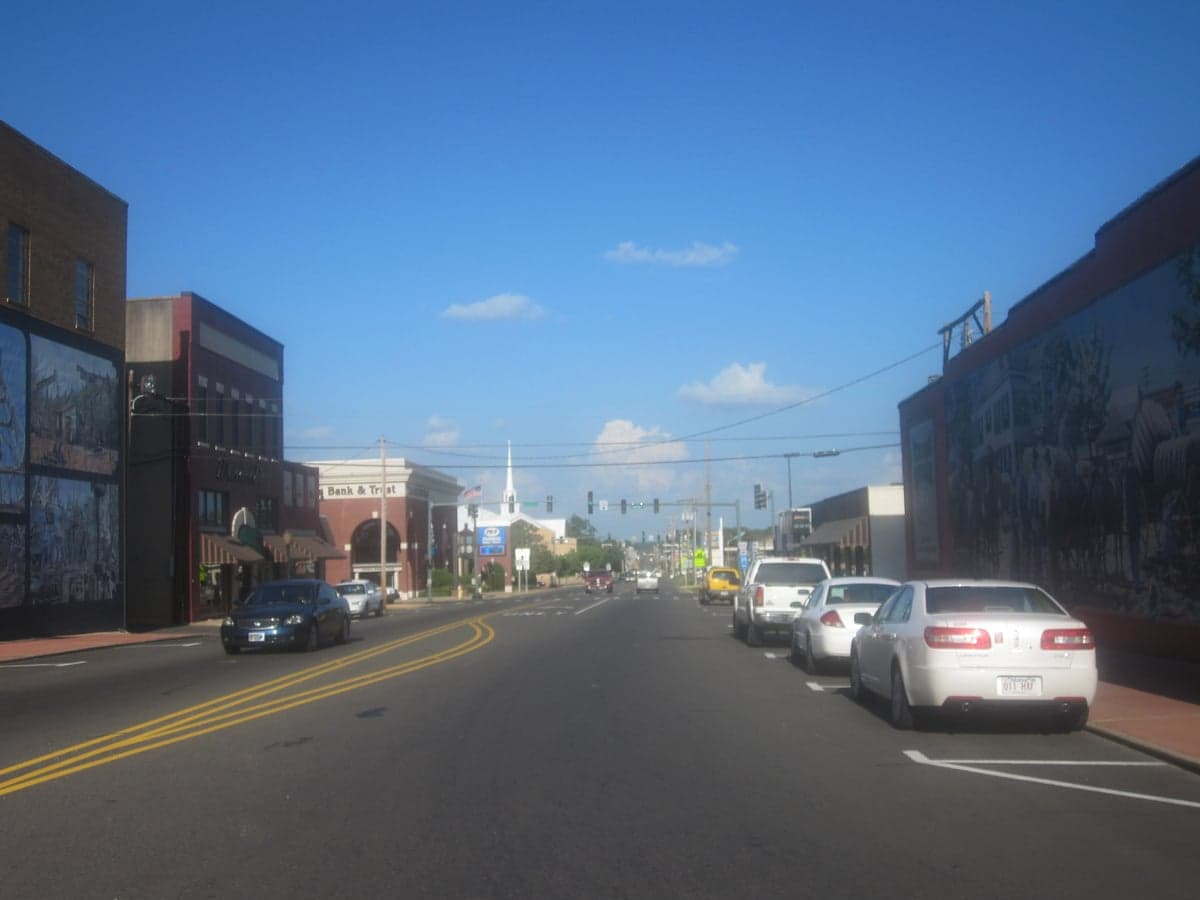
Magnolia, Arkansas, is a small city of 10,973 residents with a distinctive biracial character uncommon in the rural South: a near-even split between White (47.6%) and Black (42.7%) populations, with a small but growing Hispanic community (5.6%) and a very low foreign-born share of just 3.0%. The city’s population density is moderate for a county seat, and its identity is shaped by Southern Arkansas University, a legacy of oil-boom prosperity, and a historically rooted Black middle class that has persisted through decades of economic change. For a conservative-leaning relocator, Magnolia offers a stable, family-oriented environment where two distinct communities have coexisted for generations, though the city is slowly diversifying beyond its traditional Black-White binary.
How the city was settled and grew
Magnolia was founded in 1853 as the seat of Columbia County, drawing its first wave of settlers—primarily White yeoman farmers and merchants from Tennessee and the Carolinas—who established the Downtown Square area as the commercial and civic center. The arrival of the St. Louis, Iron Mountain and Southern Railway in the 1880s spurred a second wave: Black laborers and sharecroppers who moved into the city to work in timber, cotton gins, and railroad maintenance, settling in what became the East Side neighborhood, historically the heart of Magnolia’s African American community. A third, transformative wave came with the 1938 discovery of the Magnolia Oil Field, which drew White oil workers and entrepreneurs from across the Southwest, many of whom built homes in the North Magnolia district near the field’s edge. By 1950, the city’s population had tripled to over 10,000, and the oil boom cemented a White professional class while Black residents remained concentrated in East Side and the South Ward area, where segregated schools and churches anchored community life.
Modern era (post-1965)
The post-1965 period saw two major demographic shifts. First, the Civil Rights movement and desegregation opened housing and employment opportunities for Black residents, leading to a gradual movement of middle-class Black families into previously White neighborhoods like College Heights, near Southern Arkansas University, and the Westwood subdivision, built in the 1970s. Second, the decline of the oil industry after the 1980s triggered White out-migration to larger cities, shifting Magnolia from a majority-White city (roughly 60% White in 1980) to its current near-equal split. The Hispanic population began arriving in the 1990s, primarily as workers in poultry processing and construction, and settled in the Southwest Quadrant, an area of modest single-family homes and rental duplexes near the industrial parks. The Asian and Indian populations remain negligible (0.1% each), reflecting Magnolia’s limited draw for high-skilled immigration and the absence of major tech or medical employers that attract those groups elsewhere in Arkansas.
The future
Magnolia’s population is slowly homogenizing in terms of its Black-White ratio, but tribalizing along new lines of class and geography. The Hispanic share is growing steadily—up from 2.8% in 2010 to 5.6% today—and is expected to reach 8-10% by 2035, driven by family reunification and continued demand for low-skill labor. The Black population is stable but aging, with younger Black adults often leaving for Little Rock or Dallas for better job opportunities, while White in-migration is limited to retirees and SAU-affiliated professionals. The city is not becoming a patchwork of ethnic enclaves; rather, the Southwest Quadrant is emerging as a mixed-income, mixed-ethnicity zone where Hispanic families live alongside low-income White and Black households. The East Side remains predominantly Black and lower-income, while College Heights and Westwood are solidly middle-class and integrated. The foreign-born share will likely remain below 5% for the foreseeable future, as Magnolia lacks the economic pull to attract significant international migration.
For someone moving in now, Magnolia is becoming a more diverse but still deeply rooted community where the old Black-White dynamic is slowly giving way to a tri-ethnic reality. The city offers a stable, low-crime environment with strong churches and schools, but limited economic mobility for those without a college degree. Relocators should expect a place where neighborhoods are defined more by income than by race, and where the Hispanic presence is growing but remains small enough to integrate without friction.

* Values derived from national, state, county, city and local statistics and may differ in a specific area. Last updated: 2026-04-19T12:03:07.000Z
Narrative content on this page is AI-generated and may contain mistakes. Verify any details that matter before acting on them.
ReloMaps may earn a commission from affiliate links at no extra cost to you.

