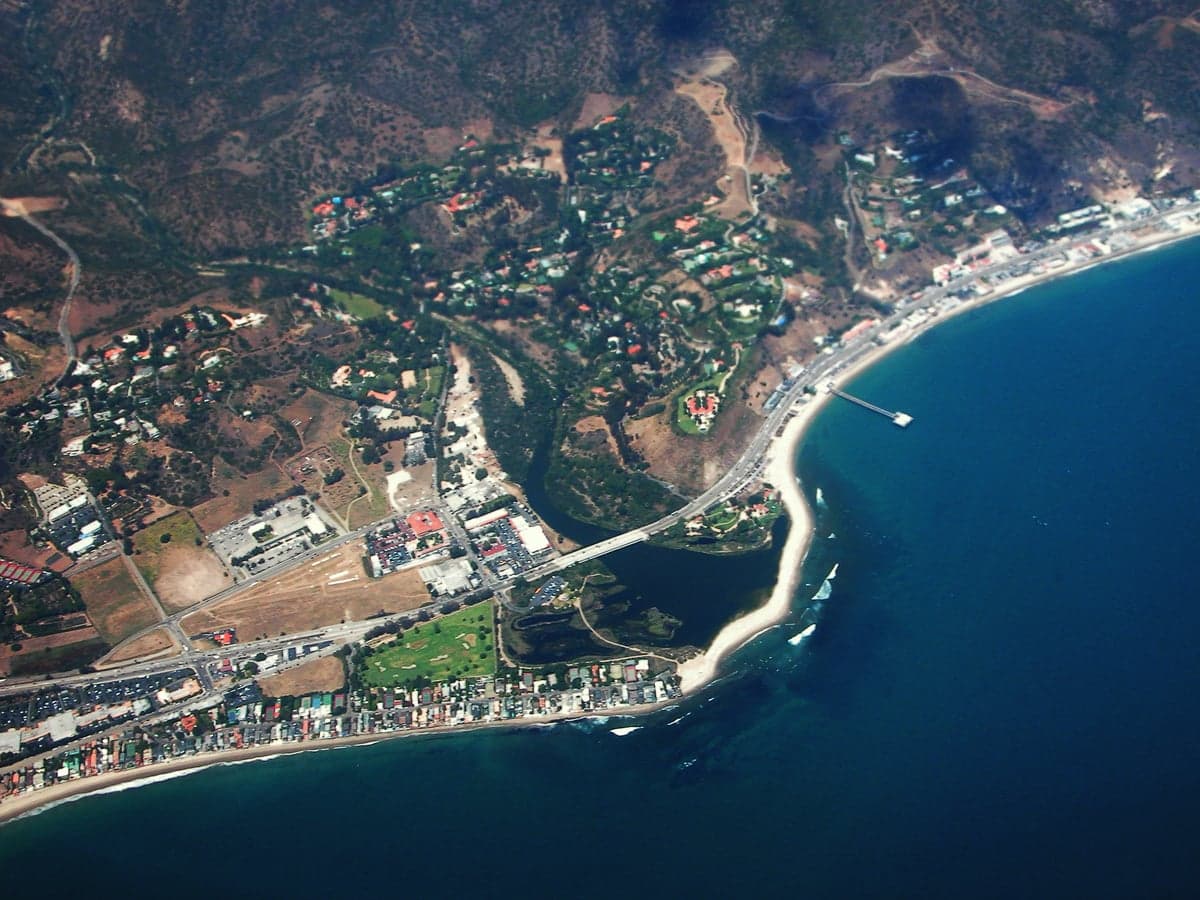
Photo: Wikipedia
Personal Sovereignty in Malibu, CA
Moderate friction. Expect trade-offs in some aspect of personal liberty and independence.
What does Personal Sovereignty tell us?
Personal Sovereignty measures your capacity for self-reliance and independence with minimal government friction. Higher scores mean fewer barriers between you and the way you want to live... but it assumes you have the space you need and good neighbors.
What does this tell us?
Personal Sovereignty measures your capacity for self-reliance and independence with minimal government friction. Higher scores mean fewer barriers between you and the way you want to live... but it assumes you have the space you need and good neighbors.
State Policy
Energy independence: Importer (33% of energy produced in-state)
Personal Liberty
Homesteading

Personal Liberty Analysis
Malibu, California presents a complex personal sovereignty landscape where the natural geography fosters a sense of isolation and self-reliance, yet the legal and regulatory environment imposes some of the state's most stringent constraints on individual autonomy. While the city's rugged coastline and canyon communities offer a physical buffer from urban density, residents operate under California's comprehensive state-level mandates on taxation, firearms, property use, and personal conduct. For a freedom-prioritizing individual or family, Malibu offers a high degree of personal space and privacy but demands careful navigation of a heavy-touch regulatory system that limits choices in housing, self-defense, and land use.
Tax burden and regulatory posture in Malibu
California's tax burden is among the highest in the nation, and Malibu residents feel this acutely. The state's progressive income tax tops out at 13.3% for high earners, and the sales tax rate in Malibu is 9.5% (as of 2026), among the highest in Los Angeles County. Property taxes are capped at roughly 1% of assessed value under Proposition 13, but because Malibu real estate values are exceptionally high—median home prices exceed $3 million—annual tax bills are substantial. The regulatory posture is equally heavy. Malibu's local government enforces some of California's strictest coastal development rules through the California Coastal Commission, which oversees virtually all construction and renovation within the coastal zone. Permitting for even minor home improvements can take months or years, and new building is heavily restricted by environmental review processes. The city also enforces strict short-term rental bans and fire safety regulations that mandate expensive vegetation management and home hardening. For a self-reliant individual, this means that the ability to modify one's property or generate income from it is sharply curtailed by layers of bureaucratic approval.
Self-defense and gun law specifics in Malibu
California's firearm laws are among the most restrictive in the United States, and Malibu residents must comply with all state-level mandates. The state requires a 10-day waiting period and a Firearm Safety Certificate for all purchases, and it maintains a roster of approved handguns that limits available models. Assault weapons and large-capacity magazines (over 10 rounds) are banned, and all firearm transfers must go through a licensed dealer. For concealed carry, California is a "may-issue" state, and Los Angeles County—which includes Malibu—is notoriously difficult for obtaining a permit. Applicants must demonstrate "good cause" beyond general self-defense, and the sheriff's office has broad discretion to deny permits. In practice, concealed carry permits are rare for ordinary residents in Malibu. Open carry of handguns is prohibited, and carrying a loaded firearm in a vehicle is generally illegal without a permit. Self-defense law in California also imposes a "duty to retreat" in public spaces before using deadly force, unless the person is in their home (the "castle doctrine" applies). Stand-your-ground protections do not exist. For a freedom-oriented individual, these restrictions mean that the ability to defend oneself with a firearm is heavily regulated and practically limited to inside the home.
Self-reliance and homesteading viability in Malibu
Malibu's zoning and lot sizes offer some potential for self-reliance, but the regulatory environment imposes significant barriers. Many residential lots in the Santa Monica Mountains are one acre or larger, providing space for gardens, small orchards, and even livestock such as chickens or goats—though city codes limit the number and type of animals. The city allows backyard chickens (hens only, no roosters) and beekeeping with permits, but larger livestock like pigs or cattle are generally prohibited on residential parcels. Off-grid feasibility is extremely limited. California building codes require connection to the electrical grid, and Malibu's water supply is managed by the Los Angeles Department of Water and Power or private wells, which are subject to strict groundwater pumping regulations. Solar panels are permitted and widely used, but battery storage systems must meet fire safety codes. Rainwater catchment is allowed but regulated to protect watersheds. Composting toilets and graywater systems require permits and are often denied in coastal zones. The city's fire hazard severity zone designation means that any off-grid living arrangement must comply with rigorous defensible space and emergency access requirements. For a homesteader, Malibu offers the land but not the legal freedom to live independently of municipal systems.
Personal liberties in Malibu: parental rights, medical autonomy, speech, and property
California law shapes personal liberties in Malibu in several key ways. Parental rights are relatively strong in educational choice—the state allows homeschooling, private school enrollment, and public school transfers—but the state mandates comprehensive vaccination requirements for school attendance (medical exemptions only, no personal belief exemptions). Parents also face strict mandates on child safety, including car seat and helmet laws. Medical autonomy is limited by California's vaccine mandates for healthcare workers and schoolchildren, but the state protects access to reproductive healthcare and gender-affirming care. The right to refuse medical treatment is generally respected for adults, though assisted suicide is legal under the End of Life Option Act. Free speech is protected under the First Amendment, but Malibu's local noise ordinances and public assembly permits can restrict expressive activities in residential areas. Property rights are significantly constrained. The California Coastal Commission has authority over land use within the coastal zone, which covers most of Malibu, and can deny building permits, require public access easements, and impose design restrictions. The city also enforces rent control on some older multifamily units, limiting a landlord's ability to set market rates. For a property owner, the ability to use, modify, or profit from land is heavily mediated by government agencies.
Overall, personal sovereignty in Malibu is a study in contrasts. The physical environment—spacious lots, ocean views, canyon privacy—supports a sense of independence and separation from urban life. But the legal and regulatory framework, driven by California state law and local coastal governance, imposes some of the nation's highest taxes, strictest gun laws, and most intrusive land-use controls. Compared to areas in Texas, Florida, or the Mountain West, Malibu offers far less autonomy in taxation, self-defense, and property rights. For a freedom-prioritizing individual or family, Malibu can work if the primary goal is physical seclusion and the willingness to comply with extensive regulation is high. It is not a location for those seeking low taxes, easy concealed carry, or the ability to live off-grid without government oversight. The trade-off is clear: privacy and natural beauty in exchange for significant constraints on personal and economic freedom.

* Values derived from national, state, county, city and local statistics and may differ in a specific area. Last updated: 2026-06-08T04:57:00.000Z
Narrative content on this page is AI-generated and may contain mistakes. Verify any details that matter before acting on them.
ReloMaps may earn a commission from affiliate links at no extra cost to you.

