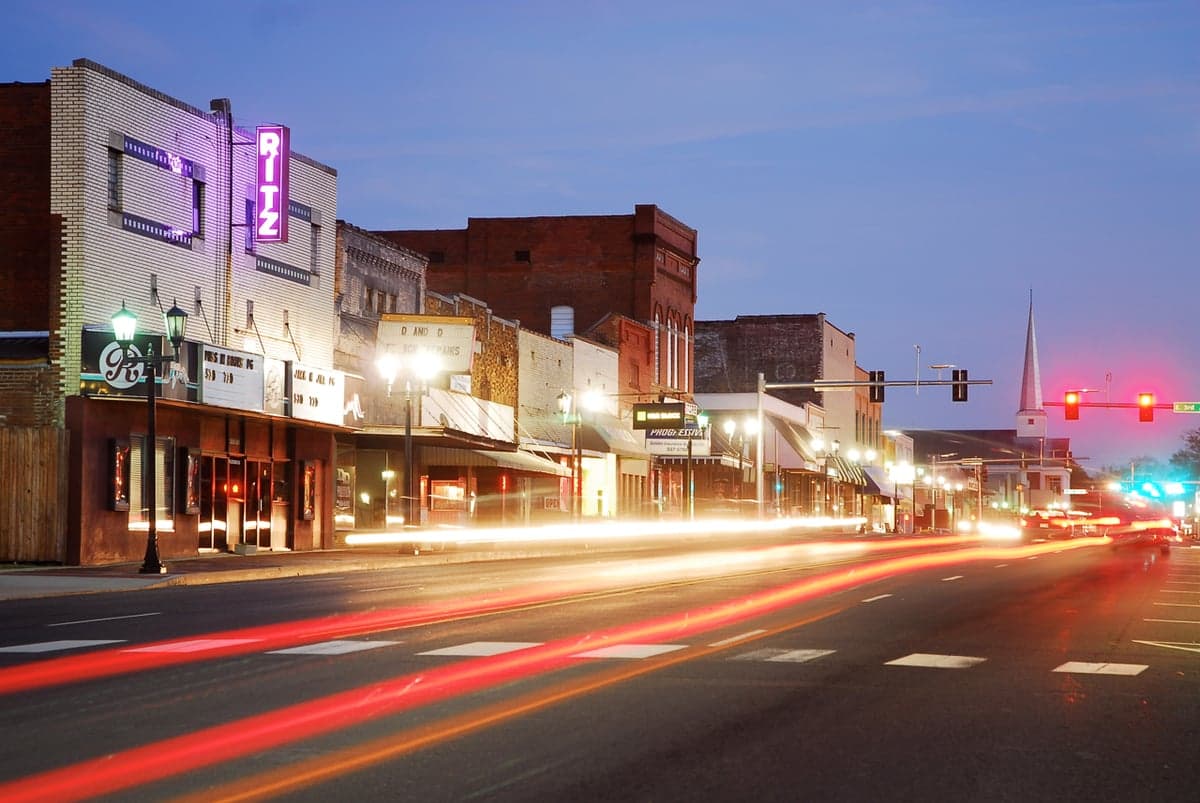
Photo: Wikipedia
Political ClimatePolitical Climate in Malvern, AR
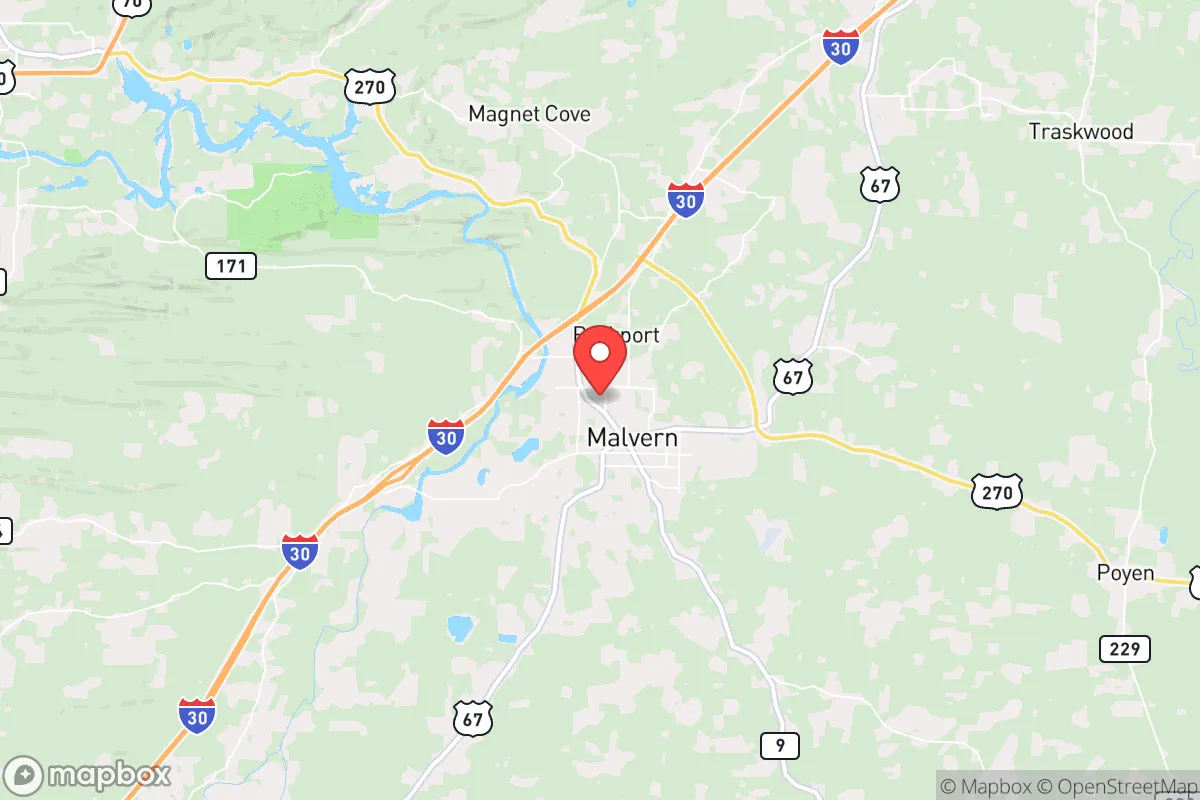
District shown is the primary district for this city’s centroid. Cities may span multiple districts.
Local Political AnalysisPolitical Analysis of Malvern, AR
Malvern, Arkansas, sits deep in conservative territory, and that’s not changing anytime soon. The Cook Partisan Voting Index (PVI) of R+20 tells you everything you need to know: this is a place where traditional values and limited government aren’t just talking points—they’re the default setting. For decades, Malvern has voted reliably Republican, and the trend is actually getting stronger as surrounding Hot Spring County continues to drift rightward. If you’re looking for a place where folks still believe in personal responsibility and don’t want the government meddling in their daily lives, this is it.
How it compares
Malvern’s political lean is noticeably more conservative than the state average, and it’s a world apart from places like Little Rock, just 45 minutes north. While Pulaski County has shifted blue in recent cycles, Malvern has held firm—and even pulled further right. Compared to nearby Hot Springs, which has a more tourist-driven, transient population and a slightly more moderate vibe, Malvern feels like the steady, grounded anchor. Even smaller towns like Benton and Bryant, which are also conservative, have seen some suburban drift toward centrist positions; Malvern hasn’t budged. The contrast is stark: drive 20 minutes east to Sheridan, and you’ll find a similar conservative ethos, but Malvern’s R+20 rating puts it in a league of its own for this region.
What this means for residents
For the people who live here, the political climate translates directly into daily life. You won’t see the kind of government overreach that’s become common in blue areas—no heavy-handed mandates, no overbearing zoning boards telling you what you can do with your property, and no pressure to adopt progressive social experiments. The local school board and city council are filled with folks who understand that their job is to keep the lights on and the roads paved, not to re-engineer society. That said, there’s a quiet concern among long-time residents that outside influences—especially from state-level initiatives or federal funding strings—could start chipping away at that independence. The feeling is: we’ve held the line so far, but we have to stay vigilant.
Cultural and policy distinctions
One thing that sets Malvern apart is its no-nonsense approach to Second Amendment rights. Gun ownership is practically universal here, and there’s zero appetite for any kind of restriction—local officials have made it clear they won’t enforce state or federal overreach on that front. You also see it in the tax structure: property taxes are low, and the county government runs lean. There’s a strong sense that the community takes care of its own, through churches and civic groups, rather than relying on government programs. The biggest worry I hear from neighbors isn’t about crime or the economy—it’s about the slow creep of progressive ideology into schools and local media. People here remember when Malvern was even more insulated, and they’re watching closely to make sure it stays that way. For now, the political climate is stable, conservative, and fiercely independent—exactly how most folks want it.

State Political ClimatePolitical Climate in Arkansas
State Political AnalysisPolitical Environment in the State
Arkansas has been a reliably red state for decades, but the political climate here is more nuanced than a simple party label suggests. The state leans solidly Republican at the federal level, with Donald Trump winning by over 27 points in 2024, and the GOP holds supermajorities in both chambers of the state legislature. However, the 10-20 year arc shows a state that was once a Democratic stronghold in local races—think Bill Clinton era—that has shifted hard right, driven by a combination of rural realignment, cultural conservatism, and a growing distrust of federal overreach. The dominant coalition is a mix of evangelical voters, rural landowners, and suburban families who prioritize low taxes, gun rights, and parental control over education.
Urban vs. rural divide
The political map of Arkansas is a classic tale of two worlds. The northwest corner, anchored by Fayetteville and Bentonville, is the state’s economic engine and a Republican stronghold, but it’s also where you’ll find the most visible pockets of progressive activism, especially around the University of Arkansas. Little Rock, the capital, is the blue dot in a red state—Pulaski County voted for Joe Biden in 2020 and Kamala Harris in 2024, driven by the city’s African American population and younger professionals. Meanwhile, the Delta counties along the Mississippi River, like Lee County and Phillips County, remain Democratic due to historic black voting blocs, but their populations are shrinking. The real story is the rural-to-suburban shift: counties like Saline County (south of Little Rock) and Faulkner County (home to Conway) have flipped from purple to deep red over the past decade as conservative families flee the capital’s crime and taxes. The divide isn’t just about party—it’s about worldview. In Fort Smith and Jonesboro, you’ll find a no-nonsense, pro-business, pro-gun culture that dominates state politics.
Policy environment
Arkansas’s policy environment is aggressively conservative, with a focus on limiting government intrusion. The state has a flat income tax of 4.4% (down from 7% in 2015), and the legislature is pushing toward elimination. Property taxes are low, and there’s no state-level estate tax. The regulatory posture is business-friendly, with right-to-work laws and minimal zoning restrictions outside of Little Rock. On education, the LEARNS Act of 2023 was a landmark—it created universal school choice, expanded charter schools, and banned “critical race theory” and “indoctrination” in classrooms. This was a direct response to parents feeling their kids were being used as guinea pigs for progressive social experiments. Healthcare is a mixed bag: the state expanded Medicaid under the private option, but it’s been paired with work requirements and a push to lower costs through market competition. Election laws are tight—voter ID is required, absentee ballot drop boxes are banned, and early voting is limited to 15 days. The state also passed a near-total abortion ban in 2023, with exceptions only for rape, incest, or the life of the mother. For a conservative, this is a state that respects local control and personal responsibility, but you still have to watch for federal overreach, especially on environmental regulations affecting the timber and poultry industries.
Trajectory & freedom
Arkansas is becoming more free in many ways, but the trajectory isn’t without bumps. The state has expanded gun rights significantly: permitless carry (constitutional carry) was signed into law in 2021, and in 2023, the legislature passed a law prohibiting local governments from enforcing federal gun restrictions. Parental rights were strengthened with the LEARNS Act, which also included a provision allowing parents to sue schools for violating their rights. Medical autonomy took a hit with the abortion ban, but the state has also protected medical freedom by banning vaccine mandates for state employees and students. On property rights, the state passed a law in 2023 limiting the use of eminent domain for private economic development. However, there are red flags: the state’s medical marijuana program, approved by voters in 2016, has been hamstrung by a slow rollout and restrictive licensing, which feels like government picking winners and losers. Also, the state’s tax burden, while falling, is still higher than neighboring Texas or Tennessee. The biggest concern is the creeping influence of federal dollars—Arkansas took billions in COVID relief, and some worry that strings attached to infrastructure money will erode local control. Overall, the trend is toward more personal liberty, but you have to stay vigilant.
Civil unrest & political movements
Arkansas has seen its share of political flashpoints, but they’re more about cultural battles than violent unrest. The most visible movement is the parental rights wave, which exploded during the COVID school closures. Groups like “Parents for Education” in Benton County organized to push back against mask mandates and critical race theory, leading to the LEARNS Act. On the left, the “Arkansas Justice Collective” has organized protests in Little Rock over police reform and racial equity, but these have been small and localized. Immigration politics are relatively quiet—the state has a small foreign-born population, and local law enforcement cooperates with ICE. There’s no sanctuary city movement. Election integrity became a hot topic after 2020, with the state passing strict voter ID laws and banning private funding of election offices. You’ll hear occasional talk of secession or nullification from fringe groups, but it’s not mainstream. The most visible flashpoint for a new resident would be the annual “Arkansas Freedom Rally” at the state capitol, where gun rights advocates and anti-vaccine activists gather. It’s a reminder that this is a state where people take their liberties seriously and aren’t afraid to show it.
Projection
Over the next 5-10 years, Arkansas is likely to become even more conservative, but with a twist. The northwest corridor—Bentonville, Rogers, and Springdale—is growing fast, attracting transplants from California and Illinois who are fleeing high taxes and crime. These newcomers are generally conservative, but they bring a more libertarian, tech-friendly vibe that could clash with the state’s traditional evangelical base. Expect more fights over school choice, with the LEARNS Act being expanded to include education savings accounts. The tax burden will continue to drop, possibly reaching zero income tax by 2030. The biggest wildcard is the Delta region, which is losing population and political clout. As rural Democratic strongholds shrink, the state will become even redder. However, the influx of out-of-state money could also bring pressure for more “business-friendly” policies that might include some social liberalization, like expanding medical marijuana or protecting LGBTQ rights in employment. For a conservative moving in now, expect a state that will remain a bastion of traditional values, but you’ll need to keep an eye on the cultural shifts in the northwest. The bottom line: Arkansas is a safe bet for someone who wants low taxes, strong gun rights, and schools that answer to parents, but you’ll have to accept that the state is still poor and rural, and that federal overreach is a constant threat.
For a new resident, the practical takeaway is straightforward: Arkansas offers a high degree of personal freedom and a government that generally stays out of your life, especially if you’re a gun owner, a parent, or a small business owner. The cost of living is low, the people are friendly, and the politics are predictable. But don’t expect a libertarian paradise—the state still has a heavy hand in some areas, like drug laws and medical marijuana, and the influence of the religious right can feel stifling if you’re not part of that culture. If you’re looking for a place where your vote counts and your values are respected, Arkansas is a solid choice. Just be prepared to drive a lot and to defend your freedoms at the ballot box every two years.
* Values derived from national, state, county, city and local statistics and may differ in a specific area. Last updated: 2026-04-30T03:13:21.000Z
Narrative content on this page is AI-generated and may contain mistakes. Verify any details that matter before acting on them.
ReloMaps may earn a commission from affiliate links at no extra cost to you.

