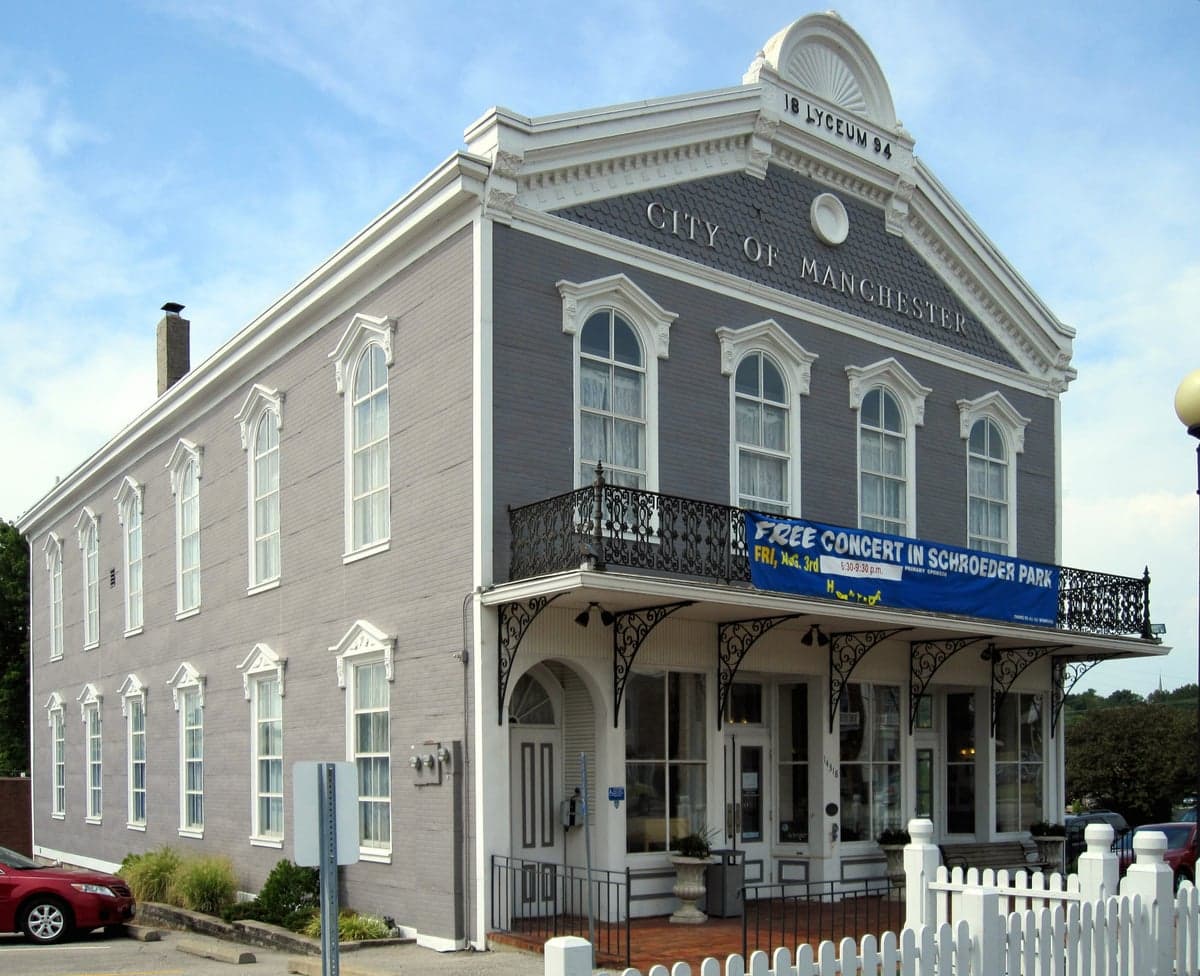
Photo: Wikipedia
Demographics of Manchester, MO
Affluence Level in Manchester, MO
An upper-middle-class area. Household wealth, education levels, and homeownership run ahead of national benchmarks.
People of Manchester, MO
The people of Manchester, Missouri, today form a highly educated, predominantly white-collar suburb of 18,189 residents, with a distinctive blend of established Midwestern families and a growing Indian-subcontinent professional class. The city’s character is defined by its 62.1% college-educated population, low foreign-born share of 3.8%, and a racial makeup that is 73.1% white, 6.9% Indian (subcontinent), 4.7% East/Southeast Asian, 4.7% Hispanic, and 3.1% Black. Manchester feels like a stable, family-oriented enclave where long-time residents in older subdivisions coexist with newer arrivals drawn to top-rated schools and corporate jobs along the I-64 corridor.
How the city was settled and grew
Manchester’s human history begins not with a grand founding but as a quiet farming crossroads in the mid-19th century. The area was originally settled by German and Irish immigrants who took up land grants along the Meramec River valley, drawn by fertile soil and proximity to St. Louis. The village of Manchester was officially platted in 1859 along the Missouri Pacific Railroad line, serving as a shipping point for grain and livestock. These early waves built the first homes in what is now the Old Manchester Historic District, a small cluster of 19th-century frame houses and a general store near the intersection of Manchester Road and Sulphur Spring Road. Through the early 1900s, the population remained tiny—fewer than 500 people—as the area stayed rural, with families farming corn and raising cattle. The first major growth spurt came after World War II, when returning veterans and St. Louis workers sought affordable land for single-family homes. Developers carved out subdivisions like Greenbriar Estates (built in the 1950s) and Westglen Village (1960s), attracting white, middle-class families from the city. These neighborhoods remain predominantly white and older today, with many original owners still in residence.
Modern era (post-1965)
The post-1965 immigration reforms had a modest direct impact on Manchester, as the city remained overwhelmingly white through the 1990s. The real demographic shift began after 2000, driven by domestic in-migration from other U.S. regions and the expansion of corporate campuses along the I-64 corridor. The arrival of major employers like Boeing (in nearby Hazelwood) and Express Scripts (now part of Cigna) drew highly educated professionals, particularly in engineering and IT. The most notable change has been the growth of the Indian-subcontinent population, which now stands at 6.9%—a share that has tripled since 2010. These families concentrated in newer, higher-density developments such as Villages of Manchester (built in the 2000s) and the Hawthorn Place townhome community, drawn by the Rockwood School District’s reputation and proximity to tech jobs. East/Southeast Asian residents (4.7%) followed a similar pattern, settling in the same subdivisions and in the Orchard Lakes area near the highway. The Hispanic and Black populations remain small (4.7% and 3.1% respectively), with no single neighborhood concentration; they are dispersed across the city’s newer apartment complexes and older single-family homes. The white population, while still the majority, has aged in place in the older subdivisions, creating a subtle generational and ethnic divide between the established neighborhoods and the newer, more diverse developments.
The future
Manchester’s population is heading toward continued diversification, but at a measured pace. The Indian-subcontinent community is the fastest-growing segment, driven by chain migration and professional recruitment, and is likely to reach 10-12% of the population within a decade. East/Southeast Asian growth will likely plateau as the tech sector stabilizes. The white population will continue to shrink slowly as older homeowners sell to younger, more diverse buyers. The city is not tribalizing into distinct ethnic enclaves—most neighborhoods remain mixed—but a subtle sorting is visible: older white residents in the 1950s-60s subdivisions, Indian and Asian families in the post-2000 townhome communities, and younger renters in apartment complexes near the highway. The foreign-born share (3.8%) is low but rising, and the city’s schools are already reflecting these shifts. For a conservative-leaning audience, the key takeaway is that Manchester remains a stable, safe, and family-oriented suburb where property values are supported by strong schools and low crime, but where the cultural and ethnic landscape is gradually becoming more diverse—a trend that mirrors the broader St. Louis region.
For someone moving in now, Manchester is a place where the past and future coexist quietly: the old German-Irish farming roots are still visible in the historic district, but the city’s trajectory is increasingly shaped by educated professionals from India and East Asia. It is not a city of rapid change or ethnic tension, but of steady, orderly diversification within a framework of suburban stability. The bottom line: Manchester offers a high-quality, low-drama environment for families and singles who value good schools and safe streets, with a demographic profile that will continue to shift toward higher education and higher income, but not toward radical cultural upheaval.

* Values derived from national, state, county, city and local statistics and may differ in a specific area. Last updated: 2026-10-10T16:28:12.000Z
Narrative content on this page is AI-generated and may contain mistakes. Verify any details that matter before acting on them.
ReloMaps may earn a commission from affiliate links at no extra cost to you.

