
Photo: Wikipedia
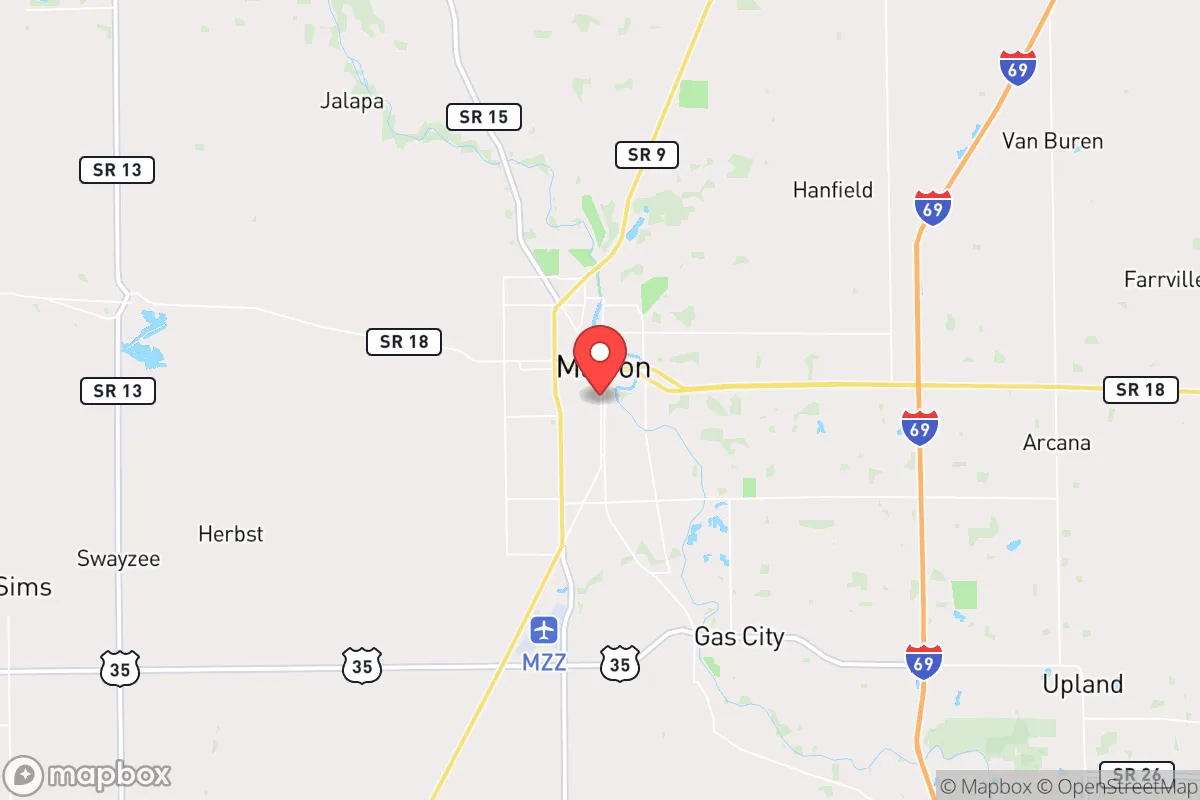
Strategic Assessment of Marion, IN
Meaningful friction. Expect exposure to either population pressure, blast zones, or natural disaster risk. Consider buying a retreat property.
What does the Strategic Assessment tell us?
Our Strategic Assessment grades tactical survivability of an area. Major population centers, military targets, fallout zones, natural disasters, and border exposure all drive risk — lower exposure means a more defensible position in a crisis.
This is heavily inspired by Joel Skousen's Strategic Relocation book. Highly recommended you checkout the book ($)What does this tell us?
Our Strategic Assessment grades tactical survivability of an area. Major population centers, military targets, fallout zones, natural disasters, and border exposure all drive risk — lower exposure means a more defensible position in a crisis.
This is heavily inspired by Joel Skousen's Strategic Relocation book. Highly recommended you checkout the book ($)Strategic Pillars

Key Distances
Regional Safe Places
Below is our recommended "safe zones" in Indiana and the surrounding area based on our strategic heuristics. For most people, it's unrealistic to live in a “safe zone” full-time due to work, family or other personal reasons. They tend to be more rural. However, many of these areas are perfect for second homes and retreat properties that double as a vacation home or even a short-term rental.

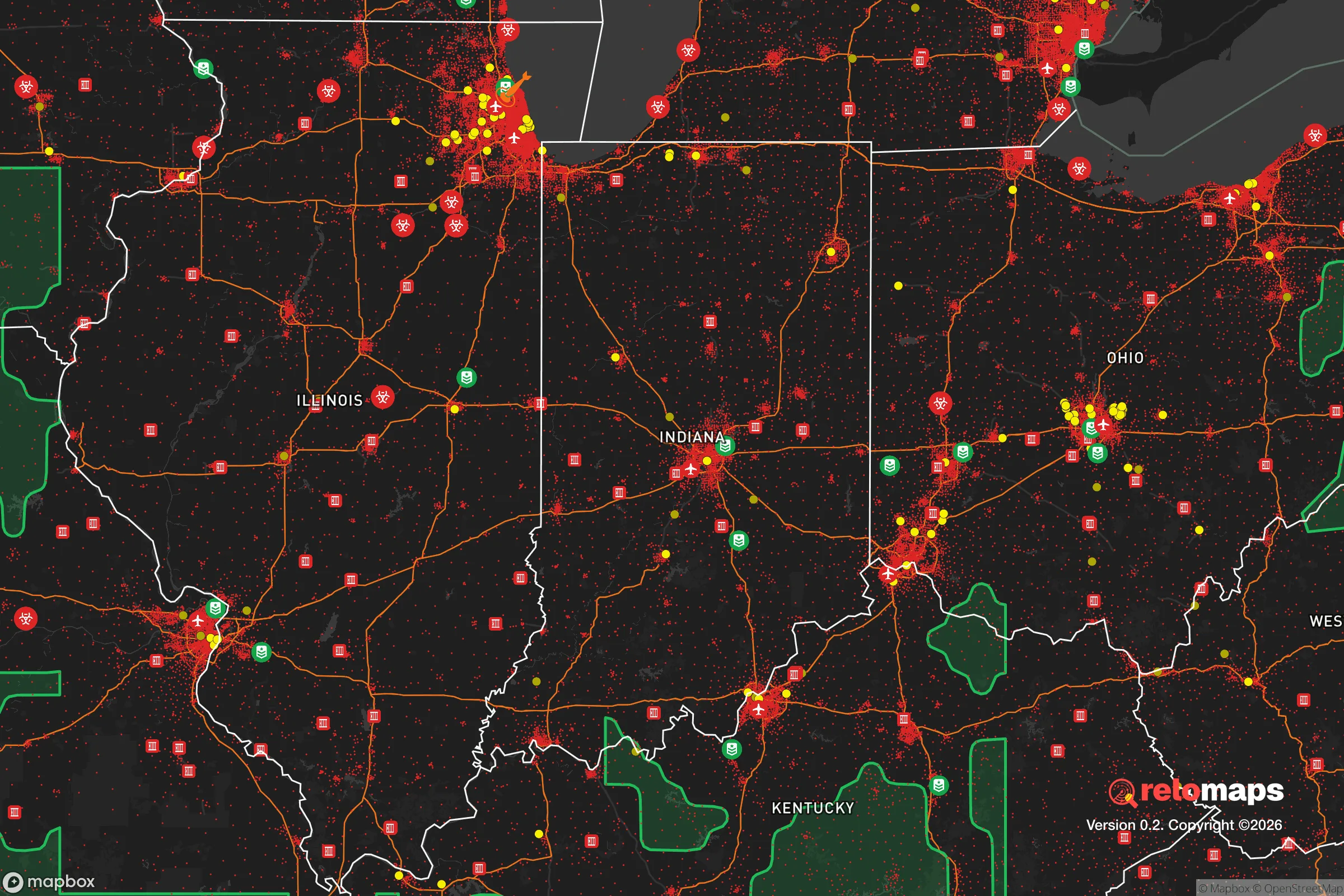


Important Note: For informational purposes only. This does not mean nothing bad ever happens in the green zones. Please use common sense. This is based on public data and modeled with AI. We tried to take a conservative approach but mistakes happen. We update this regularly as new information becomes available.
Solar Generator Recommendations
Backup power matters more here than in safer locations. We've picked three solar generators across budgets and capacity tiers — start with the budget unit if you only need a few essentials, or step up if you want to run a fridge and HVAC for days at a time.

Jackery Portable Power Station Explorer 300
Budget OptionPower on the Go: Weighing only 11 lbs, it's convenient to set up and store with book-sized foldable solar panels

BLUETTI Portable Power Station AC180
Designed for both indoor and outdoor scenarios, AC180 is highly capable as it has a robost capacity and continuous output power.

EF ECOFLOW DELTA Pro Ultra Power Station
Upgraded PickEcoFlow DELTA Pro Ultra is a whole-home energy system designed to grow with your family. Integrated with the Smart Home Panel 2, it scales to meet your evolving energy needs — keeping your home powered, intelligent, and secure through every stage of life.
We earn a commission, at no additional cost to you.
Strategic Assessment Analysis
Marion, Indiana, offers a surprisingly solid strategic position for those prioritizing resilience and self-sufficiency in an increasingly uncertain national landscape. While not a remote mountain redoubt, this Grant County seat sits far enough from major metropolitan blast zones and population centers to avoid the worst of immediate fallout, yet close enough to access critical supply chains and medical infrastructure if they remain functional. For a conservative-leaning relocator—whether a single individual or a family—Marion represents a middle-ground option: a working-class city with a declining but stable population, surrounded by productive farmland, and positioned to weather a range of disruptions from economic collapse to civil unrest.
Geographic position and natural advantages for long-term stability
Marion’s location in north-central Indiana places it roughly 70 miles northeast of Indianapolis, 60 miles south of Fort Wayne, and 100 miles west of the Ohio border. This puts it outside the immediate blast radius of any major city—a critical factor for those concerned with nuclear or EMP scenarios. The surrounding terrain is flat to gently rolling, dominated by agricultural land, which offers both food production potential and clear lines of sight for security. The Mississinewa River runs through the city, providing a surface water source, though it is not a major river and could be vulnerable to contamination or drought. The area’s natural advantages are modest but real: fertile soil, a temperate climate with four distinct seasons, and no significant seismic or hurricane risk. The biggest natural hazard is severe thunderstorms and occasional tornadoes, which are manageable with a properly reinforced shelter. For a prepper, the land here is workable—you can grow food, raise livestock, and dig a well without fighting mountains or desert.
Risks, exposures, and proximity to fallout-relevant landmarks
The primary strategic downside of Marion is its proximity to several high-value targets that could draw secondary effects during a major conflict. Grissom Air Reserve Base, located just 15 miles northwest near Peru, Indiana, is a former SAC base that still hosts aerial refueling and reserve operations. In a wartime scenario, this base could be a target for conventional or nuclear strikes, and fallout patterns from a strike there could easily reach Marion depending on wind direction. Additionally, Indianapolis—home to a FedEx hub, major logistics infrastructure, and a population of nearly 900,000—is within 70 miles. A nuclear detonation or large-scale civil unrest in Indy could send refugees and supply chain disruptions northward. The Marion VA Medical Center is a notable local asset for veterans, but in a crisis, it could become a focal point for those seeking care, potentially straining local resources. The city itself has a population of about 28,000, which is small enough to avoid the worst of urban chaos but large enough that local food and fuel supplies could deplete quickly if regional distribution fails. The nearby Mississinewa Reservoir (about 10 miles east) offers a secondary water source and some recreational land, but it is not a defensible position. Overall, the risk profile is moderate: not a target in itself, but within the shadow of real threats.
Practical resilience for a relocator: food, water, energy, and defensibility
For a relocator serious about self-sufficiency, Marion’s practical resilience hinges on a few key factors. Food production is the strongest card: Grant County is surrounded by corn and soybean fields, and local farmers’ markets and small-scale producers are common. A family with a few acres could reasonably establish a garden and small livestock operation. The soil is rich, and the growing season runs roughly April to October. Water access is more of a concern. The city’s municipal water comes from the Mississinewa River and groundwater wells, but in a prolonged grid-down scenario, a private well with a hand pump or solar-powered pump is essential. Many rural properties outside city limits already have wells, which is a strong argument for buying land just outside Marion rather than inside the city. Energy independence is achievable but not automatic. The area gets adequate sun for solar panels (about 180 sunny days per year), and wood-burning stoves are practical given the surrounding woodlots. Natural gas is available in town, but rural properties often rely on propane or heating oil. For defensibility, Marion itself is a typical Midwestern small city with a grid street layout—not easily fortified. However, the surrounding countryside offers numerous farmhouses, isolated properties, and small towns like Jonesboro or Gas City that provide better security through distance and low population density. Community resilience is a mixed bag: Grant County leans conservative, with a strong church presence and a culture of mutual aid among rural residents, but the city has pockets of poverty and drug-related crime that could become unstable during a breakdown. A relocator would do well to connect with local gun clubs, farming cooperatives, or prepper networks before moving.
The overall strategic picture for Marion, Indiana, is one of cautious viability. It is not a fortress, nor is it a wasteland. For a single individual or family willing to invest in a well, solar panels, and a defensible rural property within 20 minutes of town, it offers a realistic balance of access to resources and distance from the most dangerous targets. The proximity to Grissom Air Reserve Base and Indianapolis are genuine concerns that cannot be ignored, but they are manageable with proper planning—such as having a bug-out route east toward the less populated Ohio border or west toward the open farmland of Illinois. The local economy is stable but not booming, which means property prices remain affordable (median home values around $80,000–$100,000), and the cost of living is low. For the conservative prepper who wants to be prepared for civic unrest, supply chain collapse, or a major disaster, Marion provides a workable foundation—not a dream, but a solid, unglamorous place to build a resilient life. The key is to treat it as a base of operations, not a final redoubt, and to always have a plan for the next ring of safety further out.

* Values derived from national, state, county, city and local statistics and may differ in a specific area. Last updated: 2026-04-22T10:36:51.000Z
Narrative content on this page is AI-generated and may contain mistakes. Verify any details that matter before acting on them.
ReloMaps may earn a commission from affiliate links at no extra cost to you.

