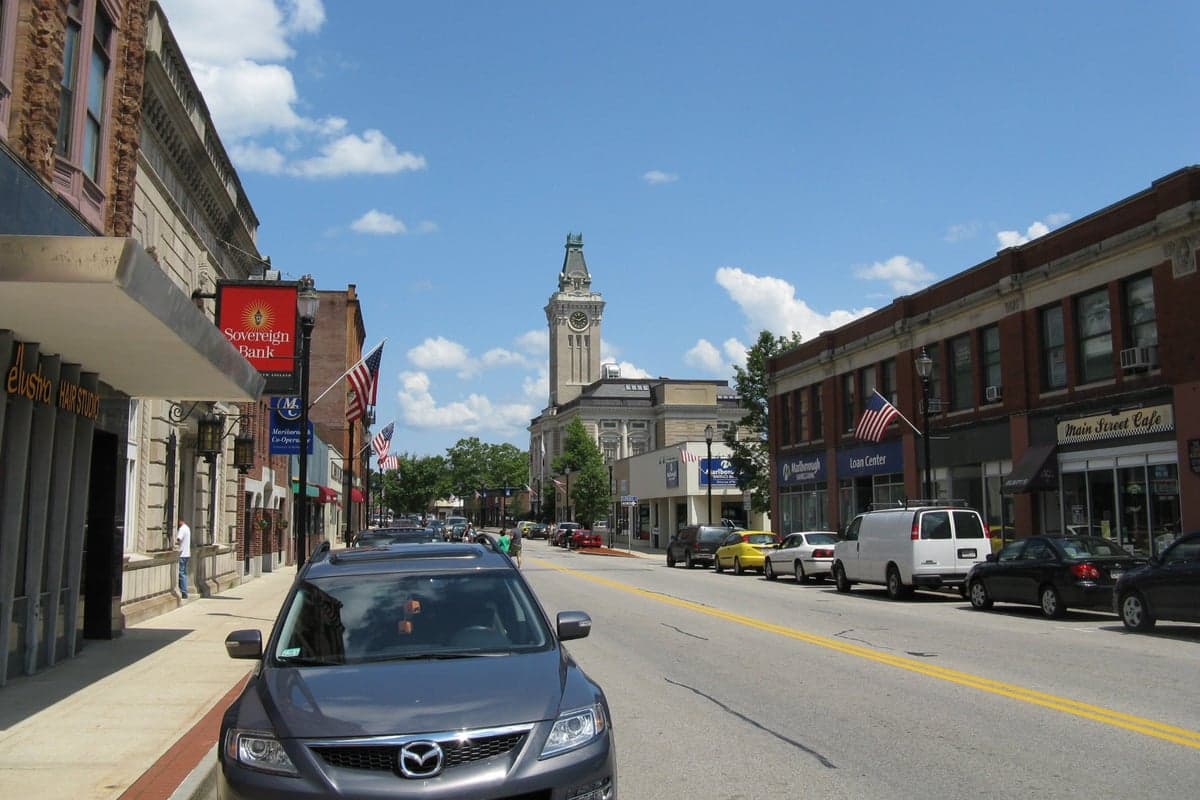
Photo: Wikipedia
Personal Sovereignty in Marlborough, MA
Viable for self-reliance. Generally workable, though some barriers may limit total independence.
What does Personal Sovereignty tell us?
Personal Sovereignty measures your capacity for self-reliance and independence with minimal government friction. Higher scores mean fewer barriers between you and the way you want to live... but it assumes you have the space you need and good neighbors.
What does this tell us?
Personal Sovereignty measures your capacity for self-reliance and independence with minimal government friction. Higher scores mean fewer barriers between you and the way you want to live... but it assumes you have the space you need and good neighbors.
State Policy
Energy independence: Importer (5% of energy produced in-state)
Personal Liberty
Homesteading

Personal Liberty Analysis
Marlborough, Massachusetts presents a complex sovereignty picture for the liberty-minded individual. While the city itself offers a moderate, business-friendly environment relative to the Boston metro, it operates under the heavy thumb of Massachusetts state law, which consistently ranks among the most restrictive in the nation for gun rights, tax policy, and personal medical autonomy. For a prepper or survivalist, Marlborough is a tactical compromise: you get the infrastructure and relative anonymity of a mid-sized city, but you must navigate a state government that views personal preparedness as a secondary concern to collective mandates. The bottom line is that your day-to-day autonomy here is significantly constrained by Beacon Hill, not by Marlborough’s local ordinances.
Tax burden and regulatory posture for the self-reliant
Massachusetts imposes a flat state income tax of 5.0% on all earned income, with a separate 4.0% tax on short-term capital gains and a 12% tax on long-term capital gains over a certain threshold. This is a direct hit on anyone trying to build wealth through investments or side hustles—a core survivalist strategy. Property taxes in Marlborough are around $14.50 per $1,000 of assessed value, which is moderate for the state but high nationally. The state’s sales tax is 6.25%, and there is no local option to reduce it. More critically for the self-reliant, Massachusetts has a strict building code and zoning regime. Marlborough’s zoning bylaws generally prohibit "tiny houses" on wheels as permanent dwellings and require minimum lot sizes of 10,000 to 20,000 square feet in most residential districts, which limits the ability to set up a self-sufficient homestead on a small parcel. The state’s regulatory posture is aggressively pro-environmental, meaning any attempt to dig a well, install a septic system, or build a root cellar will trigger multiple layers of permitting from the Conservation Commission and the Board of Health. For the prepper, this means you cannot simply buy a cheap lot and go off-grid; you must pay for lawyers and engineers to navigate the bureaucracy.
Self-defense and gun law specifics in Marlborough
This is the most significant sovereignty issue in Massachusetts. The state requires a License to Carry (LTC) for any firearm, including handguns, and the issuing authority—the Marlborough Police Department—has discretion. Massachusetts does not recognize any out-of-state concealed carry permits, and the state’s "may-issue" framework means the police chief can deny a license for "suitability" reasons, a standard that has been used to deny licenses to individuals with no criminal record but who have expressed political views deemed "unstable." The state also bans "assault weapons" by name, including the AR-15 platform, and restricts magazine capacity to 10 rounds. For a survivalist, this is a catastrophic limitation. You cannot legally own a standard defensive rifle, and your handgun magazine holds less than half the rounds of a standard Glock. Furthermore, Massachusetts has a "red flag" law that allows family members or police to petition a court to seize firearms without a criminal conviction. Marlborough itself is not a "sanctuary city" for the Second Amendment; the local police generally enforce state law without resistance. If you value the right to keep and bear arms as a fundamental check on government overreach, Marlborough—and Massachusetts as a whole—is a hostile environment. The only saving grace is that the state does allow for "shall-issue" licensing for non-residents who own property in the state, but the process is expensive and slow.
Self-reliance and homesteading viability in Marlborough
Marlborough’s zoning and land use policies make traditional homesteading difficult but not impossible. The city’s residential zones typically require a minimum lot size of 10,000 square feet (about a quarter-acre) for single-family homes, with larger lots in the more rural western parts of the city. Chickens are allowed in most residential zones, but roosters are prohibited, and you must keep the coop at least 25 feet from any neighbor’s dwelling. Beekeeping is permitted with registration, but you cannot keep goats, pigs, or cows on lots under 40,000 square feet. Off-grid living is essentially illegal: the state building code requires connection to the municipal water and sewer system if available, and Marlborough has a robust public utility network. Solar panels are allowed, but net metering is controlled by the state’s utility monopoly, Eversource, which has been known to impose interconnection fees that make small-scale systems uneconomical. Rainwater collection is technically legal but limited to 250 gallons per property under state water rights laws, and you cannot use it for drinking without a permit from the Department of Environmental Protection. For a prepper looking to become truly self-sufficient, Marlborough’s regulatory environment is a constant friction point. You can garden, you can can food, and you can store supplies, but you cannot build a fully independent life without running afoul of some code or permit requirement.
Personal liberties: parental rights, medical autonomy, speech, and property
Massachusetts is a state where government authority routinely overrides individual choice in the name of public health and safety. Parental rights are significantly curtailed: the state has a "mature minor" doctrine that allows children 16 and older to consent to medical treatment without parental knowledge, and the Department of Children and Families has broad authority to investigate families for "educational neglect" if a child is homeschooled without a state-approved curriculum. Medical autonomy is even more constrained. Massachusetts has a universal health insurance mandate, and the state government has shown a willingness to enforce vaccine mandates for school attendance and healthcare workers. During the COVID-19 pandemic, the state imposed some of the longest-lasting emergency orders in the country, including a mask mandate for children in schools that lasted into 2023. Freedom of speech is protected by the First Amendment, but Massachusetts has a "hate speech" law that criminalizes certain types of speech directed at protected classes, which has been used to prosecute individuals for online comments. Property rights are also weak: the state has a strong eminent domain power, and Marlborough has used it in the past to facilitate commercial development, including the expansion of the Apex Entertainment Center. For the liberty-minded individual, this means you have limited recourse if the government decides your property is needed for a "public purpose." The overall message is clear: in Massachusetts, the state’s interest almost always trumps the individual’s.
In the final analysis, Marlborough offers a moderate local government that is friendly to business and development, but it is a small island in a sea of state-level authoritarianism. Compared to a place like New Hampshire, where you can own a machine gun, homeschool without oversight, and pay no income tax, Marlborough is a poor choice for the serious survivalist. If you are willing to fight the bureaucracy and have the resources to hire lawyers, you can carve out a life here, but you will always be one state law away from losing your autonomy. For the conservative prepper who values personal sovereignty above all else, Marlborough is a tactical location only if you have a clear exit plan to a more liberty-friendly state. It is not a place to dig in and make a stand; it is a place to work, save, and prepare to leave.

* Values derived from national, state, county, city and local statistics and may differ in a specific area. Last updated: 2026-04-24T04:55:14.000Z
Narrative content on this page is AI-generated and may contain mistakes. Verify any details that matter before acting on them.
ReloMaps may earn a commission from affiliate links at no extra cost to you.

