Photo: Wikipedia
Demographics of Marlborough, MA
Affluence Level in Marlborough, MA
A middle-class area roughly in line with national averages across income, home values, education, and employment.
People of Marlborough, MA
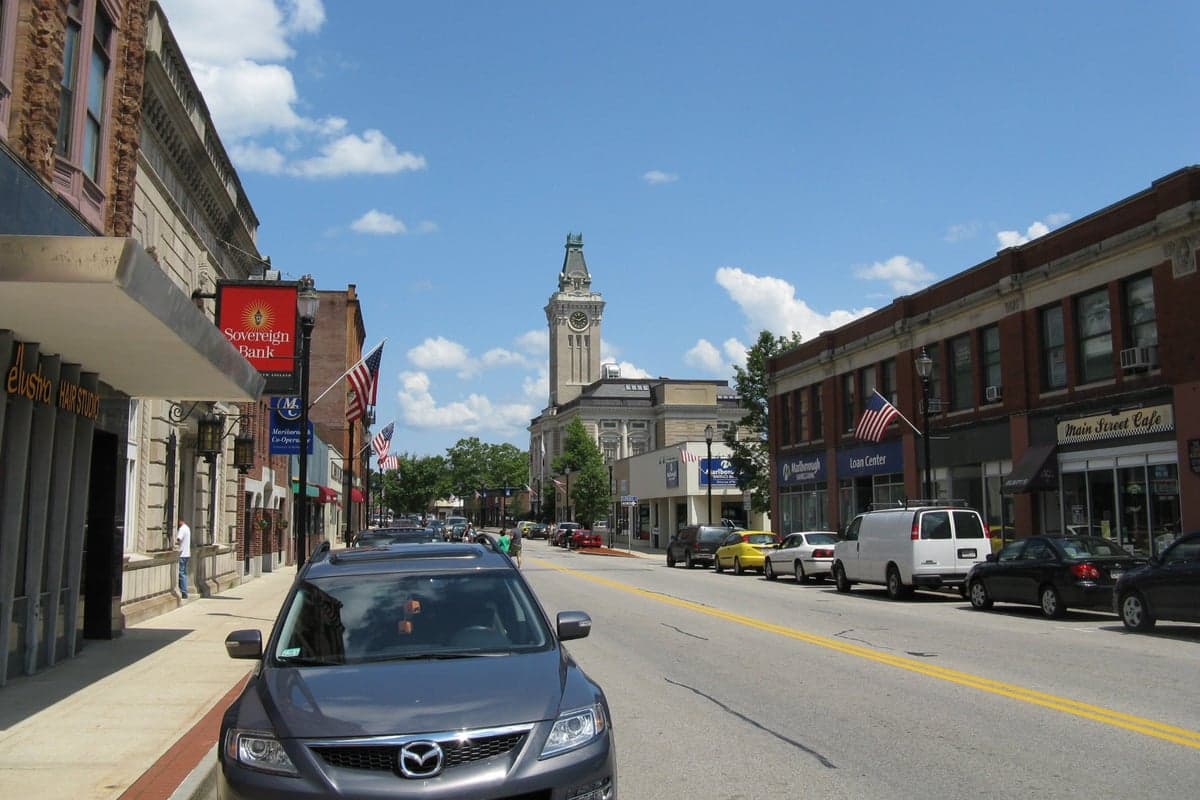
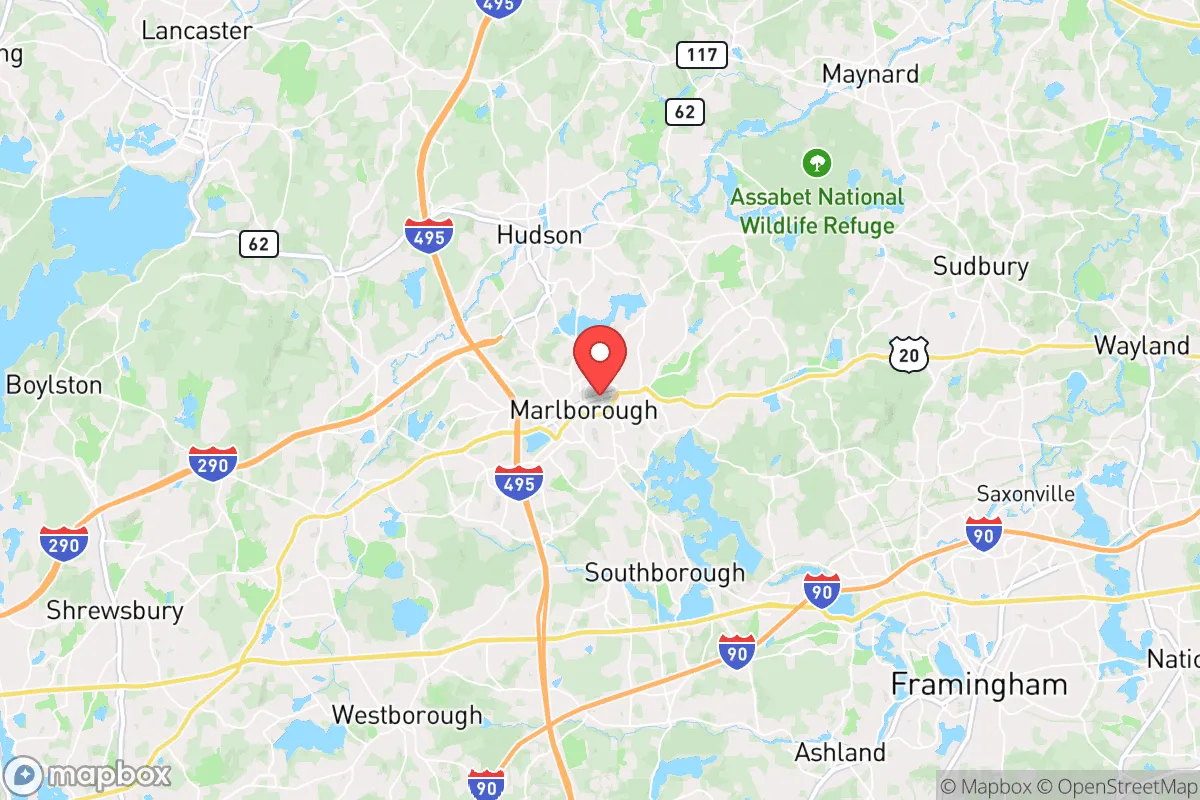
Marlborough, Massachusetts, is a city of roughly 41,400 residents that has transformed from a colonial mill town into a diverse, mid-sized suburban hub along the I-495 corridor. Its population today is notably mixed: a white majority (58.6%) coexists with a substantial Hispanic community (16.8%), a growing Indian-subcontinent population (3.2%), and smaller East/Southeast Asian (1.7%) and Black (3.5%) groups. With 17.3% foreign-born and 40.6% college-educated, Marlborough is a place where old Yankee stock, Brazilian and Puerto Rican immigrants, and tech-industry professionals from South Asia all share the same school district and downtown streets.
How the city was settled and grew
Marlborough was first settled in 1657 as a farming outpost of Sudbury, incorporated as a town in 1660, and later became a city in 1890. The original English colonists—mostly Puritans from East Anglia—farmed the rocky hillsides and built the first homes along what is now Main Street and the Marlborough Center historic district. By the early 1800s, the arrival of the Boston & Albany Railroad turned the town into a shoe-manufacturing center, drawing Irish immigrants who settled in the Irish Hill neighborhood (roughly around today's Pleasant Street and Lincoln Street). French-Canadian families followed in the 1870s-1890s, recruited for the boot and shoe factories; they clustered in the French Hill area, centered on Bolton Street and the area around St. Mary's Church. Italian immigrants arrived in the early 1900s, working in the shoe shops and settling along Broad Street and the Ward 2 neighborhoods near the downtown rail corridor. By 1920, Marlborough was a classic immigrant mill city, with a population of about 15,000 that was heavily Irish, French-Canadian, and Italian.
Modern era (post-1965)
The 1965 Hart-Cellar Act reshaped Marlborough's demographics, as did the decline of shoe manufacturing in the 1970s. The city's location along the newly built I-495 made it attractive for suburban development and light industry. The most significant post-1965 shift has been the growth of the Hispanic population, now 16.8% of the city. This community is largely of Puerto Rican and Brazilian origin, with many families arriving in the 1990s and 2000s for construction, service, and warehouse jobs. They concentrated in the Downtown area (south of Main Street) and the Marlborough Village apartment complexes near the Framingham line. The Indian-subcontinent population (3.2%) is a newer wave, driven by the expansion of tech and pharmaceutical employers along the I-495 corridor—companies like TJX, Boston Scientific, and Hewlett-Packard. These professionals, many from Gujarat and Maharashtra, have settled in the Hudson Street corridor and the newer subdivisions off Maple Street near the Bolton town line. The East/Southeast Asian community (1.7%) is smaller and more dispersed, with Chinese and Vietnamese families living in the West Side neighborhoods near the Hudson border. The white population, while still a majority, has aged and suburbanized; many younger white families have moved to newer exurban towns, leaving an older Yankee and ethnic-white base in the Marlborough Center historic district and the Lake Williams area.
The future
Marlborough's population is likely to continue diversifying, but not at a breakneck pace. The Hispanic share is stable to slowly growing, driven by births rather than new immigration; the community is becoming more assimilated, with second-generation families moving into the Maple Street subdivisions. The Indian-subcontinent population is the fastest-growing segment, fueled by H-1B visa holders and their families who work at the area's tech and biotech firms. This group is highly educated and tends to concentrate in the newer, higher-priced homes near the Bolton and Hudson borders. The East/Southeast Asian and Black populations are small and likely to remain so, as Marlborough lacks the ethnic enclave infrastructure of nearby Framingham or Worcester. The white population is declining slowly, as older residents age in place and younger white families choose more affordable exurbs. Over the next 10-20 years, Marlborough will likely become a city of three distinct enclaves: a historic, older white center; a Hispanic working-class downtown; and an Indian-professional suburban fringe. The city is not homogenizing—it is tribalizing into neighborhoods defined by income and origin.
For someone moving in now, Marlborough offers a genuine mix of old New England character and new immigrant energy, but it is not a melting pot. The schools are solid, the commute to Boston is reasonable (45 minutes by train), and the housing stock ranges from Victorian fixer-uppers to new construction. The city is becoming more Indian and more professional, but the downtown remains a working-class Hispanic hub. If you want a place where your neighbors will likely share your background, Marlborough has a neighborhood for you. If you want a place where everyone mixes, you will find that less common.

* Values derived from national, state, county, city and local statistics and may differ in a specific area. Last updated: 2026-04-24T04:55:14.000Z
Narrative content on this page is AI-generated and may contain mistakes. Verify any details that matter before acting on them.
ReloMaps may earn a commission from affiliate links at no extra cost to you.

