Photo: Wikipedia
Demographics of Marshfield, VT
Affluence Level in Marshfield, VT
A middle-class area roughly in line with national averages across income, home values, education, and employment.
People of Marshfield, VT
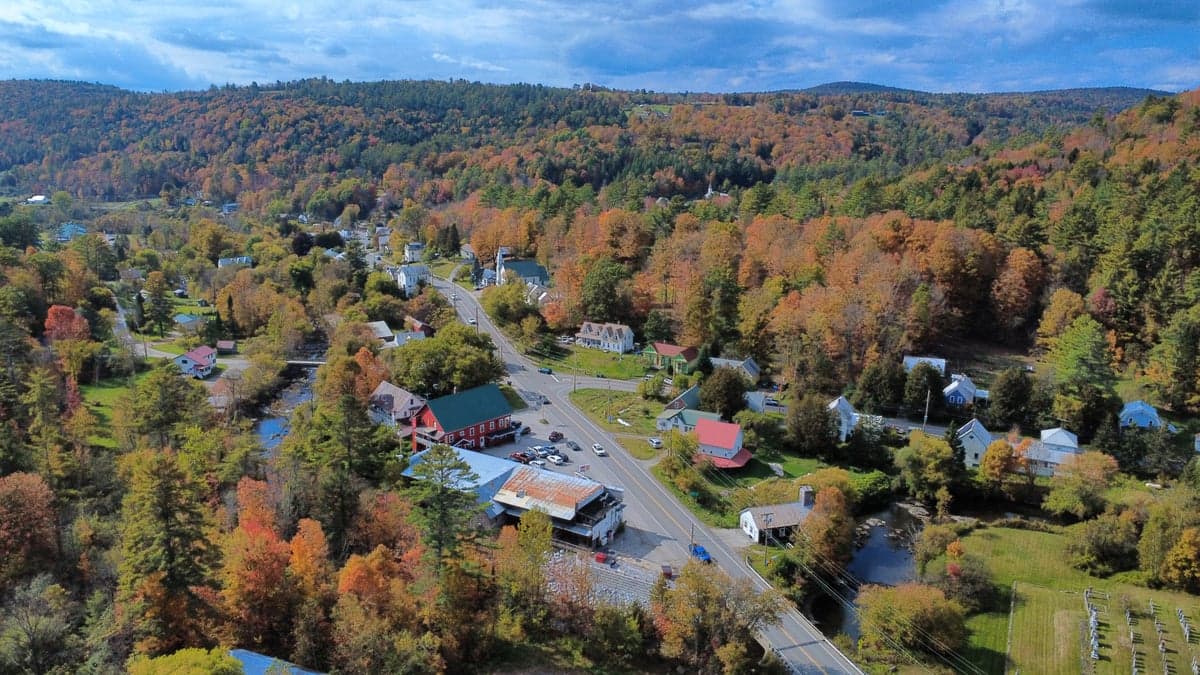
Marshfield, Vermont, is a small, rural town of 431 residents that remains overwhelmingly white (87.7%) and native-born, with a foreign-born population of just 0.2%. Its character is defined by a tight-knit, family-oriented community centered around the village of Marshfield and the surrounding agricultural and wooded areas. The town’s identity is rooted in its historic Yankee and French-Canadian heritage, with a modest but growing Hispanic presence (6.7%) and no recorded Black, East/Southeast Asian, or Indian subcontinent populations.
How the city was settled and grew
Marshfield was chartered in 1782 and first settled by Anglo-American farmers from southern New England, drawn by land grants in the fertile valleys of the Winooski River and its tributaries. The original settlers clustered in what is now the Marshfield Village historic district, building homes and farms along the river. By the mid-19th century, the arrival of the railroad spurred a second wave of settlement, bringing Irish and French-Canadian laborers who worked on the rail lines and in the area’s small lumber and grist mills. These groups established themselves in the Lower Village area, near the depot and mill sites, creating a distinct working-class enclave. The population peaked around 1,200 in the late 1800s, then declined as industry consolidated and younger generations moved to larger towns. Through the early 20th century, Marshfield remained a quiet farming community, with the East Marshfield neighborhood serving as a hub for dairy and maple syrup operations.
Modern era (post-1965)
After the 1965 Hart-Cellar Act, Marshfield saw virtually no immigration-driven demographic change; the foreign-born share remained near zero. Instead, the modern era has been shaped by domestic in-migration, primarily from other parts of Vermont and the Northeast. Beginning in the 1970s, a small wave of back-to-the-land homesteaders and counterculture families settled in the West Hill area, drawn by affordable land and a rural lifestyle. This group, often college-educated, contributed to the town’s current 33.5% college-educated rate. More recently, since 2000, a modest influx of Hispanic residents—likely agricultural workers and their families—has settled in the Plainfield Road corridor, raising the Hispanic share from near zero to 6.7%. The white population has declined slightly in absolute numbers, but remains the overwhelming majority. No Black, East/Southeast Asian, or Indian subcontinent communities have established a presence, reflecting the town’s limited economic opportunities and remote location.
The future
Marshfield’s population is projected to remain stable or shrink slightly over the next 10–20 years, as out-migration of young adults for education and jobs offsets any in-migration. The Hispanic community, while small, is likely to grow gradually through family reunification and continued agricultural labor demand, potentially reaching 10–12% of the population by 2040. The white population will continue to age, with a median age already above the state average. The town is not tribalizing into distinct enclaves; rather, the small scale means all groups interact daily in the village center, at the town hall, and at the local school. However, the West Hill area may retain a slightly more educated, newer-resident character, while Marshfield Village and East Marshfield remain strongholds of longer-term, multi-generational families. No significant growth in Black, Asian, or Indian subcontinent populations is expected, given the lack of employment diversity and housing stock.
For a conservative-leaning individual or family moving to Marshfield now, the town offers a stable, homogeneous, and family-focused environment with low crime and strong community ties. The population is becoming slightly more diverse through Hispanic growth, but remains overwhelmingly white and native-born. The key trade-off is limited economic opportunity and a shrinking tax base, balanced by a quiet, safe, and traditional rural lifestyle.

* Values derived from national, state, county, city and local statistics and may differ in a specific area. Last updated: 2026-05-01T13:30:58.000Z
Narrative content on this page is AI-generated and may contain mistakes. Verify any details that matter before acting on them.
ReloMaps may earn a commission from affiliate links at no extra cost to you.

