
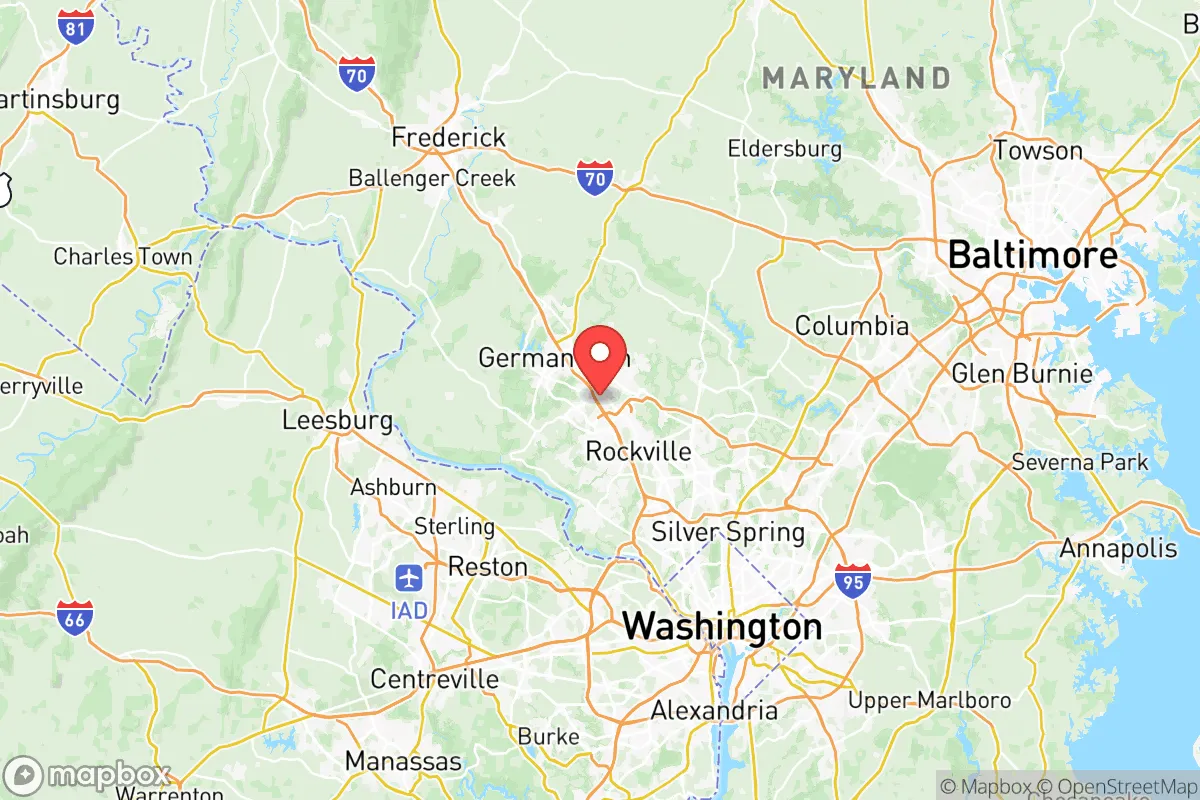
Photo: Wikipedia
Political ClimatePolitical Climate in Montgomery County
Showing district-level results — no local-only data available.
Local Political AnalysisPolitical Analysis of Montgomery County
Montgomery County, Maryland, has long been a Democratic stronghold, but its political trajectory has shifted noticeably leftward in recent years. The county currently holds a Cook Partisan Voting Index (PVI) of D+3, meaning it leans Democratic by three points relative to the national average. However, this masks a more complex reality: while the county as a whole is reliably blue, its internal dynamics have changed dramatically since the early 2000s, when it was more of a moderate Democratic area. Today, the progressive wing holds increasing sway, and that shift is reshaping everything from school policies to land use regulations.
How it compares
When you stack Montgomery County against the rest of Maryland, the difference is stark. The state as a whole has a Cook PVI of D+17, making it one of the most Democratic states in the country. Yet Montgomery County, despite being the state's most populous jurisdiction, is actually less Democratic than the state average—a fact that surprises many outsiders. This is because the county's D+3 rating reflects a more competitive environment than places like Prince George's County (D+40) or Baltimore City (D+40). But here's the catch: the county's moderate reputation is fading fast. In the 2022 gubernatorial election, Republican Dan Cox—a far-right candidate who lost statewide by 32 points—still pulled over 35% of the vote in parts of northern Montgomery County, like Poolesville and Damascus. Meanwhile, areas like Takoma Park and Silver Spring voted for Cox's opponent by margins exceeding 80%. The county is essentially two different political worlds: the urbanized, transit-oriented downcounty (Bethesda, Chevy Chase, Kensington) votes like a deep-blue city, while the upcounty exurbs (Germantown, Clarksburg, Mount Airy) still have a noticeable conservative minority that can swing local races.
What this means for residents
For a conservative-leaning resident, the trend is concerning. The county council has steadily moved toward progressive policies that many feel overreach into personal freedoms. The most visible example is the county's strict COVID-19 mandates, which lasted longer than almost anywhere else in the state—including indoor masking requirements that stayed in place months after neighboring counties dropped them. More recently, the council passed zoning changes that effectively eliminate single-family zoning in many areas, allowing duplexes and triplexes by right. Supporters call it housing equity; critics see it as government dictating what you can do with your own property. The school system, too, has become a flashpoint: MCPS (Montgomery County Public Schools) adopted a policy allowing students to change their gender identity on school records without parental notification, which many parents view as a fundamental violation of family rights. These aren't fringe issues—they're the new normal, and they're driving some families to look at moving to Frederick County or even out of state.
On the cultural front, Montgomery County has always prided itself on being diverse and educated, and that hasn't changed. But the political climate now feels less like the "live and let live" place it was 20 years ago and more like a laboratory for progressive governance. If you value low taxes and minimal government interference in your daily life, you'll find yourself increasingly at odds with the county's direction. The silver lining? The upcounty areas still offer a more balanced political environment, and local elections—especially for school board and county council—are often decided by fewer than 1,000 votes. That means engaged residents can still make a difference, but it requires showing up and staying informed. The days of Montgomery County being a comfortable home for moderates and conservatives are numbered, but they're not gone yet.

State Political ClimatePolitical Climate in Maryland
State Political AnalysisPolitical Environment in the State
Maryland is a deeply blue state with a Cook PVI of D+17, meaning it leans more than 17 points more Democratic than the national average in presidential elections. The dominant coalition is a mix of the Baltimore-Washington D.C. corridor’s affluent, educated professionals and a large, reliably Democratic African American population, particularly in Prince George’s County and Baltimore City. Over the last 10-20 years, the state has shifted steadily leftward, driven by suburbanization of D.C.-area counties and the collapse of any competitive Republican presence in the Baltimore metro, though the rural western and eastern shores have become even more Republican in reaction.
Urban vs. rural divide
The political map of Maryland is a textbook case of the urban-rural chasm. The entire Democratic majority is generated by the I-95 corridor from D.C. to Baltimore, with Montgomery County and Prince George’s County alone delivering over 600,000 Democratic votes in 2024—more than the entire Republican vote in the state. Baltimore City is a Democratic stronghold (over 85% for Biden in 2020), while the surrounding Baltimore County suburbs have flipped from purple to solid blue since 2016. On the flip side, the western counties—Garrett, Allegany, and Washington—vote Republican by 30-40 point margins, as do the rural Eastern Shore counties like Caroline, Talbot, and Wicomico. The only real suburban battleground left is Anne Arundel County (home to Annapolis), which voted for Biden by just 4 points in 2020, but has been trending left as D.C. commuters move in. Frederick County is a bellwether: it voted for Trump in 2016, flipped to Biden in 2020, and is now a competitive swing county where the GOP can still win local races if they run moderate candidates.
Policy environment
Maryland’s policy environment is aggressively progressive, with a tax burden that ranks among the highest in the nation. The state has a progressive income tax with rates up to 5.75%, plus a local piggyback tax that can push the top combined rate over 9%. Property taxes are high, especially in the D.C. suburbs—Montgomery County’s effective rate is around 1.1% of assessed value. The regulatory posture is business-unfriendly: the state has a $15 minimum wage (indexed to inflation), strict environmental regulations on development, and a paid family leave program launching in 2025 that will be funded by a payroll tax. Education policy is dominated by the Blueprint for Maryland’s Future, a massive $4 billion annual funding plan that pours money into public schools but has done little to improve outcomes—Baltimore City schools still rank among the worst in the nation. On healthcare, Maryland operates an all-payer rate-setting system for hospitals, which keeps costs lower than average but limits competition. Election laws are among the most liberal: no-excuse mail-in voting, same-day registration, and automatic voter registration at the DMV. The state also has a strict gun control regime, including a ban on “assault weapons” (defined broadly), a handgun permit requirement that was upheld after Bruen, and a 10-round magazine limit.
Trajectory & freedom
Maryland is becoming less free by almost any measure, and the pace is accelerating. The most significant recent contraction of liberty came with the 2023 gun control package (SB 1), which banned firearms in most public places, including parks, hospitals, and any private business that doesn’t post a “guns allowed” sign. This law was passed despite the Bruen decision and is currently being litigated. On parental rights, the state passed the Trans Health Equity Act in 2023, which prohibits insurance companies from denying coverage for gender transition procedures for minors, effectively overriding parental consent requirements. The state also passed a “sanctuary” law in 2019 (the Maryland Values Act) that prohibits state and local law enforcement from cooperating with federal immigration authorities. On the economic freedom front, the 2024 legislative session saw a push for a wealth tax on capital gains over $1 million, which failed but will likely return. Property rights have been eroded by the state’s aggressive use of impact fees and zoning restrictions, particularly in Montgomery County, where a new “housing policy” mandates that all new developments include a percentage of “affordable” units, effectively raising costs for market-rate buyers. The one bright spot for conservatives was the 2024 passage of a parental notification bill for school library materials, but it was vetoed by Governor Wes Moore and the override failed by one vote.
Civil unrest & political movements
Maryland has a history of civil unrest, most notably the 2015 Baltimore riots following the death of Freddie Gray, which caused over $20 million in property damage and led to a 30% increase in homicides that year. Since then, the Black Lives Matter movement has remained active, with regular protests in Baltimore and D.C. suburbs, particularly around police reform issues. On the right, the most visible movement is the “We the People” coalition, which has organized around parental rights in school boards, particularly in Frederick County and Harford County, where conservative slates have won seats. There is also a small but vocal Second Amendment sanctuary movement in the western counties—Garrett County and Allegany County have passed resolutions declaring themselves “sanctuary counties” for gun rights, though these are symbolic. Immigration politics are a flashpoint in the D.C. suburbs, where the sanctuary law has led to tensions between county police and ICE. In Prince George’s County, a 2023 incident where a county police officer was charged with smuggling undocumented immigrants led to a political firestorm. Election integrity remains a concern for conservatives: the state’s universal mail-in ballot system (made permanent in 2021) has no voter ID requirement, and a 2024 audit found over 1,000 duplicate registrations in the system. There is no serious secession movement, but the “Free State” nickname is often invoked ironically by conservatives who feel the state is anything but free.
Projection
Over the next 5-10 years, Maryland will continue to move left, driven by demographic trends. The D.C. suburbs are growing faster than the rest of the state, and the new residents are overwhelmingly young, college-educated, and progressive. The rural counties are losing population, which will further dilute the Republican vote. By 2030, it’s plausible that the Cook PVI could shift to D+20 or higher, making Maryland one of the most Democratic states in the country. The only potential brake on this trend is if the cost of living—driven by high taxes and housing prices—pushes enough moderate Democrats to move to neighboring states like Pennsylvania or Delaware. But for now, the state’s political trajectory is set: more gun control, more taxes, more regulation, and less parental autonomy. Someone moving in now should expect that their vote for governor or state legislature will have almost no impact on statewide outcomes, but local races in counties like Frederick or Anne Arundel may still be competitive for another cycle or two.
For a conservative considering relocation, the bottom line is this: Maryland offers excellent job opportunities in the D.C. area and a high quality of life in its rural areas, but you will be paying for it with high taxes and living under a government that is actively hostile to gun rights, parental choice, and economic freedom. If you can afford to live in a rural county like Garrett or Allegany, you’ll find a like-minded community, but you’ll still be subject to state laws you didn’t vote for. If you’re moving to the suburbs for work, expect to be in the minority politically and to see your values increasingly marginalized in local schools and government. It’s not a state for someone who wants to fight the culture war—it’s a state for someone who wants to make peace with being outnumbered and focus on their career and family, while hoping the next election cycle brings some sanity to Annapolis.
* Values derived from national, state, county, city and local statistics and may differ in a specific area. Last updated: 2026-05-12T23:01:09.000Z
Narrative content on this page is AI-generated and may contain mistakes. Verify any details that matter before acting on them.
ReloMaps may earn a commission from affiliate links at no extra cost to you.

