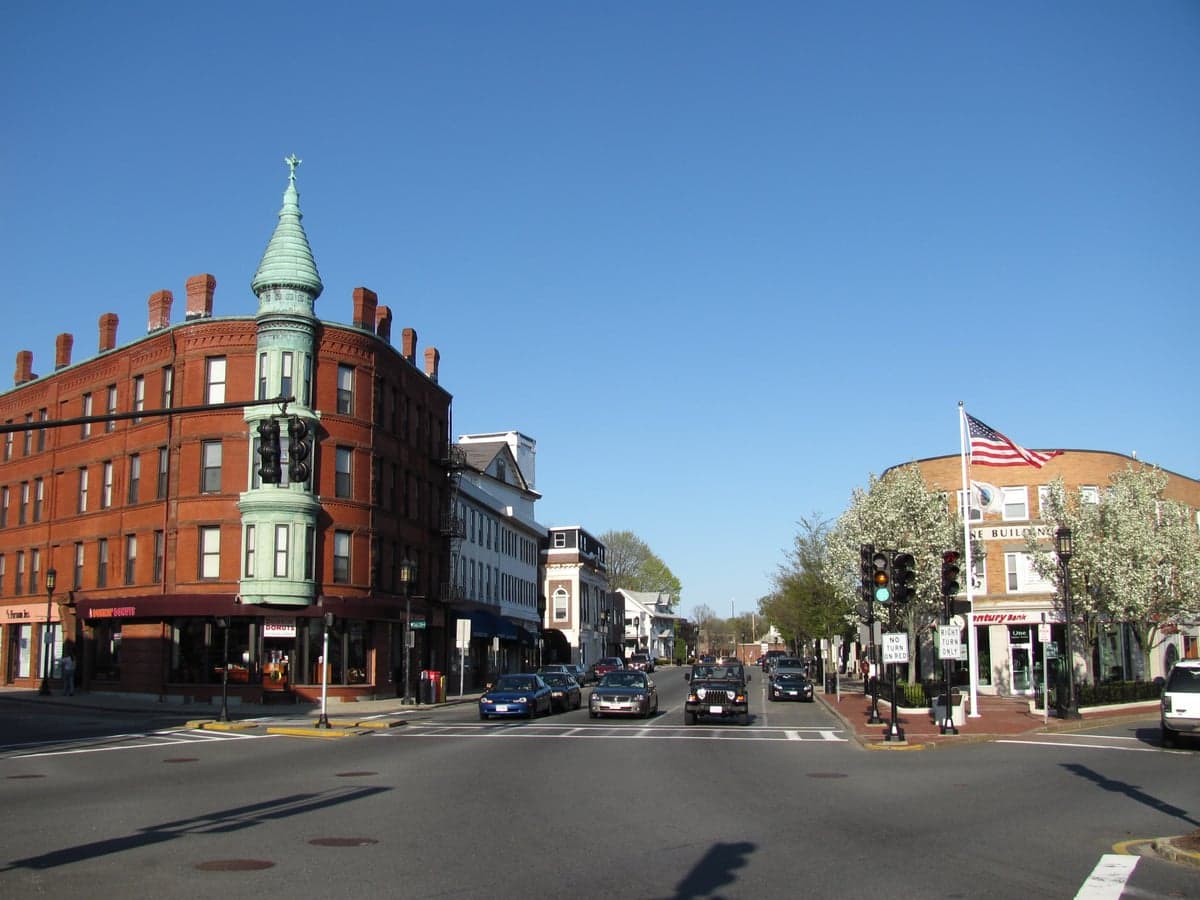
Photo: Wikipedia
Personal Sovereignty in Medford, MA
Viable for self-reliance. Generally workable, though some barriers may limit total independence.
What does Personal Sovereignty tell us?
Personal Sovereignty measures your capacity for self-reliance and independence with minimal government friction. Higher scores mean fewer barriers between you and the way you want to live... but it assumes you have the space you need and good neighbors.
What does this tell us?
Personal Sovereignty measures your capacity for self-reliance and independence with minimal government friction. Higher scores mean fewer barriers between you and the way you want to live... but it assumes you have the space you need and good neighbors.
State Policy
Energy independence: Importer (5% of energy produced in-state)
Personal Liberty
Homesteading

Personal Liberty Analysis
Medford, Massachusetts, presents a challenging environment for personal sovereignty, where state-level policies heavily constrain individual autonomy in ways that may concern those with a survivalist or prepper mindset. As a densely settled suburb just northwest of Boston, Medford operates under some of the most restrictive state laws in the nation regarding self-defense, taxation, and property use, making it a location where strategic relocation requires careful consideration of trade-offs between proximity to urban resources and the preservation of personal freedoms. For conservative-leaning individuals and parents prioritizing self-reliance, the city’s regulatory posture demands a clear-eyed assessment of what liberties are ceded to the state versus what can be retained through careful planning.
Tax burden and regulatory posture in Massachusetts
Massachusetts imposes a heavy tax and regulatory burden that directly impacts personal sovereignty. The state’s income tax rate is a flat 5.0% as of 2026, but this is applied to nearly all earned income, and the state also levies a 6.25% sales tax on most goods. Property taxes in Medford are notably high, with an effective rate around 1.2% of assessed value, which on a median home value of roughly $650,000 translates to an annual bill near $7,800. This is a significant fixed cost for any household seeking to build financial independence. Beyond taxes, the state’s regulatory environment is dense: building permits, zoning variances, and environmental reviews are common hurdles for any home improvement or land use change. For a prepper looking to modify a property—installing a backup generator, building a root cellar, or adding a greenhouse—the permitting process can be slow and expensive. The state also mandates strict vehicle emissions testing and energy efficiency standards for homes, adding layers of compliance that feel like government overreach to those who value the right to manage their own property without bureaucratic interference.
Self-defense and gun law specifics in Medford
Medford’s gun laws are among the most restrictive in the country, reflecting Massachusetts’ broader posture. The state requires a License to Carry (LTC) for any firearm possession outside the home, and Medford’s police department has historically been a “may-issue” jurisdiction, meaning approval is discretionary and not guaranteed. As of 2026, the process involves a background check, fingerprinting, a firearms safety course, and a personal interview, with the chief of police having significant leeway to deny licenses based on “suitability.” Magazine capacity is capped at 10 rounds, and the state’s assault weapons ban prohibits many common semi-automatic rifles and features like flash suppressors and pistol grips. Open carry is effectively illegal, and concealed carry requires the same LTC, which is not issued to non-residents easily. For a survivalist, this means that building a meaningful personal armory for defense against civil unrest is legally fraught. Self-defense in the home is legally protected under the “castle doctrine,” but there is no “stand your ground” law; a duty to retreat applies in public spaces. This legal landscape strongly favors those who are willing to navigate a burdensome licensing system and accept limited capacity and weapon choices.
Self-reliance and homesteading viability in Medford
Homesteading and off-grid living are nearly impossible within Medford’s urban fabric. Typical residential lot sizes range from 5,000 to 10,000 square feet, with most homes on small parcels that leave little room for substantial food production. Zoning regulations prohibit keeping livestock like chickens or goats in most residential districts, and even vegetable gardens may be subject to setback rules and aesthetic guidelines enforced by the city’s conservation commission. Off-grid systems—solar panels, rainwater collection, composting toilets—face strict building code and health department approvals. The city is fully connected to municipal water, sewer, and grid electricity, and disconnecting from any of these is not legally permitted for a primary residence. For a prepper seeking self-reliance, Medford offers little room for meaningful independence. The best strategy is to focus on urban prepping: stockpiling supplies, building a community network, and investing in portable power systems (e.g., solar generators) that can be used without permanent installation. However, any attempt to create a self-sufficient homestead will be met with regulatory resistance.
Personal liberties: parental rights, medical autonomy, speech, and property
Massachusetts law generally prioritizes state authority over individual and parental rights in several key areas. Parental rights are notably weaker than in many other states: the state has a robust vaccine mandate for school attendance, and during the COVID-19 pandemic, it was among the most aggressive in enforcing mask and vaccine requirements for children. Medical autonomy is similarly constrained—the state has a strict prescription drug monitoring program, and access to certain supplements or alternative treatments can be limited by state health regulations. Free speech is protected under the First Amendment, but Massachusetts has some of the nation’s strictest campaign finance and public assembly laws, and local ordinances in Medford can restrict signs, leafleting, and public gatherings in certain zones. Property rights are heavily circumscribed by zoning, historic district regulations (Medford has several historic overlay districts), and environmental protections that limit what owners can do with their land. For a conservative parent concerned about government overreach into family decisions, Medford’s environment is one where the state’s interests frequently override individual choice, particularly in health and education matters.
Overall, Medford ranks low on the spectrum of personal sovereignty compared to rural or exurban areas in states like New Hampshire or Texas. The combination of high taxes, restrictive gun laws, limited homesteading potential, and weak parental rights creates an environment where individual autonomy is constantly checked by state and local authority. For a survivalist or prepper, Medford is best viewed as a location for those who must remain near Boston for employment or family reasons, but who are willing to invest heavily in legal compliance and urban contingency planning. Those seeking true self-reliance and minimal government interference would find better options in less densely regulated regions, where the balance of power tilts more toward the individual and the family unit.

* Values derived from national, state, county, city and local statistics and may differ in a specific area. Last updated: 2026-05-01T06:30:28.000Z
Narrative content on this page is AI-generated and may contain mistakes. Verify any details that matter before acting on them.
ReloMaps may earn a commission from affiliate links at no extra cost to you.

