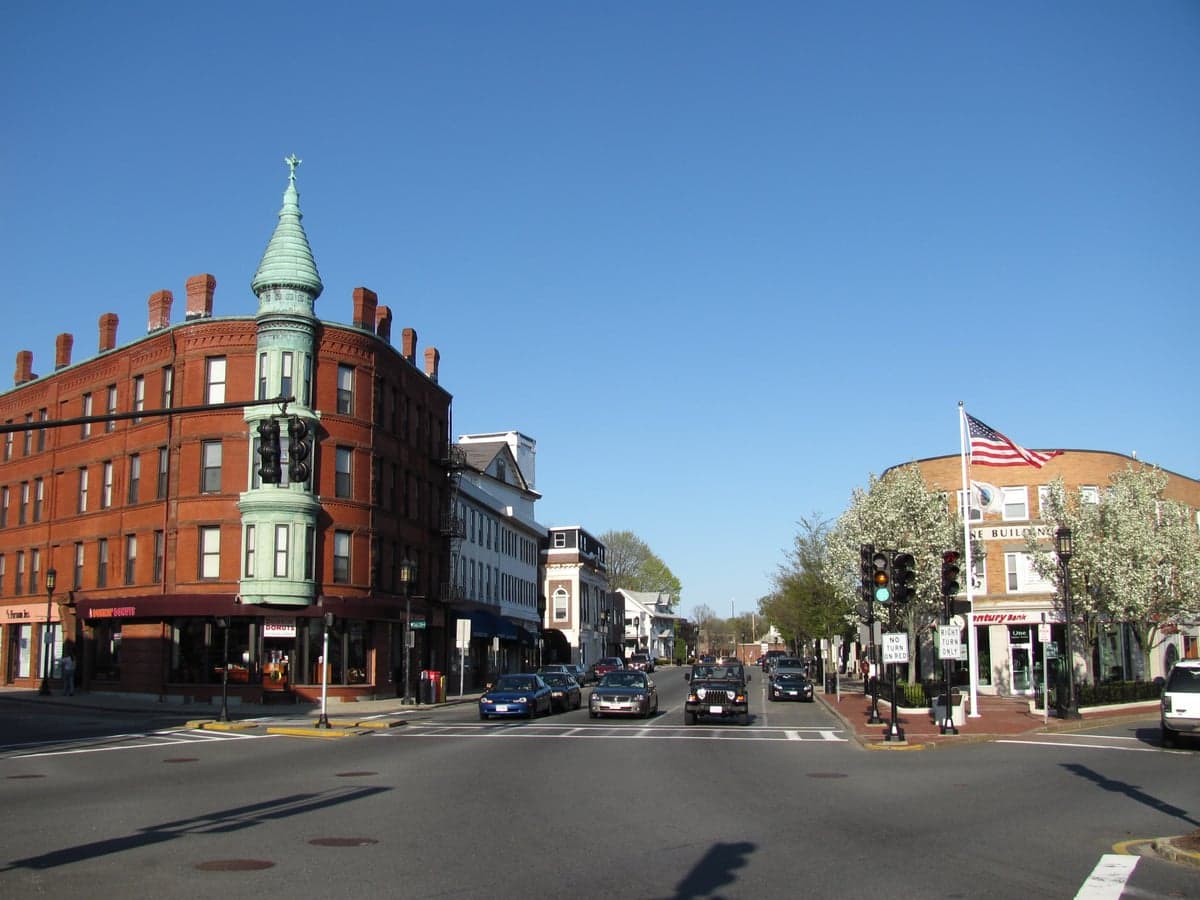
Photo: Wikipedia
Political ClimatePolitical Climate in Medford, MA
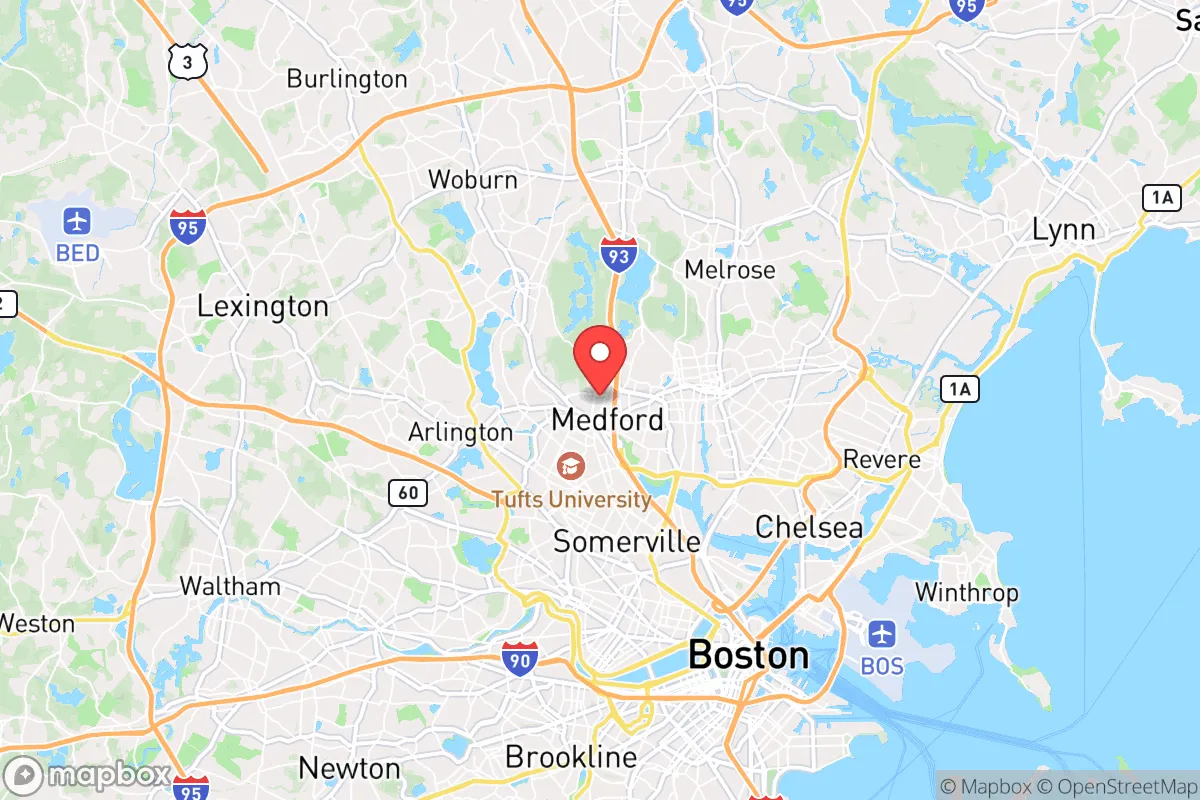
District shown is the primary district for this city’s centroid. Cities may span multiple districts.
Local Political AnalysisPolitical Analysis of Medford, MA
Medford, Massachusetts, has long been a reliably blue stronghold, but the political climate here has shifted noticeably in recent years. The Cook PVI of D+24 tells you the basics—this is a deep-blue suburb that hasn’t voted Republican in a presidential race since the 1980s—but the real story is how the local government has increasingly embraced progressive policies that many long-time residents find intrusive. Town meetings and city council votes now routinely push measures on zoning, public health mandates, and school curriculum that go well beyond what most folks here remember from even a decade ago. The trajectory is toward more government involvement in daily life, not less, and that’s a concern for anyone who values personal freedom.
How it compares
Medford sits in a political bubble compared to its neighbors. Drive ten minutes west to Winchester or north to Stoneham, and you’ll find towns that still lean Democratic but with a more moderate, pragmatic streak—they’re less likely to adopt the kind of sweeping social experiments that Medford’s city council seems to favor. Head further out to towns like Reading or Wilmington, and the contrast is stark: those communities have a stronger independent streak, with local officials who push back on state-level mandates and prioritize fiscal restraint. Even within Medford itself, the divide is real—the older neighborhoods near the Mystic River tend to vote more conservatively than the student-heavy areas around Tufts University, where progressive activism is loudest. That D+24 number masks a growing tension between the old guard and the new wave of transplants who see government as a tool for social engineering.
What this means for residents
For the average family or small business owner, the practical effect is a steady creep of regulations and costs. Property taxes have climbed to fund new social programs, and zoning changes have made it harder to run a home-based business or renovate a house without jumping through bureaucratic hoops. The school system has shifted focus toward equity initiatives and social-emotional learning, which some parents feel comes at the expense of core academics. If you’re a homeowner who values autonomy—say, the right to decide what’s best for your kids’ education or how to use your own property—you’ll find yourself increasingly at odds with city hall. The long-term outlook isn’t great: as more progressive policies take root, the tax base could shrink if families and businesses vote with their feet and move to less restrictive towns nearby.
One cultural distinction that stands out is Medford’s embrace of “sanctuary city” policies and its willingness to defy state-level transparency laws. The city council has passed resolutions limiting cooperation with federal immigration enforcement, and local police are instructed not to ask about immigration status during routine stops. While supporters frame this as compassion, critics see it as a dangerous erosion of rule of law and public safety. The annual town budget debates have become battlegrounds over funding for diversity consultants and climate action plans, while basic infrastructure like pothole repair and snow removal gets shortchanged. If you’re looking for a place where government stays out of your business and lets you live your life, Medford is heading in the opposite direction—and the trend shows no signs of reversing.

State Political ClimatePolitical Climate in Massachusetts
State Political AnalysisPolitical Environment in the State
Massachusetts has long been one of the most reliably Democratic states in the nation, with a partisan lean that has only deepened over the past two decades. In 2024, Kamala Harris carried the state by roughly 25 points, a margin that has held steady since Barack Obama’s 2012 victory. The dominant coalition is a blend of urban progressives, suburban moderates, and a shrinking but vocal Republican base concentrated in the central and southeastern parts of the state. Over the last 10-20 years, the GOP has lost nearly all its statewide offices and legislative seats, while the Democratic supermajority in the State House has pushed the policy needle steadily leftward. For a conservative considering relocation, the state’s political climate is best described as a one-party system with a strong progressive tilt, moderated only by a tradition of fiscal caution and a handful of independent-minded towns.
Urban vs. rural divide
The political map of Massachusetts is a study in extremes. The Boston metro area, including Cambridge, Somerville, and Brookline, is the engine of the state’s Democratic dominance, routinely delivering 80-90% of the vote to Democratic candidates. The western part of the state, anchored by Springfield and Amherst, is similarly progressive, though with a more working-class flavor. In contrast, the rural and exurban areas—places like the Berkshires’ hill towns, the central Massachusetts town of Sturbridge, and the southeastern communities of Fall River and New Bedford—tend to be more conservative, often voting Republican by 10-20 points. The Cape Cod region is a mixed bag: Barnstable County has flipped back and forth, but the outer Cape leans left. A notable outlier is the town of Wrentham, which has a strong conservative streak, while the affluent suburbs west of Boston, such as Wellesley and Weston, are solidly liberal. The divide is not just geographic but cultural: urbanites prioritize transit, housing, and social services, while rural residents focus on property rights, school choice, and local control.
Policy environment
Massachusetts’ policy environment is a mixed bag for conservatives. The state has a flat income tax rate of 5% (recently reduced from 5.15% via a 2022 ballot measure), but a 2022 “millionaire’s tax” added a 4% surcharge on income over $1 million, making the top rate 9%. Property taxes are high, averaging 1.1% of home value, and the state has one of the highest costs of living in the nation. On the regulatory front, Massachusetts is a leader in green energy mandates, with a 2021 law requiring net-zero emissions by 2050 and a ban on new gas hookups in many towns. Education policy is dominated by the state’s strong teachers’ unions, and the 2020 Student Opportunity Act poured billions into underfunded districts, but school choice is limited to inter-district transfers. Healthcare is heavily regulated, with a 2006 law that served as a model for the Affordable Care Act, and the state has a near-universal coverage rate. Election laws are among the most liberal: no-excuse mail-in voting, same-day registration, and early voting are all permanent fixtures. For a conservative, the policy environment feels like a slow but steady expansion of government control, with few brakes.
Trajectory & freedom
Massachusetts is becoming less free by most conservative metrics. The 2022 gun law, Chapter 135, expanded the state’s assault weapons ban, restricted magazine capacities, and required fingerprinting for all firearm purchases, making it one of the strictest in the nation. Parental rights have eroded: the 2022 “Act Relative to Gender Identity” (Chapter 260) allows minors to access gender-affirming care without parental consent, and schools are not required to notify parents if a child changes their name or pronouns. On speech, the state’s 2022 “anti-SLAPP” law was strengthened, but a 2023 bill (H. 3360) criminalized “hate speech” in public spaces, raising First Amendment concerns. Medical autonomy took a hit with the 2020 “Right to Repair” law, which expanded data access for car owners, but the state’s vaccine mandates during COVID were among the strictest, with no religious exemptions for healthcare workers. Property rights are under pressure from the 2021 “Housing Choice” law, which allows cities to override local zoning for affordable housing projects. The trajectory is clear: each legislative session brings new restrictions on personal liberty, with little pushback from the supermajority.
Civil unrest & political movements
Massachusetts has seen its share of political flashpoints. The 2020 Black Lives Matter protests in Boston were large and largely peaceful, but the city’s response included curfews and National Guard deployment. The “Stop the Steal” movement had a modest presence, with a small rally at the State House in January 2021. Immigration politics are a constant source of tension: the state is a “sanctuary” jurisdiction under the 2017 “Safe Communities Act,” which limits cooperation with ICE, and the 2023 “Work and Family Mobility Act” allows undocumented immigrants to obtain driver’s licenses. This has led to friction in towns like Methuen and Haverhill, where local officials have pushed back. Election integrity is a hot-button issue: the 2020 election saw widespread use of mail-in ballots, and a 2022 audit found no fraud, but conservatives remain skeptical of the state’s lax voter ID laws. The most visible flashpoint for a new resident might be the annual “Boston Free Speech” rally, which draws counter-protests and heavy police presence. The political climate is not violent, but it is deeply polarized, with progressive activism dominating the public square.
Projection
Over the next 5-10 years, Massachusetts will likely become more progressive, driven by demographic shifts and in-migration. The state’s population is aging, but younger, college-educated transplants from other states are replacing retirees moving to Florida or the Carolinas. These newcomers tend to be liberal, reinforcing the Democratic supermajority. The GOP’s only hope lies in the growing Hispanic population in places like Lawrence and Holyoke, which could shift the calculus if the party moderates its immigration stance. However, the state’s high cost of living and tax burden are driving some middle-class families to New Hampshire or Texas, which could accelerate the leftward tilt. Expect more gun control, more housing mandates, and more environmental regulations. A conservative moving in now should expect to live in a state where their political views are a minority, and where policy will continue to expand government’s role in daily life.
For a new resident, the bottom line is this: Massachusetts offers world-class education, healthcare, and infrastructure, but at the cost of high taxes, heavy regulation, and a political culture that is increasingly hostile to conservative values. If you value personal freedom in the traditional sense—gun rights, parental authority, low taxes—this state will feel like a constant uphill battle. If you can tolerate the policy environment for the economic and cultural opportunities, you’ll find pockets of like-minded people in the rural towns and exurbs, but the state’s trajectory is firmly leftward. Choose accordingly.
* Values derived from national, state, county, city and local statistics and may differ in a specific area. Last updated: 2026-05-01T06:30:28.000Z
Narrative content on this page is AI-generated and may contain mistakes. Verify any details that matter before acting on them.
ReloMaps may earn a commission from affiliate links at no extra cost to you.

