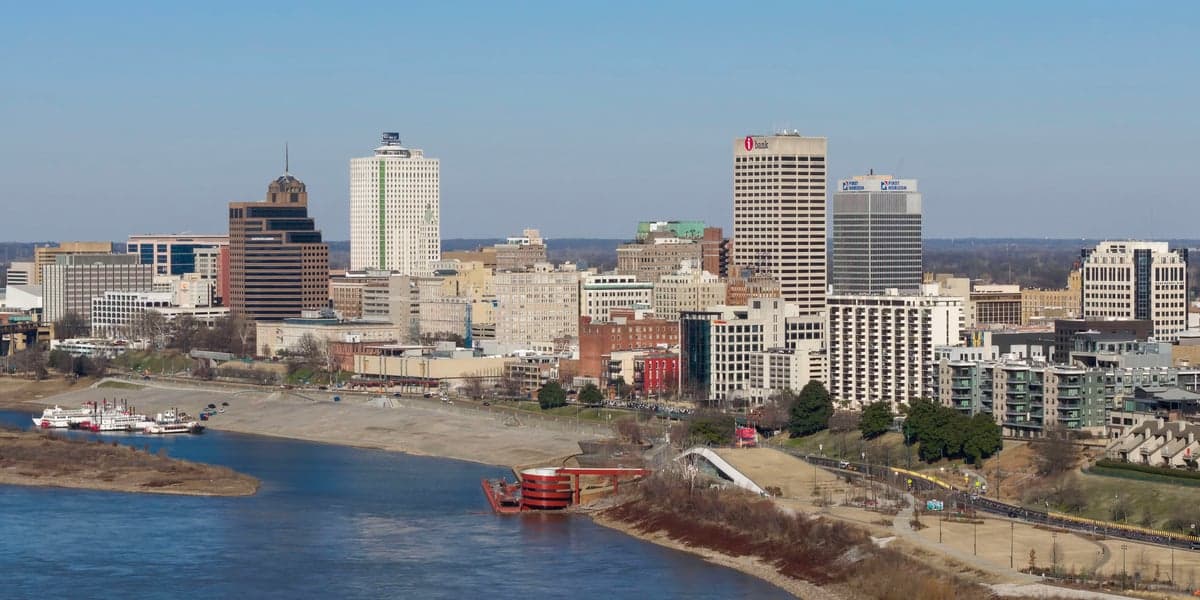
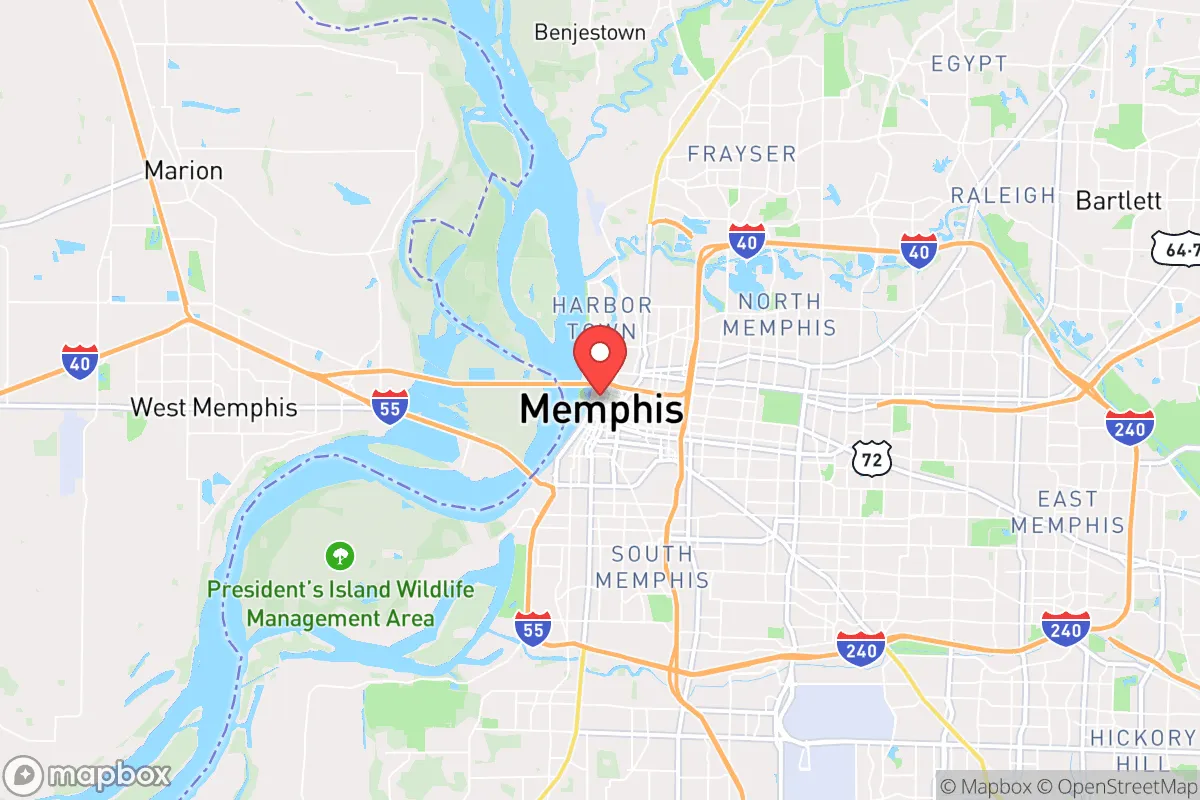
Photo: Wikipedia
Demographics of Memphis, TN
Affluence Level in Memphis, TN
A below-average socioeconomic profile. Incomes, home values, and educational attainment trail the U.S., with higher poverty and unemployment.
People of Memphis, TN
The people of Memphis, Tennessee today form a predominantly Black city (62.7%) with a notable Hispanic minority (10.2%) and a White population of 22.9%, creating a demographic profile distinct from most other Southern metros. With a population of 629,063, Memphis is dense and urban, yet marked by sharp neighborhood-by-neighborhood ethnic and economic divides. The city’s identity is rooted in a deep African American cultural heritage—from blues and soul music to civil rights history—while its relatively low foreign-born share (5.1%) and modest college attainment rate (28.2%) reflect a population shaped more by domestic migration than international immigration.
How the city was settled and grew
Memphis was founded in 1819 on a bluff above the Mississippi River, initially drawing Anglo-American settlers and land speculators drawn to the cotton trade and river commerce. The city’s early growth was fueled by enslaved African labor—by 1860, nearly a third of Shelby County’s population was enslaved, working the cotton plantations that made Memphis a regional economic hub. After the Civil War, freed Black families poured into the city, settling in neighborhoods like South Memphis and Orange Mound, the latter founded in the 1890s as one of the first planned African American subdivisions in the United States. The late 19th and early 20th centuries saw waves of European immigrants—Irish, German, Italian, and Jewish—who established themselves in Pinch District (near the river) and Cooper-Young, building churches, synagogues, and small businesses. The Great Migration (1910–1970) brought hundreds of thousands of Black Southerners from Mississippi, Arkansas, and Tennessee to Memphis, seeking industrial jobs in lumber, cotton processing, and the burgeoning music industry. By 1950, the city was roughly 40% Black, with White flight to suburbs like East Memphis already underway.
Modern era (post-1965)
The post-1965 era reshaped Memphis demographically through two major forces: continued suburbanization and the arrival of new immigrant groups. The 1968 sanitation workers’ strike and the assassination of Dr. Martin Luther King Jr. accelerated White flight, with middle-class White families moving to Germantown, Collierville, and Bartlett—independent suburbs that remain predominantly White today. By 1980, Memphis proper had become a majority-Black city, a status it retains. The Hispanic population began growing in the 1990s, driven by Mexican and Central American immigrants seeking work in construction, logistics, and food processing. Today, Hispanic residents are concentrated in Frayser and Raleigh, where they have established small businesses and Catholic parishes. East/Southeast Asian communities (1.2% of the population) are smaller but visible in East Memphis and White Station, anchored by Vietnamese and Chinese families who arrived after the 1975 fall of Saigon. The Indian-subcontinent population (0.5%) is similarly modest, with professionals working in healthcare and technology. The foreign-born share remains low (5.1%) compared to national averages, meaning Memphis’s demographic story is overwhelmingly one of domestic Black and White movement rather than international immigration.
The future
Memphis’s population is trending toward further racial and economic balkanization rather than homogenization. The city proper lost population between 2010 and 2020 (down about 3%), while surrounding suburbs grew, indicating continued Black middle-class outmigration to places like Olive Branch, Mississippi and Lakeland, Tennessee. The Hispanic share is growing steadily—projected to reach 12–14% by 2035—driven by both births and continued immigration, but remains concentrated in a few northern neighborhoods. The White population is stabilizing in gentrifying pockets like Downtown and Midtown, where young professionals are renovating historic homes, but this inflow is not large enough to reverse overall White decline. East/Southeast Asian and Indian communities are likely to remain small, as Memphis lacks the tech and professional job base that attracts these groups to cities like Nashville or Atlanta. The college-educated share (28.2%) is below the national average and growing slowly, constrained by the city’s heavy reliance on logistics, healthcare, and manufacturing employment.
For someone moving to Memphis now, the city offers a deeply rooted African American cultural experience and a lower cost of living than most major metros, but also a population that is increasingly segregated by race and income. The city is not becoming a melting pot; rather, it is solidifying into distinct ethnic enclaves and suburban refuges. New residents should expect to choose a neighborhood that aligns with their demographic and lifestyle preferences, as the city’s future is one of continued fragmentation rather than integration.

* Values derived from national, state, county, city and local statistics and may differ in a specific area. Last updated: 2026-04-15T23:51:13.000Z
Narrative content on this page is AI-generated and may contain mistakes. Verify any details that matter before acting on them.
ReloMaps may earn a commission from affiliate links at no extra cost to you.

