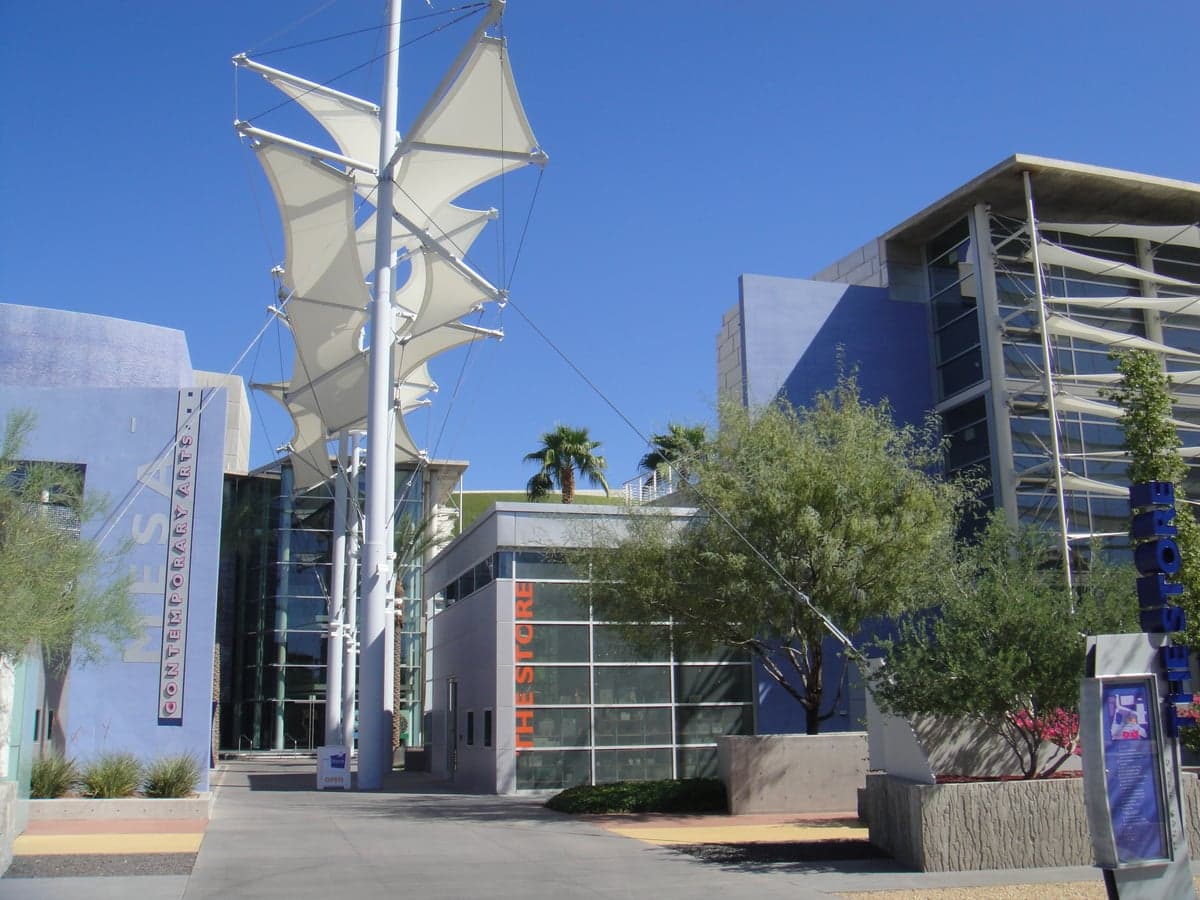
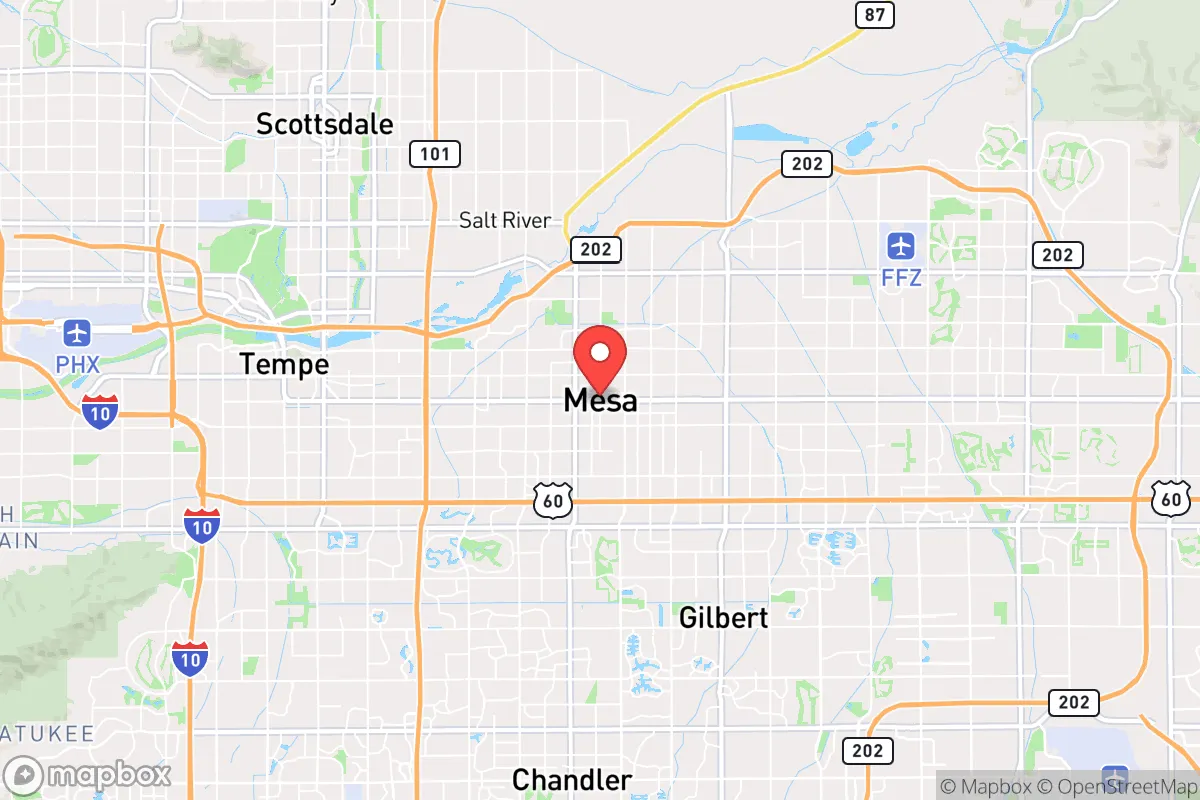
Photo: Wikipedia
Demographics of Mesa, AZ
Affluence Level in Mesa, AZ
A middle-class area roughly in line with national averages across income, home values, education, and employment.
People of Mesa, AZ
Mesa, Arizona’s 507,478 residents form a predominantly white (60.7%) and Hispanic (26.6%) city with a modest 6.7% foreign-born share, giving it a distinctly American-born, family-oriented character compared to Phoenix’s more immigrant-heavy profile. The city is denser than its suburban reputation suggests, with a strong Mormon pioneer legacy still visible in neighborhoods like Lehi and Mesa Historic District, while newer master-planned communities like Eastmark and Las Sendas attract conservative-leaning families seeking space and stability. Mesa feels less transient than many Sun Belt cities—its population growth is driven more by domestic in-migration from California and the Midwest than by international arrivals, reinforcing a culture rooted in church, school, and neighborhood associations.
How the city was settled and grew
Mesa was founded in 1878 by Mormon pioneers sent from Utah by Brigham Young to establish an agricultural settlement along the Salt River. The original settlers laid out a grid of one-square-mile blocks—still the city’s defining street pattern—and built irrigation canals from the river, turning desert into farmland. The Lehi neighborhood, settled by Mormon families in the 1880s, remains the city’s oldest continuously inhabited area and still hosts a strong LDS presence. A second wave of Anglo farmers arrived via the railroad in the 1890s, settling around what is now Mesa Historic District (Main Street and Center Street), where many Victorian-era homes still stand. The city remained overwhelmingly white and native-born through the 1950s, with agriculture—citrus, cotton, alfalfa—as the economic backbone. A small Mexican-American community formed south of the railroad tracks near Country Club Drive and Broadway Road, working in the fields and packing sheds, but Mesa was not a major destination for early 20th-century immigration.
Modern era (post-1965)
Mesa’s modern demographic story is one of domestic in-migration, not international immigration. The post-1965 Hart-Cellar Act had little immediate effect here; the city’s foreign-born share remains low at 6.7%, compared to Phoenix’s 15% or Tucson’s 12%. Instead, the 1970s through 1990s brought waves of white retirees and families from the Midwest and California, drawn by affordable housing, dry heat, and a conservative political climate. These newcomers filled master-planned subdivisions like Las Sendas (golf-course homes on the Superstition foothills) and Eastmark (a 3,200-acre tech-oriented community near Phoenix-Mesa Gateway Airport). The Hispanic population grew from roughly 10% in 1980 to 26.6% today, driven largely by natural increase and domestic relocation from California and Texas, not by new immigration. Hispanic families concentrated in central Mesa neighborhoods like Westwood and Dobson Ranch, where older, smaller homes remain more affordable. The Black population (4.1%) and East/Southeast Asian population (2.0%) are small but visible in newer subdivisions near the Mesa Tech Corridor along the Loop 202 freeway, where aerospace and semiconductor employers like Boeing and Intel have drawn skilled workers. The Indian-subcontinent population (0.3%) is negligible, concentrated among professionals in the tech sector.
The future
Mesa’s population is likely to continue growing—projections suggest 600,000 by 2035—but the character of that growth is shifting. The city is not homogenizing into a single white-majority blob; instead, it is tribalizing into distinct enclaves. Las Sendas and Eastmark will remain overwhelmingly white and affluent, while central Mesa neighborhoods like Westwood will become increasingly Hispanic as older Anglo homeowners sell to younger families. The immigrant communities—Hispanic, East/Southeast Asian, and Indian—are not plateauing but are slowly assimilating into the broader American suburban culture, with second-generation residents moving outward to newer subdivisions. The foreign-born share may rise to 9-10% by 2040, still low by national standards. The biggest wildcard is the Mesa Tech Corridor: if semiconductor and aerospace jobs continue to expand, the city could attract a more diverse, college-educated workforce (currently 31.5% college educated), potentially shifting its political and cultural center of gravity toward a more moderate, professional-class conservatism.
For someone moving in now, Mesa offers a stable, family-oriented environment where neighborhoods still have distinct identities and the pace of change is slow enough to feel manageable. It is not a melting pot—it is a collection of enclaves, each with its own character, and the city’s future will be shaped by which of those enclaves grows fastest.

* Values derived from national, state, county, city and local statistics and may differ in a specific area. Last updated: 2026-04-19T06:52:16.000Z
Narrative content on this page is AI-generated and may contain mistakes. Verify any details that matter before acting on them.
ReloMaps may earn a commission from affiliate links at no extra cost to you.

