Photo: Wikipedia
Strategic Assessment of Mesa, AZ
Multiple tactical vulnerabilities. Population density, target proximity, or disaster risk are likely compounding. A retreat property and exit planning is required.
What does the Strategic Assessment tell us?
Our Strategic Assessment grades tactical survivability of an area. Major population centers, military targets, fallout zones, natural disasters, and border exposure all drive risk — lower exposure means a more defensible position in a crisis.
This is heavily inspired by Joel Skousen's Strategic Relocation book. Highly recommended you checkout the book ($)What does this tell us?
Our Strategic Assessment grades tactical survivability of an area. Major population centers, military targets, fallout zones, natural disasters, and border exposure all drive risk — lower exposure means a more defensible position in a crisis.
This is heavily inspired by Joel Skousen's Strategic Relocation book. Highly recommended you checkout the book ($)Strategic Pillars

Key Distances
Regional Safe Places
Below is our recommended "safe zones" in Arizona and the surrounding area based on our strategic heuristics. For most people, it's unrealistic to live in a “safe zone” full-time due to work, family or other personal reasons. They tend to be more rural. However, many of these areas are perfect for second homes and retreat properties that double as a vacation home or even a short-term rental.
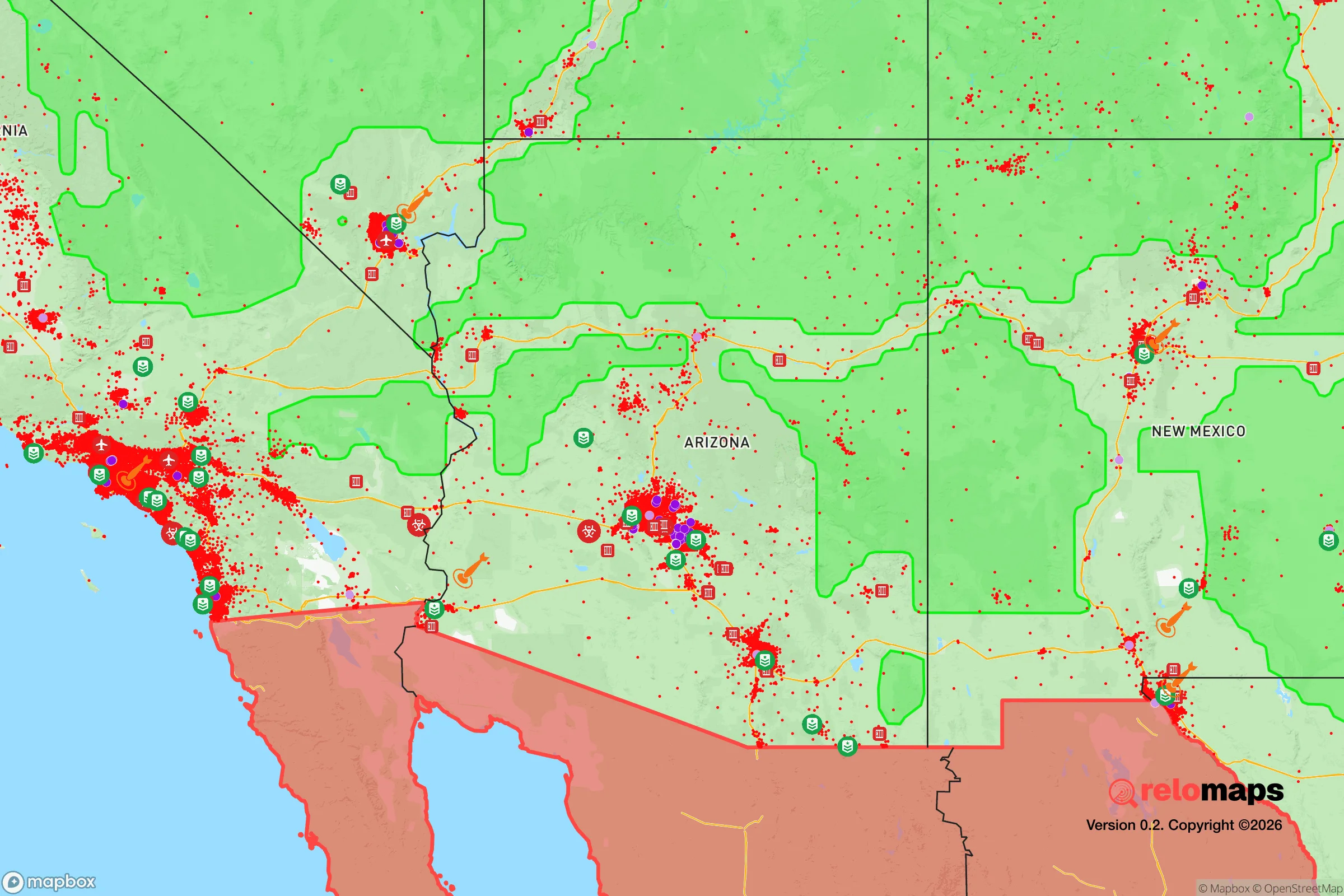
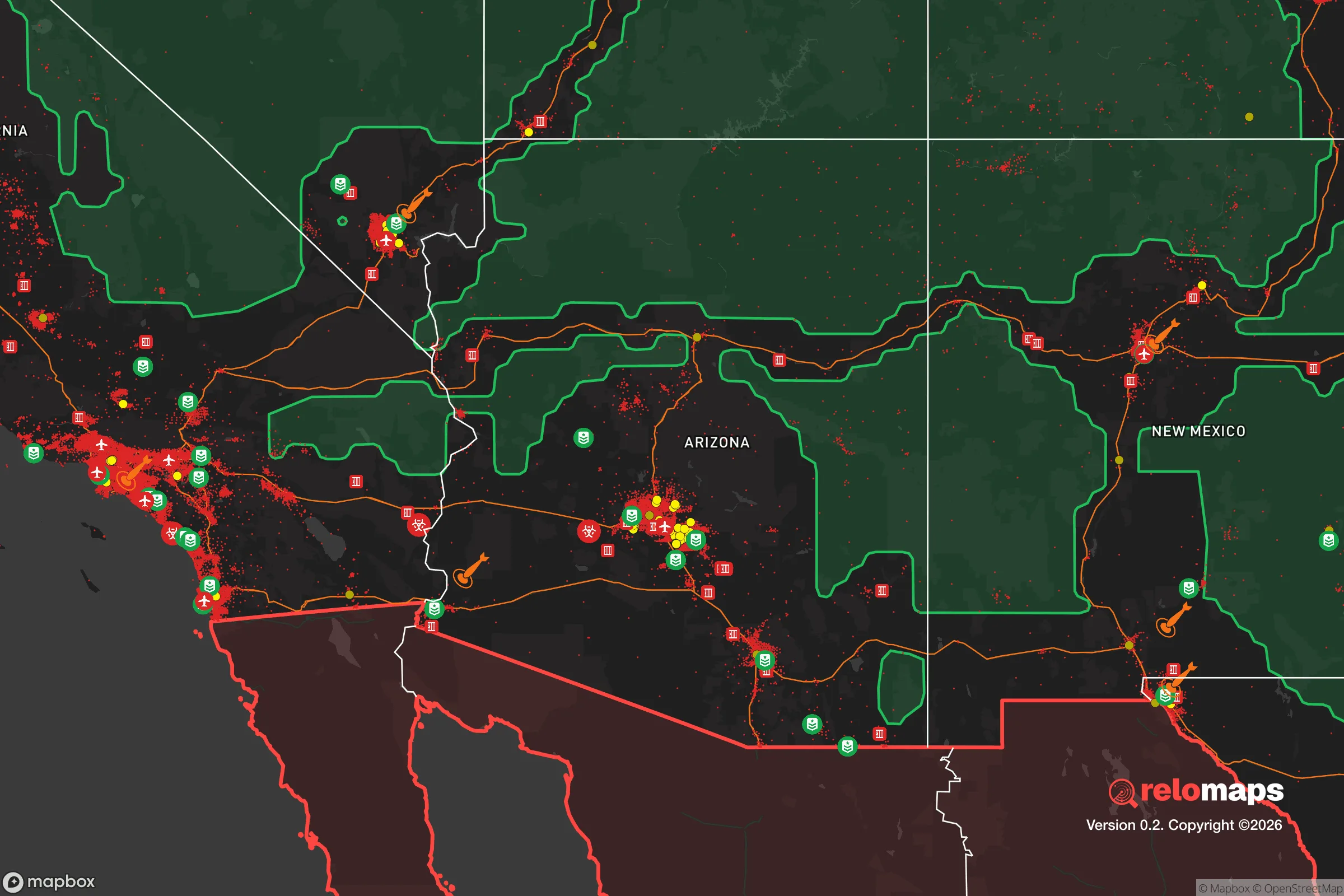


Important Note: For informational purposes only. This does not mean nothing bad ever happens in the green zones. Please use common sense. This is based on public data and modeled with AI. We tried to take a conservative approach but mistakes happen. We update this regularly as new information becomes available.
Solar Generator Recommendations
Backup power matters more here than in safer locations. We've picked three solar generators across budgets and capacity tiers — start with the budget unit if you only need a few essentials, or step up if you want to run a fridge and HVAC for days at a time.

Jackery Portable Power Station Explorer 300
Budget OptionPower on the Go: Weighing only 11 lbs, it's convenient to set up and store with book-sized foldable solar panels

BLUETTI Portable Power Station AC180
Designed for both indoor and outdoor scenarios, AC180 is highly capable as it has a robost capacity and continuous output power.

EF ECOFLOW DELTA Pro Ultra Power Station
Upgraded PickEcoFlow DELTA Pro Ultra is a whole-home energy system designed to grow with your family. Integrated with the Smart Home Panel 2, it scales to meet your evolving energy needs — keeping your home powered, intelligent, and secure through every stage of life.
We earn a commission, at no additional cost to you.
Strategic Assessment Analysis
Mesa, Arizona, presents a complex strategic picture for the conservative prepper or survivalist. Its primary advantage is raw geographic resilience—a sprawling, inland desert city with a robust water allocation from the Salt River Project and a diversified economy that has weathered national downturns better than most. However, its position as the third-largest city in Arizona and a core suburb of the Phoenix metroplex introduces significant vulnerabilities that cannot be ignored. For the single individual or family prioritizing long-term preparedness, Mesa offers a foundation of stability but demands a clear-eyed assessment of its proximity to high-value targets and the logistical realities of desert survival.
Geographic position and natural advantages for long-term stability
Mesa sits in the eastern Salt River Valley, roughly 20 miles from downtown Phoenix, at an elevation of about 1,200 feet. This location provides a distinct climatic buffer—summer temperatures regularly exceed 110°F, which acts as a natural deterrent to mass migration during a crisis. The arid environment drastically reduces the risk of waterborne disease outbreaks and mold-related infrastructure decay that plague wetter regions. The city’s water portfolio is arguably its strongest asset: the Salt River Project delivers a senior, pre-1919 water right that is among the most legally secure in the arid West. Mesa also maintains significant groundwater storage credits through the Central Arizona Project, giving it a multi-year buffer even during extended drought. The surrounding Superstition Mountains and Tonto National Forest provide immediate backcountry access for those with the skills to use it, offering potential retreat routes that are less congested than the urban corridors to the west. The region’s geology is stable—no significant earthquake risk, no hurricane threat, and tornadoes are virtually nonexistent. For the prepper, this means the primary natural threat is heat and water scarcity, both of which are predictable and can be mitigated with proper planning.
Risks, exposures, and proximity to fallout-relevant landmarks
The most glaring vulnerability is Mesa’s location within the Phoenix metropolitan statistical area, home to nearly 5 million people. This density creates a single point of failure for supply chains, fuel distribution, and emergency services. In a mass casualty event or prolonged grid-down scenario, the population of the Valley would rapidly become a liability. Mesa is situated roughly 15 miles from Phoenix Sky Harbor International Airport, a major transportation hub that would be a primary target in any conflict involving strategic infrastructure. Additionally, the Palo Verde Nuclear Generating Station, the largest nuclear power plant in the United States by net generation, lies about 50 miles west of Mesa. While prevailing winds typically blow from the west, a radiological release would place Mesa in the downwind plume path under certain weather patterns. The city also hosts multiple military-adjacent facilities, including the Phoenix-Mesa Gateway Airport, which is used by the Air Force and Arizona National Guard. These assets make the area a secondary target for any adversary seeking to disrupt military logistics. For the survivalist, the calculus is clear: Mesa offers strong baseline resources but sits within a blast radius of multiple high-value civilian and military infrastructure points. The risk of civil unrest following a national crisis is elevated due to the sheer population density and the presence of large, vulnerable populations dependent on just-in-time delivery systems.
Practical resilience for a relocator: food, water, energy, and defensibility
Water is the first and most critical consideration. While Mesa’s municipal supply is robust, a relocator must assume that centralized systems will fail in a prolonged emergency. Rainwater harvesting is impractical here—annual precipitation is under 10 inches, and the monsoon season is brief and unpredictable. The only reliable off-grid water source is deep groundwater, requiring a well drilled to 300–600 feet, which is expensive and regulated by the Arizona Department of Water Resources. For those without a well, storing a minimum of 55 gallons per person per month is non-negotiable. Food production is challenging but possible. The growing season is long, but the intense heat limits cool-weather crops to winter months. Soil is alkaline and low in organic matter, requiring raised beds and imported compost. Backyard chickens are legal in most of Mesa, but water consumption for livestock adds to the logistical burden. Energy resilience is more favorable. Mesa averages over 300 sunny days per year, making solar power a highly viable option. Net metering policies are favorable, and battery storage systems can provide full off-grid capability for a well-designed home. Natural gas infrastructure is widespread, but a prepper should plan for a propane backup system that does not rely on pipeline delivery. Defensibility is the weakest link. Mesa is a sprawling, flat suburban grid with multiple ingress and egress points. There are no natural chokepoints or defensible terrain features within the city limits. A single-family home on a quarter-acre lot offers limited standoff distance. The best defensive strategy is to live on the eastern or southeastern fringe, closer to the Superstition Mountains, where rural parcels provide more space and fewer neighbors. Gated communities offer some perimeter security but can become traps if the gates fail or are breached. For the single individual or family, the practical takeaway is that Mesa requires a high level of self-sufficiency in water and energy, and a low-trust posture regarding neighbors and local government response times.
The overall strategic picture for Mesa is one of calculated trade-offs. It is not a bug-out location—it is a stay-and-build location for those who can secure a property with a well, solar array, and defensible perimeter on the city’s eastern edge. The city’s economic diversity and water security make it more resilient than most Sun Belt suburbs, but its population density and proximity to multiple high-value targets mean that a relocator must be prepared for the worst-case scenario of a regional evacuation or prolonged isolation. For the conservative prepper who values economic opportunity and legal self-defense (Arizona is a constitutional carry state with strong castle doctrine laws), Mesa offers a viable base of operations—provided you treat the city as a resource hub and not a sanctuary. The mountains are close, the water rights are real, and the heat is a filter. If you can handle the summer and the crowds, Mesa can work. If you cannot, look farther east toward the White Mountains or south toward the borderlands.

* Values derived from national, state, county, city and local statistics and may differ in a specific area. Last updated: 2026-04-19T06:52:16.000Z
Narrative content on this page is AI-generated and may contain mistakes. Verify any details that matter before acting on them.
ReloMaps may earn a commission from affiliate links at no extra cost to you.

