
Photo: Wikipedia
Political ClimatePolitical Climate in Mesa, AZ
District shown is the primary district for this city’s centroid. Cities may span multiple districts.
Local Political AnalysisPolitical Analysis of Mesa, AZ
Mesa, Arizona, has long been a conservative stronghold in the East Valley, but the political climate here is shifting in ways that have long-time residents like me paying close attention. While the city’s voter registration still leans Republican, the Cook PVI rating of D+4 tells you the real story: this area is now a battleground, and the progressive influence from nearby Tempe and Phoenix is creeping in. You can feel it in local elections and policy debates—what was once a reliably red city is now a place where your personal freedoms and rights are increasingly up for debate.
How it compares
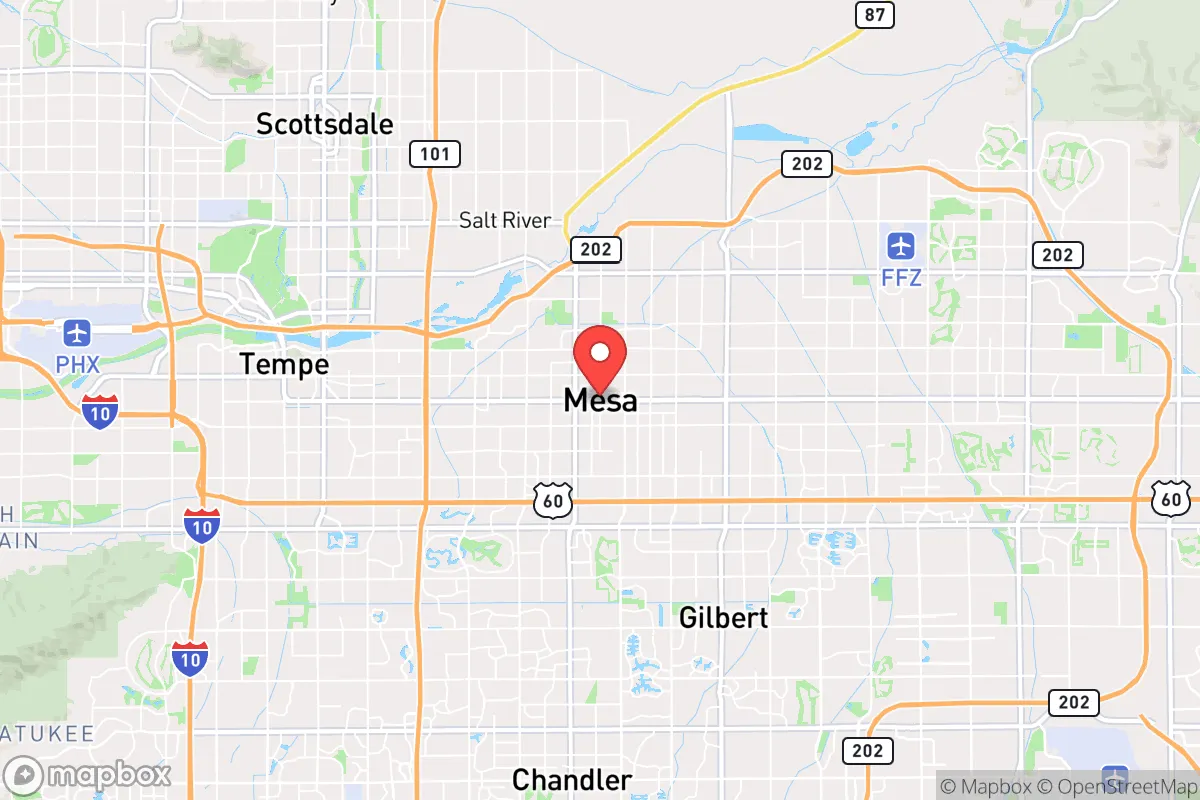
Drive ten minutes west to Tempe, and you’re in a completely different world—that city is a deep blue college town where progressive policies on housing, policing, and taxes are the norm. Head east to Gilbert or Queen Creek, and you’ll find the kind of conservative, family-oriented governance that Mesa used to be known for. The contrast is stark: Mesa sits right in the middle, absorbing the cultural and political spillover from both sides. In the past, you could count on Mesa’s city council to push back against state-level overreach, but now you see more votes aligning with the Phoenix metro’s leftward drift. It’s not just about party labels—it’s about the erosion of local control and the creeping idea that government knows better than you do about how to run your life.
What this means for residents
For folks who value personal liberty, the biggest concern is how this shift affects everyday life. Property taxes have been climbing, and there’s growing pressure to adopt zoning changes that could bring denser, more expensive housing—the kind that makes it harder to own a home with a yard. You’re also seeing more debates over public health mandates and school curriculum, where the default answer from some local leaders is “the government should decide.” If you’re a parent or a small business owner, you’re probably already feeling the squeeze. The long-term trend is worrying: if Mesa continues to follow the path of Tempe or central Phoenix, you can expect more regulations, higher costs, and less say in how your neighborhood operates.
One thing that still sets Mesa apart is its strong sense of community and its resistance to the most extreme progressive policies. The city has a deep Mormon heritage and a large retired population, which keeps things grounded in traditional values. But the influx of younger, more liberal transplants from California and other states is changing the voting demographics fast. In the near term, I’d expect more close elections and more fights over things like mask mandates, land use, and school board decisions. The bottom line: if you’re looking for a place where your rights and freedoms are respected without constant government interference, Mesa is still a decent bet—but you’ll need to stay engaged and vote in every local election to keep it that way.

State Political ClimatePolitical Climate in Arizona
State Political AnalysisPolitical Environment in the State
Arizona has shifted from a reliably Republican stronghold to a genuine battleground state over the past two decades, but its political soul remains deeply divided. The state voted for Joe Biden by just 10,457 votes in 2020 after backing Trump in 2016, and the 2024 race is expected to be razor-thin again. The dominant coalition is no longer a single party but a tense standoff between a growing progressive base centered in Maricopa County’s urban core and a still-potent conservative coalition anchored by retirees, rural voters, and the booming exurbs of places like Buckeye and Queen Creek.
Urban vs. rural divide
The political map of Arizona is essentially a story of two Maricopa Counties. The core of Phoenix and its inner-ring suburbs like Tempe and Scottsdale (the latter trending leftward in recent cycles) are solidly Democratic. Meanwhile, the sprawling outer suburbs—Mesa, Gilbert, Chandler, and especially the fast-growing exurbs of Buckeye and Queen Creek—remain Republican strongholds, though their margins have thinned. Pima County, home to Tucson, is reliably blue, while the rest of the state—from Yuma in the southwest to Flagstaff in the north and Sierra Vista in the southeast—is overwhelmingly red. The 2022 gubernatorial race saw Democrat Katie Hobbs win by just 17,000 votes statewide, while Republican Kari Lake carried 13 of Arizona’s 15 counties. The divide is stark: the two urban counties (Maricopa and Pima) decide the state, while the other 13 counties vote heavily Republican but lack the population to overcome the metro vote.
Policy environment
Arizona’s policy environment is a mixed bag for conservatives. The state has a flat income tax rate of 2.5% (down from 4.5% in 2015), and no estate tax, which is a clear win for fiscal conservatives. Property taxes are low, with an effective rate around 0.62% of home value. However, the regulatory posture has shifted leftward under Governor Katie Hobbs. She vetoed a record number of bills in 2023, including a school choice expansion and a bill to ban transgender athletes from girls’ sports. Education policy is a flashpoint: the state has a robust Empowerment Scholarship Account (ESA) program—the nation’s most expansive school choice system—but Hobbs has tried to defund it. Election laws have been a rollercoaster: the 2021 audit of Maricopa County ballots (the “Cyber Ninjas” audit) was a national story, and subsequent laws tightened voter ID requirements and restricted ballot drop boxes. However, a 2024 law allowing same-day voter registration was signed by Hobbs, a move many conservatives see as a threat to election integrity. Healthcare policy leans libertarian: no certificate-of-need laws, and telehealth is broadly permitted. But the state expanded Medicaid under the Affordable Care Act, a decision that remains controversial among limited-government advocates.
Trajectory & freedom
The trajectory of personal freedom in Arizona is a tug-of-war. On the positive side for conservatives, the state passed a constitutional carry law in 2010 (no permit needed to carry a concealed firearm), and a 2022 law prohibits enforcement of federal gun laws that violate the Second Amendment. Parental rights were strengthened with a 2023 law requiring schools to notify parents of any changes to a student’s mental, emotional, or physical health—a direct response to the transgender sports debate. Property rights are generally strong, with no state-level rent control and a 2022 law limiting homeowners’ association fines. However, the trend is concerning on several fronts. The state’s 2023 “red flag” law (HB 2540) allows courts to temporarily seize firearms from individuals deemed a threat, which many conservatives view as a due-process violation. Medical autonomy took a hit with a 2024 law that effectively bans abortion after 15 weeks (with no exceptions for rape or incest), but a 2024 ballot initiative to enshrine abortion rights in the state constitution is expected to pass, which would override the ban. Taxation is trending in the right direction—the flat tax cut was phased in through 2024—but local governments in Phoenix and Tucson have imposed new sales taxes on services. The net effect is a state that is freer than California but less free than Texas, and the direction depends entirely on who controls the governor’s office after 2026.
Civil unrest & political movements
Arizona has been a national epicenter of political activism and unrest. The 2020 election aftermath saw massive protests at the Maricopa County Recorder’s Office, with armed activists on both sides. The “Stop the Steal” movement was particularly strong here, culminating in the 2021 audit that drew international attention. Immigration politics are a constant flashpoint: Yuma has been a hotspot for border crossings, and the state’s 2010 SB 1070 law (the “show me your papers” law) was largely upheld by the Supreme Court, though its most controversial provisions were struck down. In 2024, the state legislature passed a bill making it a state crime to enter Arizona from Mexico outside a port of entry, which is being challenged in court. Sanctuary city policies are a local issue: Tucson and Flagstaff have declared themselves sanctuary cities, while Phoenix has not. Election integrity remains a raw nerve: the 2022 election saw long lines and machine malfunctions in Maricopa County, fueling ongoing distrust. On the left, the “Red for Ed” teacher strikes in 2018 were the largest in state history, and the movement has kept education funding at the forefront. A new resident will notice the intensity: political signs are everywhere, local news is dominated by election coverage, and conversations about politics are common at coffee shops and grocery stores.
Projection
Over the next 5-10 years, Arizona is likely to become more competitive, not less. The demographic trends favor Democrats: the state’s Hispanic population (now 32% of the total) is growing fast, and younger voters moving to Phoenix and Tucson are more progressive. However, the exurban boom in Buckeye and Queen Creek is bringing in conservative families from California and the Midwest. The 2024 election will be a bellwether: if Trump wins Arizona, the state may hold as a red-leaning swing state; if Biden wins again, expect a permanent shift toward blue. The wildcard is the 2026 gubernatorial race, which will determine the next decade of policy. If a conservative wins, expect further tax cuts, school choice expansion, and tighter election laws. If a progressive wins, look for Medicaid expansion, renewable energy mandates, and a push for state-level rent control. The most likely outcome is continued gridlock, with the state legislature staying Republican and the governor’s office flipping between parties. For a new resident, this means policy stability is low—expect major changes every four years.
For a conservative considering a move to Arizona, the bottom line is this: the state offers low taxes, strong gun rights, and a growing conservative exurban base, but you’ll be living in a political battleground where every election feels like a national referendum. The urban centers are hostile to conservative values, and the state government is split between a Republican legislature and a Democratic governor who will veto your priorities. If you’re looking for a place where your vote consistently wins, look at Texas or Florida. But if you’re willing to fight for your freedoms in a state that still has room to grow, Arizona is a high-risk, high-reward bet. Just be prepared for the fight—and the heat.
* Values derived from national, state, county, city and local statistics and may differ in a specific area. Last updated: 2026-04-19T06:52:16.000Z
Narrative content on this page is AI-generated and may contain mistakes. Verify any details that matter before acting on them.
ReloMaps may earn a commission from affiliate links at no extra cost to you.

