Photo: Wikipedia
Personal Sovereignty in Mackinac County
Strong independent fundamentals that actively favor personal liberty and low regulation.
What does Personal Sovereignty tell us?
Personal Sovereignty measures your capacity for self-reliance and independence with minimal government friction. Higher scores mean fewer barriers between you and the way you want to live... but it assumes you have the space you need and good neighbors.
What does this tell us?
Personal Sovereignty measures your capacity for self-reliance and independence with minimal government friction. Higher scores mean fewer barriers between you and the way you want to live... but it assumes you have the space you need and good neighbors.
State Policy
Energy independence: Importer (20% of energy produced in-state)
Personal Liberty
Homesteading

Personal Liberty Analysis
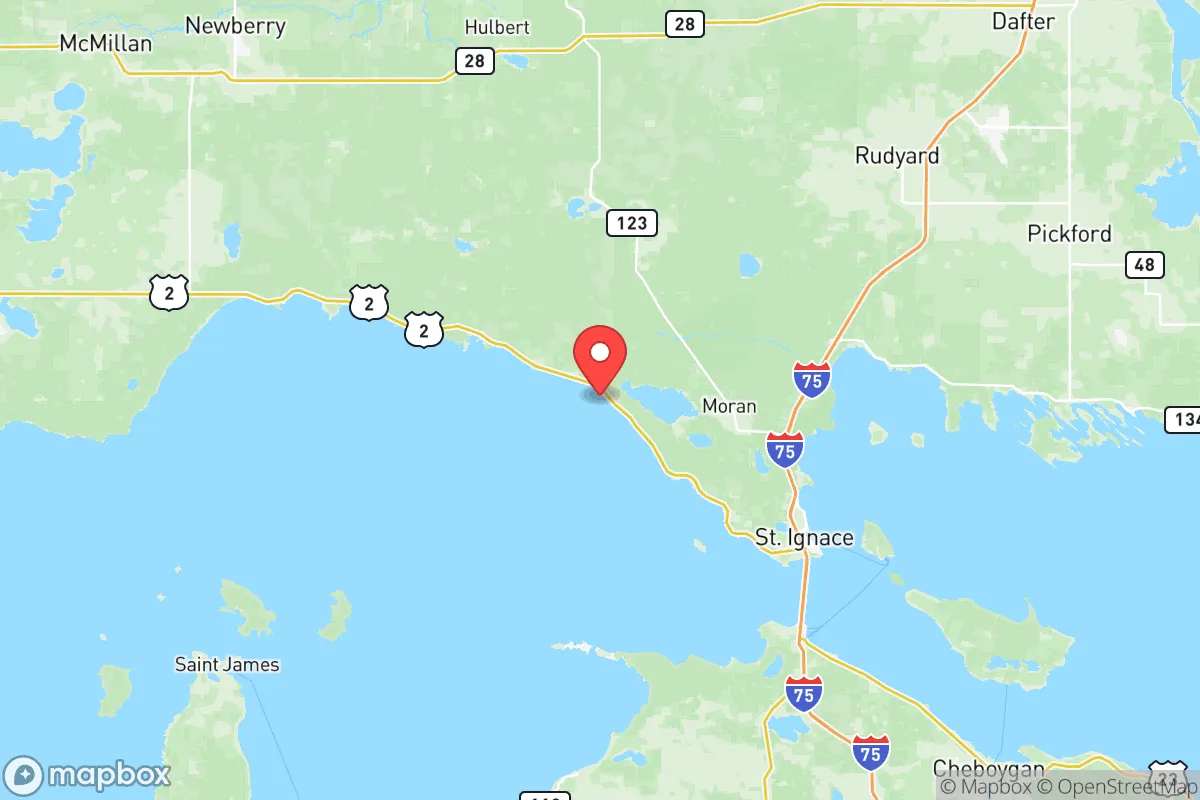
Mackinac County, Michigan, offers one of the more permissive personal sovereignty environments in the Upper Peninsula, where state-level preemptions on firearms and property rights combine with a light local regulatory touch to create a high-autonomy atmosphere. The county's 2024 population of roughly 10,800 is spread across a 2,100-square-mile landscape of state forest, Lake Huron shoreline, and inland lakes, meaning most residents experience minimal government interaction in daily life. For the relocation reader prioritizing independence—whether through self-defense, homesteading, or medical choice—Mackinac County presents fewer friction points than downstate urban areas, though the region's remote character itself imposes certain practical constraints.
Tax burden and regulatory posture in Mackinac County
Michigan's state-level tax structure is moderate, with a flat 4.25% personal income tax and a 6% sales tax, but Mackinac County's local property tax rates are notably low relative to the rest of the state. The county's average millage rate hovers around 28 mills, translating to roughly $2,800 annually on a $100,000 home—well below the Michigan average of 32 mills and far under downstate counties like Washtenaw (50+ mills). St. Ignace, the county seat, and the smaller communities of Cedarville and Engadine operate with minimal local business licensing requirements; there is no county-wide zoning overlay outside of the St. Ignace city limits and the shoreline protection districts along Lake Huron. The regulatory posture is best described as "hands-off by necessity"—the county government employs fewer than 150 full-time staff, so enforcement capacity is thin. Building permits are required for new structures but are typically issued within a week, and the county does not impose any local income or payroll taxes. For a reader comparing tax burdens, Mackinac County's effective total tax rate (state + local) ranks in the bottom third of Michigan counties, a meaningful advantage for both single earners and families.
Self-defense and gun law specifics in the Upper Peninsula
Michigan is a shall-issue state for concealed pistol licenses (CPL), and Mackinac County's gun culture is among the most permissive in the state. The county sheriff's office processes CPL applications within the statutory 45-day window, and open carry is widely practiced without local restriction—St. Ignace, Moran Township, and the village of Mackinaw City (which straddles the county line) have no local ordinances that preempt state preemption law. Michigan's preemption statute (MCL 123.1102) prohibits local governments from regulating firearms, so Mackinac County's townships cannot impose magazine limits, waiting periods, or registration requirements. Stand-your-ground law applies statewide, with no duty to retreat in any place where the individual is lawfully present. For the self-defense-minded reader, the practical reality is that Mackinac County's remote geography—many homes sit on 5- to 40-acre parcels with half-mile driveways—makes personal firearm ownership a near-necessity for wildlife management and property protection, not merely a political preference. The county has no gun range noise complaints on record for 2023-2024, reflecting the cultural acceptance of shooting on private land.
Self-reliance and homesteading viability: lot sizes, zoning, and off-grid feasibility
Mackinac County is one of the most homestead-friendly jurisdictions in Michigan, largely because zoning is minimal outside of the St. Ignace city limits and the Lake Huron shoreline corridor. Unincorporated townships like Brevort, Hendricks, and Marquette Township impose no minimum acreage for agricultural use, and parcels under 5 acres are common for small-scale homesteading. Off-grid living is legally straightforward: Michigan has no state law prohibiting rainwater collection, and Mackinac County does not require connection to municipal water or sewer systems outside of platted subdivisions. Septic permits are required (costing roughly $400-800 for a standard system), but the county health department processes them in under two weeks. Solar panel installation requires no county permit, though net metering through Cloverland Electric Cooperative (the dominant utility) caps residential systems at 20 kW. The growing season is short (Zone 4b/5a, roughly 100 frost-free days), which limits market-garden viability but does not impede personal food production. For the reader serious about self-reliance, the combination of cheap land (undeveloped parcels in Hendricks Township average $2,500-$5,000 per acre), minimal permitting, and low enforcement density makes Mackinac County a strong candidate for off-grid homesteading—provided the individual is prepared for six months of winter.
Personal liberties: parental rights, medical autonomy, speech, and property
Michigan's legal framework for personal liberties is mixed, but Mackinac County's local application tends toward the permissive end of the spectrum. Parental rights in education are governed by state law: Michigan's Revised School Code grants parents the right to opt children out of sex education and to review instructional materials, and Mackinac County's three public school districts (St. Ignace, LaSalle, and Engadine) have not faced parental-rights litigation in the past decade. Homeschooling is straightforward—Michigan requires only a notice of intent and no standardized testing for non-public schools—and the county's homeschool population is estimated at 5-7% of school-age children, roughly double the state average. Medical autonomy is limited by Michigan's vaccine mandate for school attendance (which applies statewide), but Mackinac County's health department does not enforce any local vaccine requirements beyond state law. Property rights are robust: the county has no rent control, no short-term rental bans outside of St. Ignace's limited historic district, and no tree-cutting ordinances on private land. Free speech protections follow First Amendment baseline, and the county's small population means social enforcement (rather than legal) is the primary constraint on expression. For the reader weighing personal liberties, Mackinac County's advantage is not in novel legal protections but in the absence of local overreach—the county government simply lacks the bandwidth and inclination to regulate the details of daily life.
Relative to other areas of Michigan and the broader Midwest, Mackinac County ranks among the top 15% of jurisdictions for personal sovereignty, comparable to the western Upper Peninsula counties of Ontonagon and Gogebic but with better access to services via the I-75 corridor. The trade-off is clear: high autonomy comes with low population density, limited healthcare access (the nearest Level II trauma center is 60 miles south in Petoskey), and a harsh winter climate that tests self-reliance in ways no legal framework can address. For the relocation reader who values independence over convenience and is willing to accept the practical burdens of remote living, Mackinac County delivers a regulatory environment that largely stays out of the way.

* Values derived from national, state, county, city and local statistics and may differ in a specific area. Last updated: 2026-10-20T16:00:49.000Z
Narrative content on this page is AI-generated and may contain mistakes. Verify any details that matter before acting on them.
ReloMaps may earn a commission from affiliate links at no extra cost to you.

