Photo: Wikipedia
Demographics of Mackinac County
Affluence Level in Mackinac County
A below-average socioeconomic profile. Incomes, home values, and educational attainment trail the U.S., with higher poverty and unemployment.
People of Mackinac County
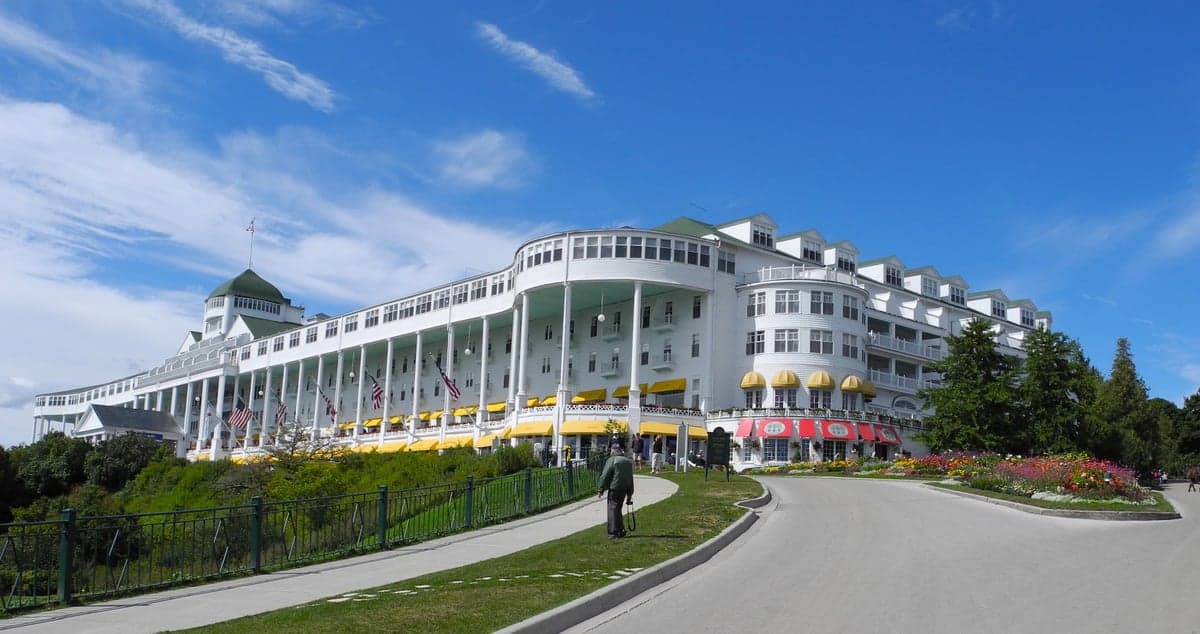
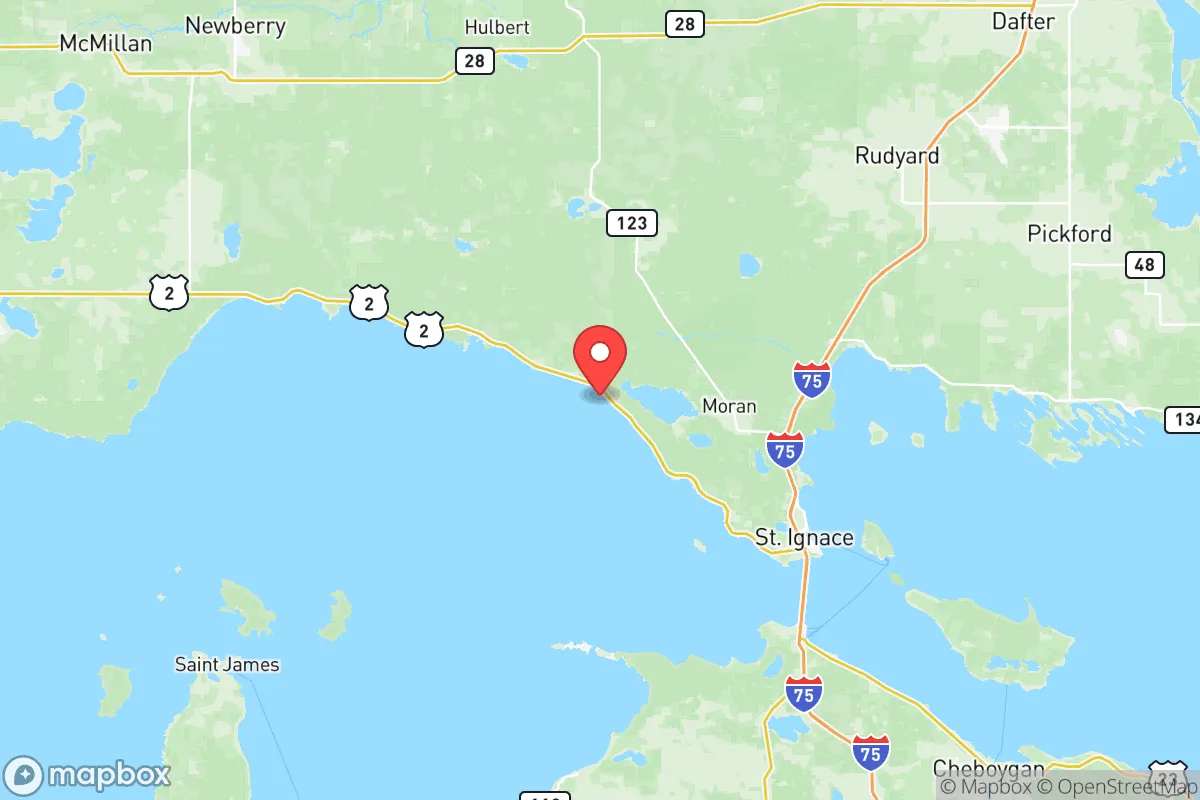
Mackinac County’s 10,865 residents today form a predominantly white (71.8%) population with a significant Native American presence, concentrated in the eastern Upper Peninsula along the Straits of Mackinac. The county is characterized by its small, historic lakeshore communities—St. Ignace, Mackinac Island, and Cedarville—where a mix of tourism-driven service work, government employment, and seasonal living defines daily life. With just 23.5% of adults holding a college degree and a foreign-born share of 4.1%, the county remains culturally insular and economically tied to its natural resources and heritage tourism.
Settlement & growth (pre-1960)
Long before European contact, the Straits of Mackinac region was the heartland of the Anishinaabe people—primarily the Ojibwe (Chippewa) and Odawa nations. These groups established seasonal fishing and trading camps along the shores of what is now St. Ignace and Mackinac Island, using the straits as a central water highway. French explorers and Jesuit missionaries arrived in the 1670s, founding the mission of St. Ignace in 1671, which became one of the earliest European settlements in the Upper Great Lakes. French fur traders and coureurs des bois intermarried with Native women, creating a substantial Métis population that remained the demographic backbone of the region through the 18th century.
British control after 1763 brought little new settlement to what is now Mackinac County, as the fur trade continued under British and later American flags. The 1795 Treaty of Greenville and subsequent land cessions gradually opened the area to American settlers, but the region remained sparsely populated. The real shift came after the War of 1812, when the U.S. established Fort Mackinac on Mackinac Island, drawing soldiers, traders, and their families. By the 1830s, commercial fishing and lumbering began to attract Yankees from New England and New York, who settled in St. Ignace and the emerging village of Hessel on the Lake Huron shore.
The lumber boom of the 1870s–1890s transformed the county. Sawmills sprang up in St. Ignace, Moran, and Gould City, drawing waves of French-Canadian lumberjacks and mill workers from Quebec, along with smaller numbers of Irish and German laborers. The Michigan Central Railroad reached St. Ignace in 1881, connecting the county to the lower peninsula and spurring a brief population surge. By 1900, the county’s population peaked near 13,000, with St. Ignace as the commercial hub and Mackinac Island emerging as a summer resort destination for wealthy Midwestern industrialists. The decline of old-growth lumber after 1910 triggered a long population slide, as mills closed and workers moved west or south.
From 1910 through 1960, Mackinac County’s economy shifted to tourism and government. The creation of the Mackinac Bridge Authority and the construction of the bridge (1954–1957) brought a wave of construction workers and engineers, many of whom stayed in St. Ignace. The state park system on Mackinac Island and the Hiawatha National Forest lands in the county’s interior provided stable federal and state employment. By 1960, the population had stabilized around 8,000, with a demographic profile that was overwhelmingly white, with a significant Native American minority concentrated in the St. Ignace area and on the Mackinac Island tribal trust lands.
Modern era (post-1965)
The 1965 Hart-Cellar Act had a limited direct impact on Mackinac County, as the region did not attract the large immigrant flows seen in urban Michigan. The foreign-born share today stands at just 4.1%, with the largest groups being Canadian (many with historic French-Canadian ties) and a small but growing Indian-subcontinent population (0.5%) working in healthcare and hospitality in St. Ignace. East and Southeast Asian residents (0.4%) are almost entirely concentrated in the county’s medical and university-adjacent sectors, with no distinct ethnic enclave forming.
Domestic migration has been the more significant force. Since the 1970s, Mackinac County has attracted a steady trickle of retirees and second-home buyers from downstate Michigan, particularly from the Detroit and Grand Rapids areas. These newcomers have concentrated in lakefront properties around Cedarville, Hessel, and Naubinway, driving up seasonal home prices and shifting the county’s political leanings slightly more conservative. The county’s Black population (4.1%) is almost entirely composed of military and federal employees stationed at the U.S. Coast Guard base in St. Ignace and the Mackinac Island state park workforce, with no historic Black settlement pattern.
Hispanic residents (2.1%) have grown slowly since 2000, primarily through service-industry workers in St. Ignace and seasonal agricultural labor in the county’s small-scale berry and maple syrup operations. The Native American population, while not separately tracked in the provided data, remains a culturally and politically significant presence, with the Sault Ste. Marie Tribe of Chippewa Indians operating a casino and tribal government offices in St. Ignace. Suburbanization has been minimal—Mackinac County has no suburbs in the conventional sense, but the unincorporated areas around Moran and Brevort have seen scattered residential development as St. Ignace’s housing costs rise.
The future
Mackinac County’s population is projected to remain stable or decline slightly over the next decade, as the county’s high median age (roughly 50) and limited job growth outside tourism and government constrain in-migration. The county is becoming slightly more diverse at the margins—Hispanic and Indian-subcontinent populations are growing from very small bases—but will remain overwhelmingly white and Native American for the foreseeable future. The most notable demographic trend is the continued concentration of seasonal and retirement residents along the Lake Huron and Lake Michigan shorelines, while the interior townships lose year-round population.
New communities are not forming; instead, existing settlements like St. Ignace, Mackinac Island, and Cedarville are absorbing most new residents, with little dispersion into the rural townships. The county’s cultural identity is evolving from a working-class lumber-and-fishing heritage toward a tourism-and-retirement economy, a shift that is accelerating as younger residents leave for college and careers in the Lower Peninsula. The Native American community’s political influence is growing, particularly through tribal economic development, which is reshaping local politics and land use.
For someone moving to Mackinac County now, the region offers a stable, low-density, nature-oriented lifestyle with a conservative-leaning social character and a strong seasonal economy. The population is aging, but the county’s deep-rooted Native and French-Canadian heritage provides a distinctive cultural texture that newer resort communities lack. The trade-off is limited economic opportunity, a long winter, and a social environment that can feel insular to outsiders—but for those seeking quiet, lakefront living with a tangible sense of place, Mackinac County remains one of Michigan’s most historically intact corners.

* Values derived from national, state, county, city and local statistics and may differ in a specific area. Last updated: 2026-10-20T16:00:49.000Z
Narrative content on this page is AI-generated and may contain mistakes. Verify any details that matter before acting on them.
ReloMaps may earn a commission from affiliate links at no extra cost to you.

