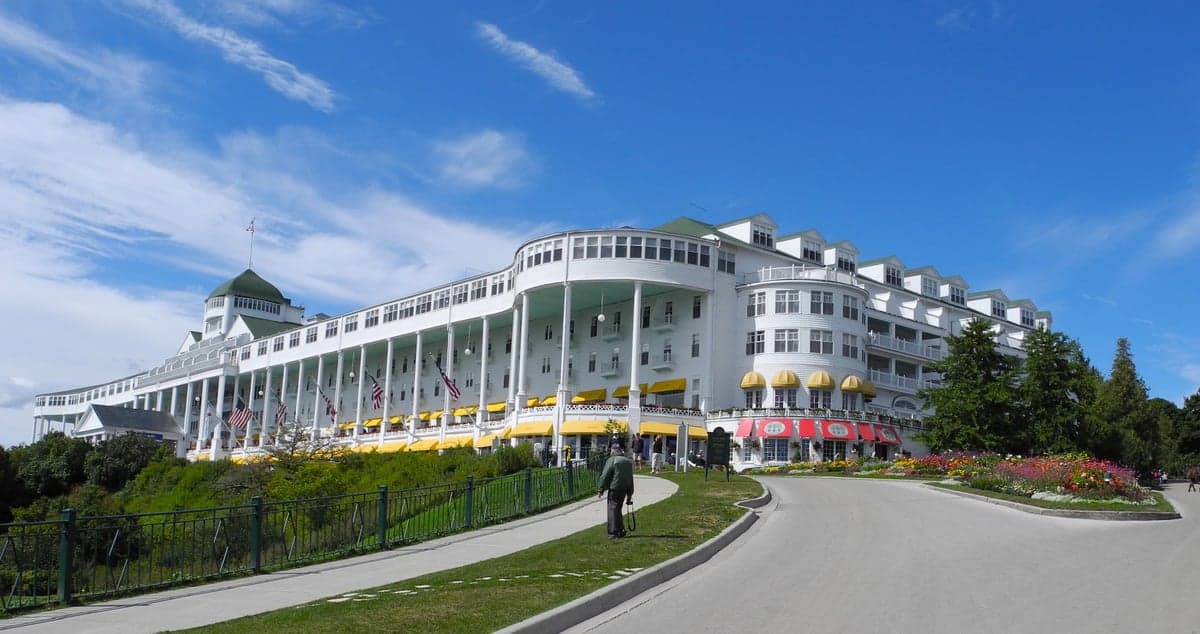
Photo: Wikipedia
Political ClimatePolitical Climate in Mackinac County
Showing district-level results — no local-only data available.
Local Political AnalysisPolitical Analysis of Mackinac County
Mackinac County leans reliably Republican, carrying a Cook Partisan Voting Index (PVI) of R+11, a sharp contrast to the state of Michigan as a whole, which sits at EVEN. This means the county typically votes about 11 percentage points more Republican than the national average, while the state overall is a pure battleground. The shift has been gradual but steady; the county voted for Trump by a wider margin in 2020 than it did for Romney in 2012, reflecting a broader rural realignment toward the GOP. That said, the county isn't a monolith — the small city of St. Ignace, the county seat, often runs a few points bluer than the surrounding townships, while communities like Moran Township and Brevort Lake tend to be more conservative.
How it compares
Michigan's EVEN PVI means the state is a true swing state, decided by margins in the suburbs of Detroit, Grand Rapids, and the I-96 corridor. Mackinac County, by contrast, sits in the reliably red Upper Peninsula, where cultural and economic ties to hunting, tourism, and seasonal work create a different political landscape. Within the county itself, the variation is mostly between the more moderate St. Ignace and the deeply red rural townships like Hendricks and Garfield. The swing precincts — those that occasionally flip between parties — are almost nonexistent; most precincts vote Republican by double digits. The only real exception is the precinct around the Mackinac Island ferry docks, where a mix of seasonal workers and tourism employees sometimes produce a slightly more Democratic vote, though still not enough to flip the county.
What this means for residents
For conservative residents, the R+11 lean means their values are broadly reflected in local governance — county commission races, sheriff elections, and school board seats tend to go to Republicans. For liberal residents, it means their vote is often a minority one, but not without influence; St. Ignace's more moderate lean means local issues like tourism infrastructure and ferry access can still get bipartisan attention. The practical effect is that national political debates feel distant — the county's politics are more about potholes, snow removal, and the summer ferry schedule than about culture wars. Both sides tend to agree on the importance of protecting the Straits of Mackinac and maintaining the area's natural beauty, which is the real economic driver.
Culturally, Mackinac County is distinct from the rest of Michigan in its pace and priorities. The area's economy is heavily seasonal, with tourism dominating from May through October, and the political conversation shifts accordingly — debates over short-term rental regulations, marina fees, and state park funding matter more than the urban-versus-suburban fights that define politics downstate. The county's strong Republican lean also means it often votes against statewide ballot measures that pass in Michigan, like the 2018 legalization of recreational marijuana, which failed locally. That said, the area is not hostile to newcomers; the political climate is more about live-and-let-live than ideological purity, and most residents — regardless of party — share a deep attachment to the land and water that define life here.

State Political ClimatePolitical Climate in Michigan
State Political AnalysisPolitical Environment in the State
Michigan is the ultimate swing state, with a Cook PVI of EVEN that perfectly captures its knife-edge political balance. Over the past 20 years, the state has lurched from reliably blue in the 1990s and early 2000s to a genuine toss-up after 2016, when Donald Trump famously flipped it by 10,704 votes. The 2020 and 2024 cycles confirmed the new normal: Joe Biden won it back by 154,000 votes in 2020, but the margins in both directions have been razor-thin, driven by a shrinking, union-heavy industrial base in Detroit and a surging, populist-leaning exurban and rural vote across the rest of the Lower Peninsula. The state is now a three-way tug-of-war between the Democratic stronghold of Wayne County (Detroit), the rapidly growing Republican suburbs of Kent and Ottawa counties (Grand Rapids), and a volatile bloc of working-class voters in the Saginaw Valley and the Thumb who swing hard between parties depending on economic messaging and cultural flashpoints.
Urban vs. rural divide
The political map of Michigan is a story of two peninsulas and a fractured middle. The Democratic base is concentrated in the southeast corner: Wayne County alone delivers roughly 30% of the statewide Democratic vote, with Detroit, Ann Arbor (Washtenaw County), and the inner-ring suburbs of Oakland County forming a solid blue wall. But that wall is cracking. Oakland County, once a classic Republican suburban bastion, has trended Democratic for a decade, while Macomb County — home to the famous "Reagan Democrats" — has become the ultimate bellwether, flipping from Obama to Trump to Biden and back again. Meanwhile, the western side of the state tells a different story. Grand Rapids (Kent County) has grown explosively and is now a Republican stronghold, with Ottawa County being one of the most conservative counties in the Midwest. The rural Upper Peninsula, once reliably Democratic, has swung hard toward the GOP, as have the Thumb region and the northern Lower Peninsula. The result is a state where the political geography is almost perfectly split: the southeast corner and a handful of college towns (Ann Arbor, East Lansing, Kalamazoo) vote blue; everything else — from the exurbs of Grand Rapids to the farmlands of the Saginaw Valley to the mining towns of the UP — votes red.
Policy environment
Michigan's policy landscape reflects its split personality. The state has a flat income tax rate of 4.25%, which was cut from 4.35% in 2023 as part of a bipartisan deal, and a 6% sales tax. Property taxes are relatively high, but the Proposal A system (1994) caps annual increases for homeowners, making long-term ownership more predictable. The regulatory posture is mixed: Michigan is a right-to-work state, but that law was repealed by the Democratic legislature in 2023, meaning union membership is once again mandatory in unionized workplaces. Education policy is a flashpoint: the state has a robust charter school sector (one of the most permissive in the nation) and a school choice system that includes inter-district open enrollment, but the Detroit Public Schools Community District remains chronically underfunded and underperforming. Healthcare is dominated by the state's expansion of Medicaid under the Healthy Michigan Plan, which covers roughly 1 million residents. Election laws are relatively moderate: no-excuse absentee voting was approved by voters in 2018, and same-day voter registration is available, but voter ID is required at the polls. The state does not have a "stand your ground" law, but it does have a "castle doctrine" and a shall-issue concealed carry system.
Recent policy direction
The last two years have seen a dramatic shift in Michigan's policy direction, driven by the first unified Democratic control of state government in 40 years (2023-2024). The legislature repealed the right-to-work law, expanded the Elliott-Larsen Civil Rights Act to include sexual orientation and gender identity, and enacted a package of gun safety laws that includes universal background checks, safe storage requirements, and red flag orders. On the other hand, the state has not moved on several issues that matter to conservative relocators: there is no state-level abortion ban (Proposal 3, passed in 2022, enshrined reproductive rights in the state constitution), and the state has not adopted any new restrictions on homeschooling or private schooling. Property rights remain strong, with no statewide rent control and limited eminent domain expansion. On taxation, the state has actually moved in a slightly more conservative direction: the income tax rate was cut, and the retirement tax was phased out for most seniors. Voting access has been expanded, but the state still requires voter ID at the polls, and ballot drop boxes are regulated. For a relocator weighing liberties, the picture is mixed: gun owners face new restrictions, but parents retain significant educational freedom, and the tax burden is moderate and trending downward.
Civil unrest & political movements
Michigan has been a national flashpoint for political activism on both sides. The 2020 COVID lockdowns sparked the "Operation Gridlock" protests in Lansing, where armed demonstrators occupied the state capitol, and the Gretchen Whitmer kidnapping plot emerged from that same extremist fringe. The state has a long history of labor activism, with the United Auto Workers (UAW) still a powerful force in the southeast, but union power is waning as the auto industry shifts toward electric vehicles and non-union plants in the South. Immigration politics are relatively quiet — Michigan is not a border state and has no major sanctuary city policies, though Detroit and Ann Arbor have "welcoming city" ordinances. Election integrity has been a persistent controversy: the 2020 results were subject to multiple audits and lawsuits, all of which affirmed Biden's win, but a significant portion of the Republican base remains skeptical. The state has seen a rise in local-level activism, particularly in conservative counties like Ottawa and Livingston, where parents' rights groups have successfully pushed for school board changes and library book challenges. A new resident would notice the political polarization most acutely in the suburbs: a drive from Ann Arbor to Howell (Livingston County) is a journey from a progressive college town to a Trump-flag-heavy exurb, and the cultural divide is visible in yard signs, bumper stickers, and local news coverage.
Projection
Over the next 5-10 years, Michigan is likely to remain a competitive swing state, but the demographic trends favor a slight rightward drift. The population is aging and the state is growing slowly, with most growth concentrated in the conservative-leaning western side (Grand Rapids, Holland, Traverse City) and the exurban ring around Detroit (Livingston, Macomb, and northern Oakland counties). The Detroit metro area is losing population, which weakens the Democratic base, while the Grand Rapids area is gaining population and becoming more politically influential. The state's electoral votes (15 after the 2020 census) will continue to be hotly contested, but the map is shifting: the "blue wall" of the southeast is cracking, and the "red wall" of the west is solidifying. A relocator moving to Michigan in 2026 should expect to find a state that is politically divided but not dysfunctional — the two parties have a history of compromise on bread-and-butter issues like infrastructure and economic development, even as they clash on cultural and social policy. The state is unlikely to become a deep red or deep blue state in the next decade; it will remain a battleground where every election is close and every policy debate is contentious.
For a new resident, the bottom line is this: Michigan offers a genuinely mixed political environment where your experience will depend heavily on where you live. If you're a conservative, you'll find welcoming communities in Grand Rapids, Holland, Traverse City, and the exurbs of Livingston and Macomb counties, with a state government that is currently liberal but a local culture that is deeply traditional. If you're a liberal, you'll feel at home in Ann Arbor, Detroit, East Lansing, and Kalamazoo, with a state government that has recently enacted your priorities on labor, civil rights, and gun safety. The practical takeaway is that Michigan is a state where your local community matters more than the state-level politics, and where the political climate is competitive enough that your vote genuinely counts — for better or worse, depending on your perspective.
* Values derived from national, state, county, city and local statistics and may differ in a specific area. Last updated: 2026-10-20T16:00:49.000Z
Narrative content on this page is AI-generated and may contain mistakes. Verify any details that matter before acting on them.
ReloMaps may earn a commission from affiliate links at no extra cost to you.

