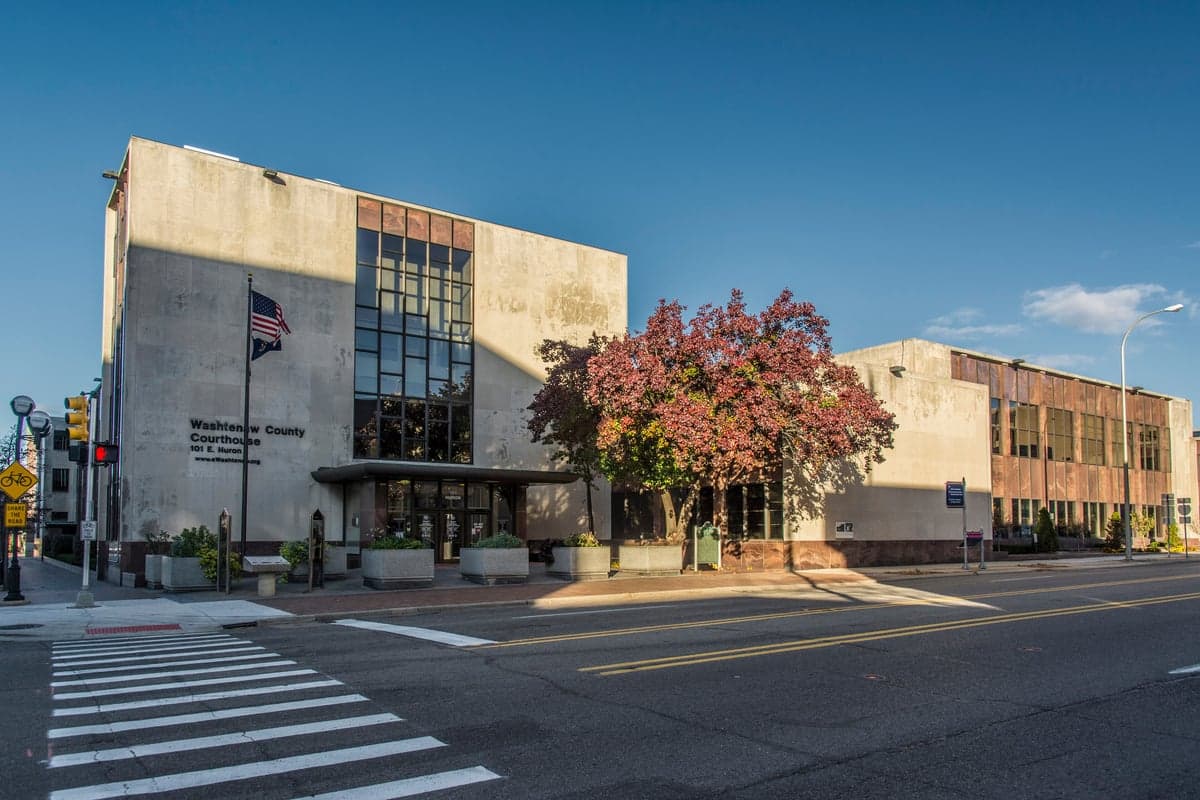
Photo: Wikipedia
Demographics of Washtenaw County
Affluence Level in Washtenaw County
A middle-class area roughly in line with national averages across income, home values, education, and employment.
People of Washtenaw County
Today, Washtenaw County’s 368,394 residents form one of Michigan’s most educated and economically stratified populations, anchored by the University of Michigan in Ann Arbor. The county is a study in contrasts: a globally connected, liberal-leaning university hub surrounded by conservative-leaning small towns and farmland, with a population that is 67.9% white, 11.4% Black, 6.0% East/Southeast Asian, 5.6% Hispanic, and 2.8% Indian (subcontinent). With 58.1% of adults holding a bachelor’s degree or higher, the county’s identity is overwhelmingly shaped by the knowledge economy, yet its deep roots in agriculture, manufacturing, and automotive parts remain visible in communities like Saline, Chelsea, and Dexter.
Settlement & growth (pre-1960)
Long before European settlement, the region was home to the Council of Three Fires—the Ojibwe, Odawa, and Potawatomi nations—who used the Huron River as a travel corridor. The Potawatomi maintained villages along the river near what is now Ypsilanti and Ann Arbor. By the 1820s, the 1807 Treaty of Detroit and subsequent land cessions forced these tribes westward, opening the area to American settlers.
The first wave of Euro-American settlers arrived from New York and New England in the 1820s and 1830s, drawn by the promise of cheap land under the federal land auction system. John Allen and Elisha Rumsey founded Ann Arbor in 1824, naming it for their wives, both named Ann. These early settlers were largely of English and Scots-Irish stock, and they established a farming economy based on wheat and corn. Ypsilanti, founded in 1823, grew as a mill town on the Huron River, while Dexter and Chelsea emerged as stagecoach stops and agricultural trading centers. The Michigan Central Railroad, completed through the county in the 1840s, accelerated growth by connecting local farms to Detroit markets.
A second, smaller wave of German immigrants arrived in the 1840s and 1850s, settling primarily in the rural townships of Salem, Northfield, and Freedom. These families established dairy farms and small breweries, and their Lutheran churches and German-language newspapers persisted into the early 20th century. Unlike the heavily German settlements of the Saginaw Valley or the Thumb, Washtenaw’s German population was more dispersed and quickly assimilated.
The post-Civil War era brought a significant Black population to the county. Freed slaves and their descendants moved north during Reconstruction, settling in Ann Arbor and Ypsilanti, where they found work as domestic servants, railroad laborers, and factory hands. By 1900, Ann Arbor’s Black community was small but established, centered around the Second Baptist Church and the Northside neighborhood. A second, larger wave of Black migration came during the Great Migration (1910–1970), as African Americans left the Jim Crow South for industrial jobs in Michigan. In Washtenaw, this meant work at the Ford Motor Company plant in Ypsilanti and at the University of Michigan. The Black population grew from roughly 2% in 1910 to over 7% by 1960, with Ypsilanti’s West Willow neighborhood and Ann Arbor’s Kerrytown and Old Fourth Ward becoming key enclaves.
The 20th century also saw the arrival of Eastern European immigrants, particularly Poles and Ukrainians, who came to work in the county’s growing manufacturing sector. They settled in Ypsilanti and the industrial corridor along US-12, establishing Catholic parishes and fraternal organizations. The automotive boom of the 1920s and 1950s drew additional workers from Appalachia, especially from Kentucky and Tennessee, who found jobs at the Willow Run Bomber Plant (built 1941) and later at General Motors’ Hydra-Matic plant in Ypsilanti. Willow Run, which produced B-24 Liberator bombers during World War II, attracted a massive influx of workers from across the Midwest and South, briefly making Ypsilanti one of Michigan’s fastest-growing cities. Many of these Appalachian families stayed after the war, settling in Ypsilanti Township and the city of Milan.
Modern era (post-1965)
The 1965 Hart-Cellar Act fundamentally reshaped Washtenaw County’s demographics, as it did across the nation. The most dramatic change was the arrival of Asian and Indian-subcontinent immigrants, drawn overwhelmingly by the University of Michigan’s graduate programs and research hospitals. From the 1970s onward, Ann Arbor became a magnet for Chinese, Korean, and Taiwanese graduate students and faculty, many of whom stayed after completing their degrees. Today, the 6.0% East/Southeast Asian population is concentrated in Ann Arbor’s central neighborhoods and in the newer subdivisions of Pittsfield Township, near the university’s North Campus research complex. The Indian-subcontinent population, at 2.8%, arrived slightly later, accelerating in the 1990s and 2000s as the tech and biotech sectors expanded. Indian professionals cluster in Ann Arbor’s Scio Township and in the upscale developments around the Domino’s Farms office park.
The Hispanic population, now 5.6%, grew steadily from the 1980s onward, driven by Mexican and Central American immigrants who found work in construction, landscaping, and the county’s agricultural sector. Unlike the university-focused Asian and Indian populations, Hispanic residents are more dispersed, with notable concentrations in Ypsilanti, where they have revitalized the Depot Town commercial corridor, and in the rural communities of Saline and Manchester, where they work in greenhouse and nursery operations. The Arab population, though not separately tracked in the county’s 6.4% foreign-born figure, is small but visible in Ann Arbor’s Southside neighborhoods, with a handful of Middle Eastern grocery stores and restaurants serving a community of Lebanese and Iraqi families.
Domestic migration has also reshaped the county. Since the 1980s, Washtenaw has attracted a steady stream of professionals from the coasts, particularly from the New York and San Francisco metro areas, drawn by the University of Michigan’s prestige and the county’s relatively lower cost of living. This influx has driven up housing prices in Ann Arbor and pushed middle-class families into outlying towns like Dexter, Chelsea, and Saline, which have transformed from farm communities into bedroom suburbs. At the same time, the county has seen a modest outflow of Black residents to southern states, part of a broader reverse Great Migration, with some families leaving Ypsilanti for Atlanta, Charlotte, and other Sun Belt cities.
The future
Washtenaw County is projected to become more diverse and more educated over the next two decades, though the pace of change will be slower than in coastal metros. The white share of the population is expected to decline gradually, from 67.9% to roughly 62-64% by 2040, driven by the aging of the native-born white population and the continued arrival of international graduate students and tech workers. The East/Southeast Asian and Indian-subcontinent populations will likely grow the fastest, as the University of Michigan continues to recruit globally and as Ann Arbor’s biotech and pharmaceutical sectors expand. New immigrant arrivals are dispersing beyond Ann Arbor into Pittsfield Township and Ypsilanti Township, where newer housing stock and lower property taxes are attracting families.
The Hispanic population is expected to grow steadily, driven by both immigration and higher birth rates, with Ypsilanti and Saline emerging as the primary hubs. The Black population, which has been stable at around 11% for two decades, may see modest growth if the county can retain young Black professionals graduating from the university, though the pull of Sun Belt job markets remains strong. The county’s overall population is projected to reach 400,000 by 2035, with most growth occurring in the suburban townships rather than in Ann Arbor proper, which is landlocked and increasingly expensive.
Culturally, Washtenaw County is becoming a more polarized place. Ann Arbor and its inner-ring suburbs are growing more cosmopolitan, liberal, and globally connected, while the outlying towns of Manchester, Milan, and Dexter remain more conservative, white, and rooted in agricultural and manufacturing traditions. For a newcomer, this means choosing between the dense, walkable, high-cost environment of Ann Arbor and the quieter, more affordable, car-dependent lifestyle of the surrounding towns—a choice that increasingly defines the county’s social geography.
For someone moving to Washtenaw County today, the region offers a rare combination of world-class education and employment opportunities alongside genuine small-town character, but the trade-offs are real: high housing costs in the core, growing traffic congestion, and a cultural divide between the university bubble and the rest of the county. The people who thrive here are those who can navigate that divide—or who know which side they belong on.

* Values derived from national, state, county, city and local statistics and may differ in a specific area. Last updated: 2026-08-08T15:47:25.000Z
Narrative content on this page is AI-generated and may contain mistakes. Verify any details that matter before acting on them.
ReloMaps may earn a commission from affiliate links at no extra cost to you.

