Photo: Wikipedia
Demographics of Milwaukee, WI
Affluence Level in Milwaukee, WI
A below-average socioeconomic profile. Incomes, home values, and educational attainment trail the U.S., with higher poverty and unemployment.
People of Milwaukee, WI
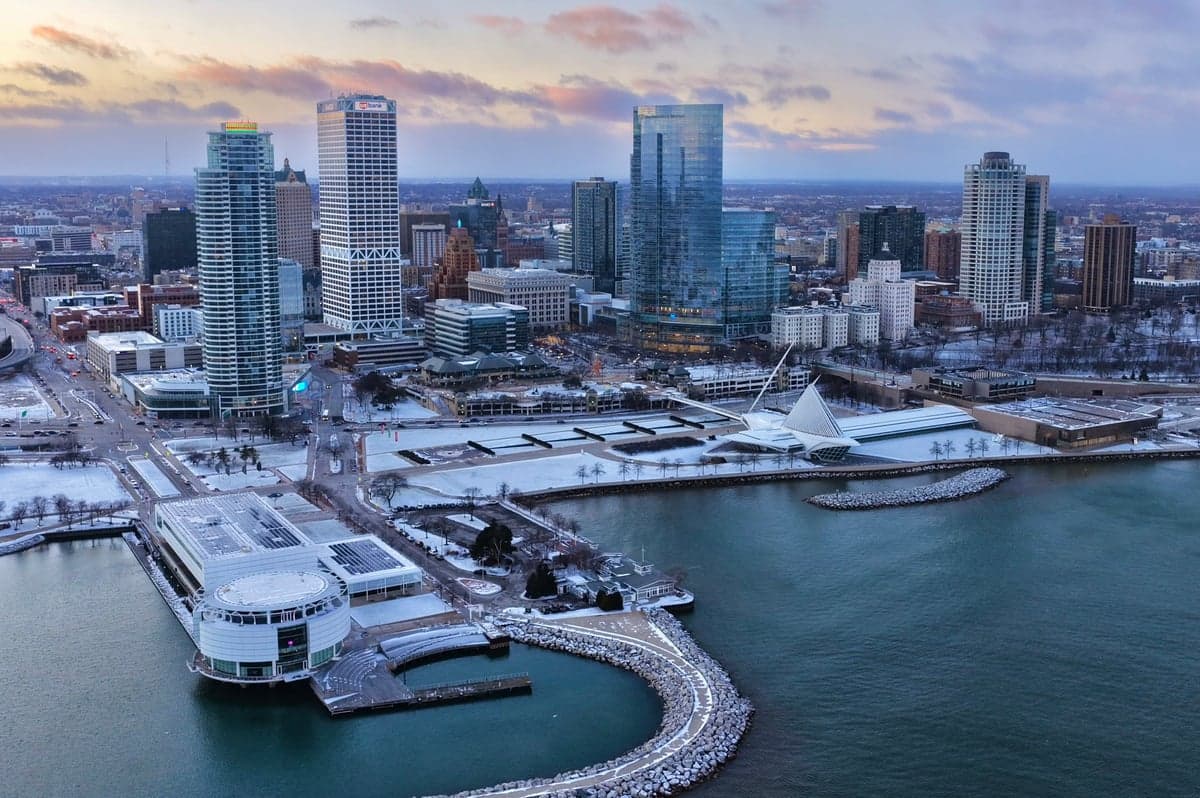
Milwaukee today is a majority-minority city of 569,756 residents, defined by deep racial and ethnic segmentation. It is one of the most segregated metropolitan areas in the United States, with a Black population of 38.1%, a White population of 32.3%, and a Hispanic population of 20.7%. The city’s character is a patchwork of historically rooted neighborhoods, each shaped by distinct waves of immigration and migration, and its population continues to slowly decline even as suburban growth accelerates.
How the city was settled and grew
Milwaukee’s population history begins with three waves of German immigrants in the 1840s–1880s, who made it the most German city in America. They settled the Historic Third Ward and Walker’s Point, building breweries, tanneries, and machine shops along the Milwaukee River. Polish immigrants followed in the 1880s–1910s, creating a dense working-class enclave in Lincoln Village (often called “Polonia”) centered around St. Josaphat Basilica. A smaller but influential wave of Italian immigrants settled the Yankee Hill area near the lakefront. By 1910, Milwaukee was 85% foreign-born or of foreign parentage, overwhelmingly German and Polish. The city’s industrial base—brewing, heavy machinery, and meatpacking—drew these groups, and the neighborhoods they built remain ethnic landmarks today, though the original populations have largely dispersed to the suburbs.
Modern era (post-1965)
The Great Migration brought tens of thousands of Black Americans from the rural South between 1940 and 1970, transforming Milwaukee’s demographics. By 1970, the Black share had risen to 15%, concentrated in the Bronzeville neighborhood (near North Avenue and Dr. Martin Luther King Jr. Drive) and later spreading north into the Havenwoods area. This influx coincided with white flight to suburbs like Wauwatosa and Brookfield, accelerating racial isolation. After the 1965 Hart-Cellar Act, a modest wave of Hmong refugees from Laos settled on the city’s northwest side, particularly around Silver Spring Drive, creating one of the largest Hmong urban communities in the U.S. (now roughly 4.2% East/Southeast Asian). Hispanic immigration, primarily Mexican and Puerto Rican, grew steadily from the 1970s onward, concentrating in the South Side neighborhoods of Mitchell Street and Burnham Park. Today, the Hispanic population is 20.7% and is the city’s fastest-growing major demographic group. The Indian-subcontinent population remains tiny at 0.6%, with no significant enclave.
The future
Milwaukee’s population is projected to continue its slow decline, having fallen from a peak of 741,000 in 1960 to 569,756 today. The city is not homogenizing; rather, it is tribalizing into distinct enclaves. The Black population, historically concentrated on the north side, is slowly dispersing to inner-ring suburbs like Brown Deer and Glendale. The Hispanic population is expanding southward and into previously Black areas near the Menomonee River Valley, creating new zones of contact and tension. The White population, now a minority, is increasingly clustered in the East Side and Bay View neighborhoods, which are also attracting young professionals and college graduates (26.6% of residents hold a bachelor’s degree or higher). The Hmong community is aging and assimilating, with younger generations moving to Waukesha County. Immigration from abroad remains low—only 6.7% foreign-born—so future growth depends almost entirely on domestic migration and birth rates. The city is likely to become more Hispanic and more polarized by class, with a shrinking middle class and a growing divide between the lakefront gentrification corridor and the struggling north side.
For someone moving to Milwaukee now, the city offers distinct neighborhood choices that align with different priorities. The East Side and Bay View provide walkable, amenity-rich urban living with a liberal tilt. The South Side offers a strong Hispanic cultural identity and lower housing costs. The north side remains predominantly Black and faces significant disinvestment. The city’s trajectory is toward greater ethnic balkanization, not integration, and its population decline suggests that Milwaukee is not a growth market for most relocators, but rather a stable, affordable option for those who value its specific neighborhood character and industrial heritage.

* Values derived from national, state, county, city and local statistics and may differ in a specific area. Last updated: 2026-04-29T23:26:13.000Z
Narrative content on this page is AI-generated and may contain mistakes. Verify any details that matter before acting on them.
ReloMaps may earn a commission from affiliate links at no extra cost to you.

