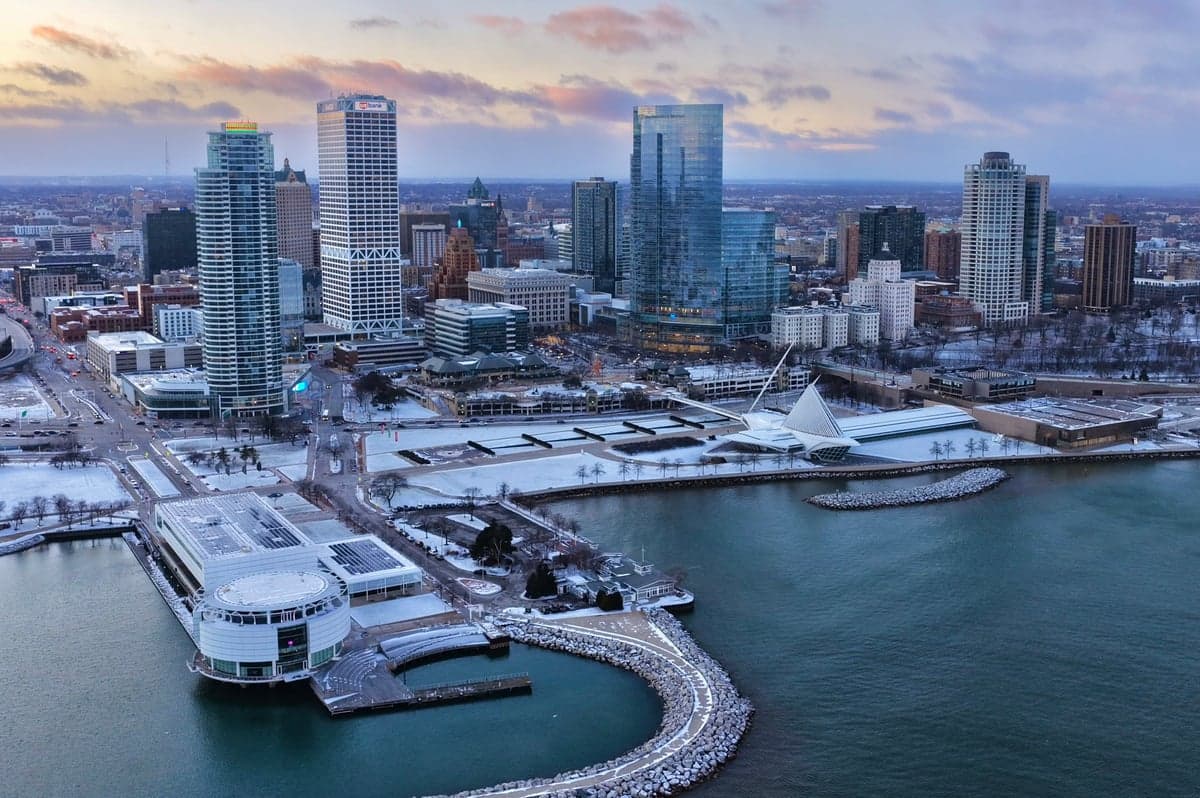
Photo: Wikipedia
Personal Sovereignty in Milwaukee, WI
Moderate friction. Expect trade-offs in some aspect of personal liberty and independence.
What does Personal Sovereignty tell us?
Personal Sovereignty measures your capacity for self-reliance and independence with minimal government friction. Higher scores mean fewer barriers between you and the way you want to live... but it assumes you have the space you need and good neighbors.
What does this tell us?
Personal Sovereignty measures your capacity for self-reliance and independence with minimal government friction. Higher scores mean fewer barriers between you and the way you want to live... but it assumes you have the space you need and good neighbors.
State Policy
Energy independence: Importer (15% of energy produced in-state)
Personal Liberty
Homesteading

Personal Liberty Analysis
Milwaukee, Wisconsin, presents a complex and often contradictory environment for personal sovereignty, one where a strong tradition of local self-reliance clashes with a state and city government that increasingly asserts control over individual decisions. For the strategic relocator with a conservative, survivalist mindset, the city offers a mixed bag: a gritty, blue-collar resilience and a relatively low cost of entry, but also a regulatory and tax climate that can feel like a slow squeeze on autonomy. The key is understanding that while Wisconsin’s constitutional framework provides some bedrock protections, Milwaukee’s municipal code and the state’s recent legislative trends have tilted the scales away from the individual and toward the collective, making it a location that demands constant vigilance rather than offering a sanctuary of freedom.
Tax burden and regulatory posture in Milwaukee and Wisconsin
Wisconsin’s tax posture is a significant drag on personal sovereignty, particularly for those seeking to maximize their retained earnings and minimize government entanglement. The state imposes a progressive income tax with a top marginal rate of 7.65%, which kicks in at a relatively modest income level, and Milwaukee County adds its own 0.6% county sales tax on top of the state’s 5% rate. Property taxes are among the highest in the nation, with Milwaukee’s effective rate hovering around 2.2% of assessed value, meaning a $250,000 home carries an annual tax bill of roughly $5,500. This heavy property tax burden directly undermines the concept of owning your land free and clear, as you are perpetually renting from the government. The regulatory environment in Milwaukee is equally dense, with strict building codes, a complex permitting process for home-based businesses, and a city government that has aggressively pursued zoning enforcement against what it deems "nuisance" properties. For the prepper or homesteader, this means that even simple improvements like adding a shed, installing a rainwater catchment system, or keeping a few chickens can trigger bureaucratic headaches and potential fines. The state’s overall regulatory climate is moderate, but Milwaukee’s municipal overlay adds a layer of control that feels intrusive to anyone valuing maximum personal latitude.
Self-defense and gun law specifics in Milwaukee County
On the surface, Wisconsin is a shall-issue state for concealed carry, and it preempts local governments from enacting their own firearm ordinances, which is a critical win for personal sovereignty. However, the reality on the ground in Milwaukee is far more restrictive than the state law suggests. While you can legally carry a concealed firearm with a license, the city’s high crime rate and the Milwaukee Police Department’s well-documented slow response times create a situation where the practical ability to defend yourself is paramount, yet legally fraught. The state does not have a "stand your ground" law in the purest sense, instead relying on a "castle doctrine" that applies to your home and vehicle but not to public spaces. This means that a defensive use of force outside your residence can lead to lengthy legal battles, even if you are in the right. Furthermore, while the state preempts local gun bans, Milwaukee has used other tools—like strict "dangerous weapon" ordinances that cover things like pepper spray and tasers in certain public buildings—to chip away at the right to carry less-lethal options. For the survivalist, the core issue is that while the legal framework for gun ownership is solid, the cultural and judicial environment in Milwaukee County is hostile to self-defense, and a defensive shooting could easily ruin you financially even if you are acquitted criminally.
Self-reliance and homesteading viability in Milwaukee’s urban core
True self-reliance in Milwaukee is a challenge, but not impossible, if you are willing to operate within tight constraints. The typical residential lot in the city is a narrow 40x120 feet, offering limited space for significant food production. While backyard gardening is common, zoning codes explicitly prohibit keeping livestock like chickens, goats, or bees on most residential lots, and any attempt to build a substantial greenhouse or root cellar would require a building permit that could be denied. Off-grid living is essentially illegal within city limits, as the city mandates connection to municipal water and sewer systems, and any attempt to install solar panels with battery backup is subject to utility interconnection agreements that effectively prevent true energy independence. The viability of homesteading improves dramatically as you move into the outer suburbs like Germantown or Richfield, where lot sizes increase to half an acre or more and zoning is more permissive. For the prepper who wants to be within striking distance of Milwaukee’s job market, the strategy is clear: live outside the city limits where you can own a piece of land with fewer strings attached. Inside the city, self-reliance is limited to maximizing your garden space, learning food preservation, and building community networks—a valuable but incomplete version of the homesteading ideal.
Personal liberties: parental rights, medical autonomy, speech, and property
This is where Milwaukee and Wisconsin show their most troubling contradictions for the conservative individualist. On parental rights, Wisconsin has a mixed record: it has a strong open-enrollment law that allows school choice, and the Milwaukee Parental Choice Program is one of the oldest and largest school voucher programs in the nation, giving parents real leverage over their children’s education. However, the state has also expanded its authority over child welfare, and Milwaukee County’s Department of Health and Human Services is known for aggressive investigations into parental decisions, particularly around homeschooling and medical choices. Medical autonomy is under significant pressure, with Wisconsin having some of the strictest vaccine mandates for school attendance in the Midwest, and the state’s medical board has shown little tolerance for alternative or holistic practitioners. On speech, the First Amendment is generally respected, but Milwaukee has a history of using "disorderly conduct" ordinances to chill public dissent, and the city’s social climate can be hostile to conservative viewpoints, creating a de facto chilling effect. Property rights are the weakest link: the city has an aggressive tax foreclosure process, and the use of eminent domain for private development projects has been a recurring issue. For the relocator, the bottom line is that while you have formal rights on paper, the practical exercise of those rights in Milwaukee requires constant legal vigilance and a willingness to fight city hall.
In the broader landscape of personal sovereignty, Milwaukee sits in a precarious middle ground. It is not the authoritarian nightmare of a state like California or New York, but it is far from the libertarian-friendly environments of Texas or New Hampshire. The city’s high taxes, dense regulations, and hostile judicial climate toward self-defense make it a place where you must be constantly on guard against government overreach. For the strategic relocator, Milwaukee offers a low-cost entry point into a region with strong Midwestern values of community and hard work, but it demands that you build your life around a defensive posture—legally, financially, and practically. If you are willing to fight for every inch of your freedom, you can carve out a decent life here. But if you are looking for a place where the government largely leaves you alone, you will need to look further north or west, where the land is cheaper and the regulatory grip is looser. Milwaukee is a city for the engaged, not the passive, and your sovereignty will be directly proportional to your willingness to engage with the system on your own terms.

* Values derived from national, state, county, city and local statistics and may differ in a specific area. Last updated: 2026-04-29T23:26:13.000Z
Narrative content on this page is AI-generated and may contain mistakes. Verify any details that matter before acting on them.
ReloMaps may earn a commission from affiliate links at no extra cost to you.

