
Photo: Wikipedia
Demographics of Clay County
Affluence Level in Clay County
A middle-class area roughly in line with national averages across income, home values, education, and employment.
People of Clay County
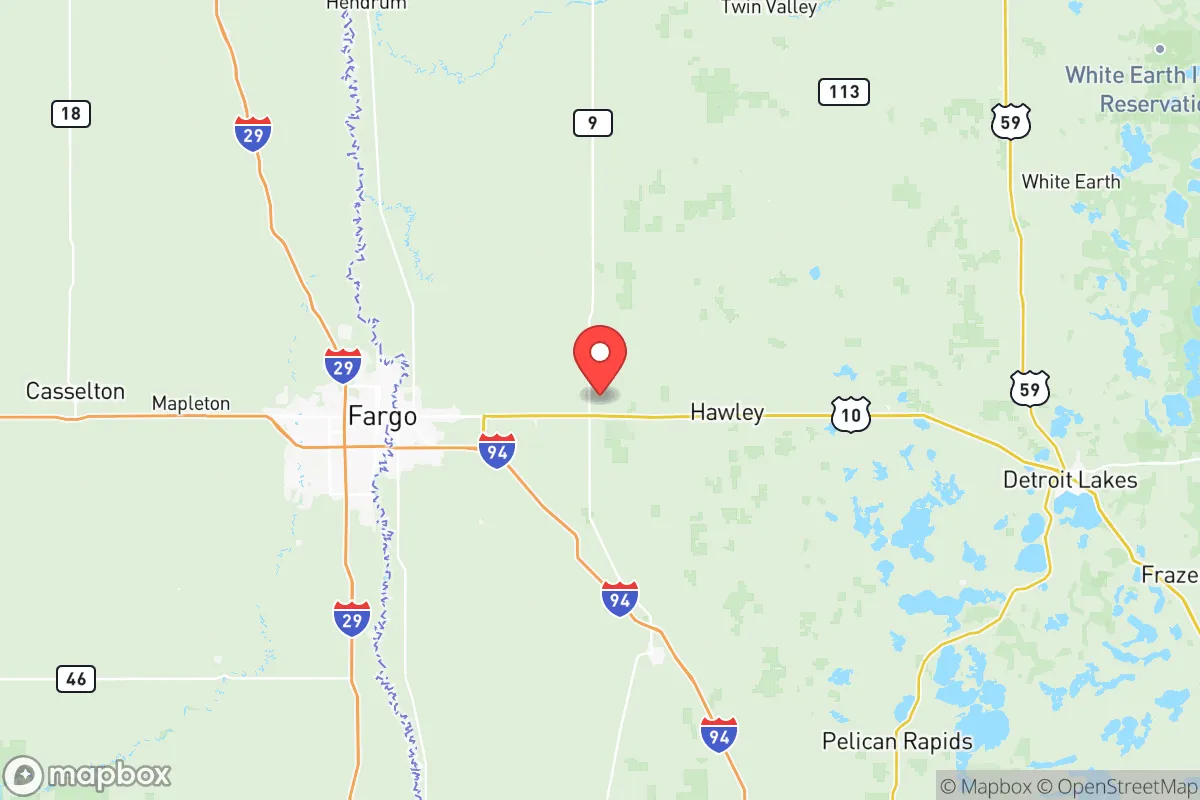
Today, Clay County, Minnesota is home to 65,628 residents, a population that remains predominantly white (84.3%) with a notably low foreign-born share of just 1.8%. The county’s character is shaped by its Red River Valley agricultural roots, a strong Scandinavian and German heritage, and the presence of Minnesota State University Moorhead, which gives the county a moderate college-educated rate of 39.0%. Distinctive identity markers include a blend of rural farming communities and the urban anchor of Moorhead, which sits directly across the Red River from Fargo, North Dakota, creating a unique bi-state metro area.
Settlement & growth (pre-1960)
Before European settlement, the area now known as Clay County was inhabited by the Dakota (Sioux) and Ojibwe (Chippewa) nations, who used the Red River Valley for hunting, fishing, and seasonal camps. The region was part of the vast territory claimed by France and later the United States through the Louisiana Purchase of 1803. The first permanent non-Native settlement began in the 1850s, spurred by the 1854 Treaty of Washington, which opened the land to American settlers. The town of Moorhead was founded in 1871 as a railroad town on the Northern Pacific Railway, quickly becoming the county’s commercial and transportation hub.
The major population wave came from Scandinavian immigrants—Norwegians and Swedes—beginning in the 1870s, drawn by the promise of fertile farmland in the Red River Valley. These settlers established farming communities like Glyndon (founded 1872), Hawley (founded 1873), and Barnesville (founded 1874), where their descendants remain concentrated today. German immigrants also arrived in significant numbers during the same period, settling in areas like Ulen and Felton. The Homestead Act of 1862 and the subsequent railroad land grants were the primary pull factors, offering 160-acre parcels for a small filing fee. By 1900, the county’s population had reached roughly 17,000, overwhelmingly white and of Northern European descent.
The early 20th century saw continued agricultural expansion, with sugar beet farming becoming a major industry after the American Crystal Sugar Company built a processing plant in East Grand Forks (just north of the county) in 1926. This drew a smaller wave of Polish and Russian-German immigrants to the region, though Clay County itself remained less affected than neighboring counties. The Dust Bowl and Great Depression of the 1930s caused some out-migration, but the county’s population held relatively steady. Post-World War II, the GI Bill and the expansion of Minnesota State University Moorhead (then Moorhead State Teachers College) brought a new wave of domestic migrants—veterans and their families—who settled in Moorhead and the growing suburbs of Dilworth and Sabin. By 1960, the county’s population had grown to approximately 35,000, still overwhelmingly white and rural.
Modern era (post-1965)
The 1965 Hart-Cellar Act, which abolished national-origin quotas, had a minimal immediate impact on Clay County due to its remote location and lack of industrial job base. The foreign-born population remains very low at 1.8% today, far below the national average. The most significant demographic shift since 1965 has been domestic: the growth of Moorhead as a regional education and healthcare center. Minnesota State University Moorhead expanded its enrollment from about 4,000 in 1970 to over 5,500 today, attracting students from across the Upper Midwest and a small number of international students. This has slightly diversified the county, with the Asian (East/Southeast Asian) population reaching 1.4% and the Black population reaching 4.6%, largely concentrated in Moorhead near the university.
The Hispanic population, at 4.9%, has grown primarily through agricultural labor, particularly in sugar beet and potato farming. Many Hispanic families have settled in Moorhead and Barnesville, where seasonal work is available. The Indian (subcontinent) population remains tiny at 0.3%, mostly tied to professional roles at the university or regional healthcare systems. Suburbanization has been modest compared to national trends, with Dilworth and Glyndon seeing new housing developments as bedroom communities for Fargo-Moorhead commuters. The county’s overall racial composition has shifted only slightly: from 98% white in 1970 to 84.3% white today, with the change driven almost entirely by Hispanic and Black in-migration.
The future
Clay County’s population is projected to grow slowly, reaching roughly 70,000 by 2035, driven primarily by natural increase and continued domestic migration to the Fargo-Moorhead metro area. The county is not tribalizing into distinct ethnic enclaves; instead, the small Hispanic and Black populations are largely assimilating into existing communities, particularly in Moorhead. The East/Southeast Asian and Indian populations are expected to remain small, plateauing at current levels unless the university significantly expands its international recruitment. The white majority is aging, with a median age of 36.5, slightly above the state average, suggesting a gradual demographic shift as younger, more diverse families move in.
Culturally, the county is absorbing new arrivals into its existing Scandinavian-American and agricultural identity rather than being transformed by them. The next 10-20 years will likely see a slow, steady diversification of Moorhead, while rural towns like Hawley, Ulen, and Felton will remain overwhelmingly white and older. The county’s political and social character will likely remain moderate-conservative, with the rural areas leaning Republican and Moorhead providing a more liberal counterweight.
For someone moving in now, Clay County offers a stable, low-diversity environment with a strong sense of place rooted in its agricultural and Scandinavian heritage. The population is becoming slightly more diverse but at a pace that will not disrupt the county’s fundamental cultural identity for at least another generation.

* Values derived from national, state, county, city and local statistics and may differ in a specific area. Last updated: 2026-05-09T01:57:22.000Z
Narrative content on this page is AI-generated and may contain mistakes. Verify any details that matter before acting on them.
ReloMaps may earn a commission from affiliate links at no extra cost to you.

