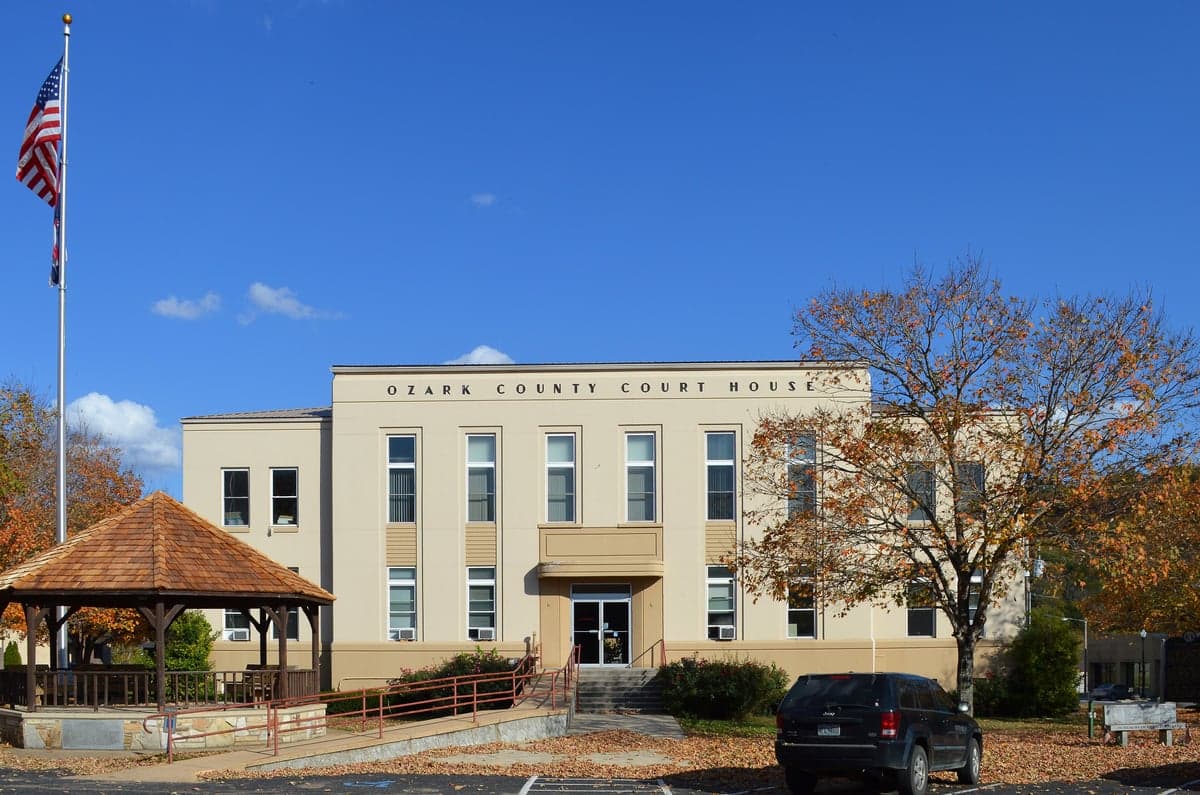
Photo: Wikipedia
Demographics of Ozark County
Affluence Level in Ozark County
A below-average socioeconomic profile. Incomes, home values, and educational attainment trail the U.S., with higher poverty and unemployment.
People of Ozark County
Ozark County, Missouri, is home to 8,773 residents, making it one of the state’s most sparsely populated counties, with a population density of just 8.5 people per square mile. The population is overwhelmingly white (93.9%) and native-born (99.7% U.S.-born), with only 0.3% foreign-born residents, reflecting a deeply rooted, insular community shaped by generations of rural settlement. Distinctive markers include a low college attainment rate (12.4%), a strong reliance on agriculture, tourism, and small-town services, and a cultural identity tied to the Ozarks’ hill-country traditions of self-reliance and conservative values.
Settlement & growth (pre-1960)
The land now called Ozark County was originally inhabited by the Osage Nation, who controlled much of southern Missouri and northern Arkansas. The Osage were forcibly removed through treaties and land cessions in the early 1800s, opening the region to Euro-American settlement. Spanish and French fur traders passed through but left no permanent settlements; the first lasting European presence came with American pioneers after the Louisiana Purchase of 1803.
The first major wave of settlers arrived between 1820 and 1850, primarily Scots-Irish and English families migrating from Kentucky, Tennessee, and the Upper South. They were drawn by the promise of cheap, fertile land in the White River Valley and the protection of the 1820 Missouri Compromise, which allowed slavery in the territory. These early settlers established the county’s first towns: Gainesville (the county seat, founded 1841), Rockbridge (a mill town on the North Fork River), and Theodosia (a river landing). The population grew slowly, reaching about 3,000 by 1850, with a subsistence economy based on corn, livestock, and timber.
After the Civil War, a second wave of settlement occurred between 1870 and 1900, as Union and Confederate veterans alike sought land in the Ozarks. This period saw the founding of Dora, Bakersfield, and Wasola, each built around a general store, a church, and a one-room school. The arrival of the railroad in the 1880s—the Kansas City, Ozarks & Southern Railway—connected Gainesville to the outside world and spurred a brief timber boom. By 1900, the population had climbed to 9,812, the county’s historic peak. The railroad also brought a small number of German and Irish families, but they were quickly absorbed into the dominant Scots-Irish culture.
The period from 1900 to 1960 was one of stagnation and decline. The timber industry collapsed, the railroad was abandoned in the 1930s, and the Great Depression hit the Ozarks hard. Many families left for cities like Springfield, St. Louis, and Detroit. The population fell to 6,226 by 1950. No new immigrant groups arrived; the county remained almost entirely native-born white, with a tiny Black population (under 1%) descended from a few freed slaves who stayed after the Civil War. The construction of the Norfork Dam (1944) and Bull Shoals Dam (1951) on the White River created large reservoirs that later fueled a tourism economy, but the county’s population did not recover until the 1970s.
Modern era (post-1965)
The 1965 Hart-Cellar Act had virtually no effect on Ozark County. The foreign-born population remains at 0.3%—essentially zero—and there are no immigrant enclaves anywhere in the county. The demographic story of the modern era is instead one of domestic migration: a slow, steady return of retirees, second-home buyers, and remote workers drawn by the area’s low cost of living, natural beauty, and conservative culture.
Between 1970 and 2000, the population grew from 6,226 to 9,542, driven by in-migration from the Midwest and Rust Belt states. Many of these new residents settled around the county’s two major lakes: Bull Shoals Lake (in the southeast, near the town of Theodosia) and Norfolk Lake (in the northeast, near Gainesville). These lake communities attracted retirees from Illinois, Indiana, and Ohio, as well as vacation-home owners from Springfield and Kansas City. The town of Gainesville saw new subdivisions and a modest retail expansion, while Rockbridge became a hub for trout fishing and canoe outfitters.
The Hispanic population, though still small (1.9%), is the only minority group to show any growth since 2000. This is almost entirely due to Mexican and Central American laborers working in the county’s poultry processing plants (e.g., the Cargill plant in nearby Butterfield, just over the line in Barry County) and in seasonal agricultural work. These families are dispersed across the county, with small clusters in Gainesville and Bakersfield, but they have not formed a visible ethnic enclave. The Black population (0.4%) and Asian population (0.0%) remain negligible. The county’s racial homogeneity is among the highest in Missouri, rivaled only by a handful of other Ozark counties.
Suburbanization has been minimal. There are no suburbs in the traditional sense; the largest town, Gainesville, has only 773 residents. Most new housing is built on rural acreage or along lakefront lots, reinforcing the county’s dispersed, low-density character. The internet and remote work have brought a trickle of younger families from larger cities, but they remain a small minority.
The future
Ozark County is not becoming more diverse. The white share of the population has actually increased slightly since 2000 (from 93.0% to 93.9%), while the Hispanic share has plateaued. The foreign-born share is effectively zero and is unlikely to rise, given the county’s lack of major employers, limited housing stock, and distance from any interstate highway. The county’s population is projected to remain flat or decline slightly over the next 20 years, as the retiree cohort ages out and younger residents continue to leave for college and jobs in Springfield, Branson, or beyond.
New communities are not forming; instead, existing towns like Gainesville, Rockbridge, and Theodosia are likely to see modest infill development as lakefront property becomes more valuable. The cultural identity of the county will remain deeply conservative, evangelical Christian, and Scots-Irish in character. The only significant demographic shift may be a gradual increase in the share of residents over 65, as the county becomes an even more pronounced retirement destination.
For someone moving in now, Ozark County offers a quiet, affordable, and culturally homogeneous environment—a place where change comes slowly and tradition runs deep. It is not a place of demographic dynamism or diversity, but rather a stable, rural stronghold where the population’s history is still visible in its people, its place names, and its way of life.

* Values derived from national, state, county, city and local statistics and may differ in a specific area. Last updated: 2026-09-10T00:49:35.000Z
Narrative content on this page is AI-generated and may contain mistakes. Verify any details that matter before acting on them.
ReloMaps may earn a commission from affiliate links at no extra cost to you.

