Photo: Wikipedia
Political ClimatePolitical Climate in Ozark County
Showing district-level results — no local-only data available.
Local Political AnalysisPolitical Analysis of Ozark County
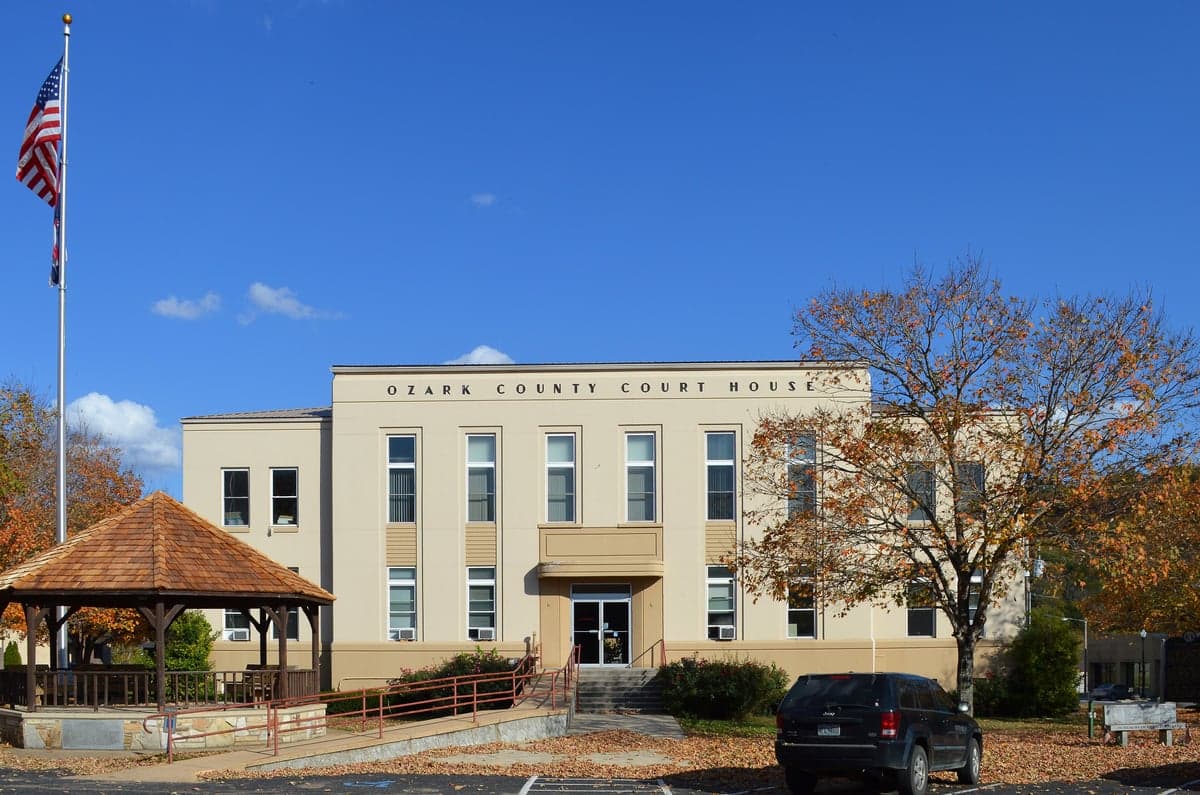
Ozark County, Missouri, is one of the most reliably Republican counties in the state, with a Cook Partisan Voting Index (PVI) of R+27—meaning it votes about 27 points more Republican than the national average. That’s a far cry from Missouri’s statewide PVI of R+8, and the gap has only widened over the last decade. The county hasn’t voted for a Democratic presidential candidate since 1964, and in 2024, Donald Trump carried it by a margin north of 80 percent. The political center of gravity here is deeply conservative, but it’s not a monolith—there are real pockets of variation, especially around the county’s few small towns.
How it compares
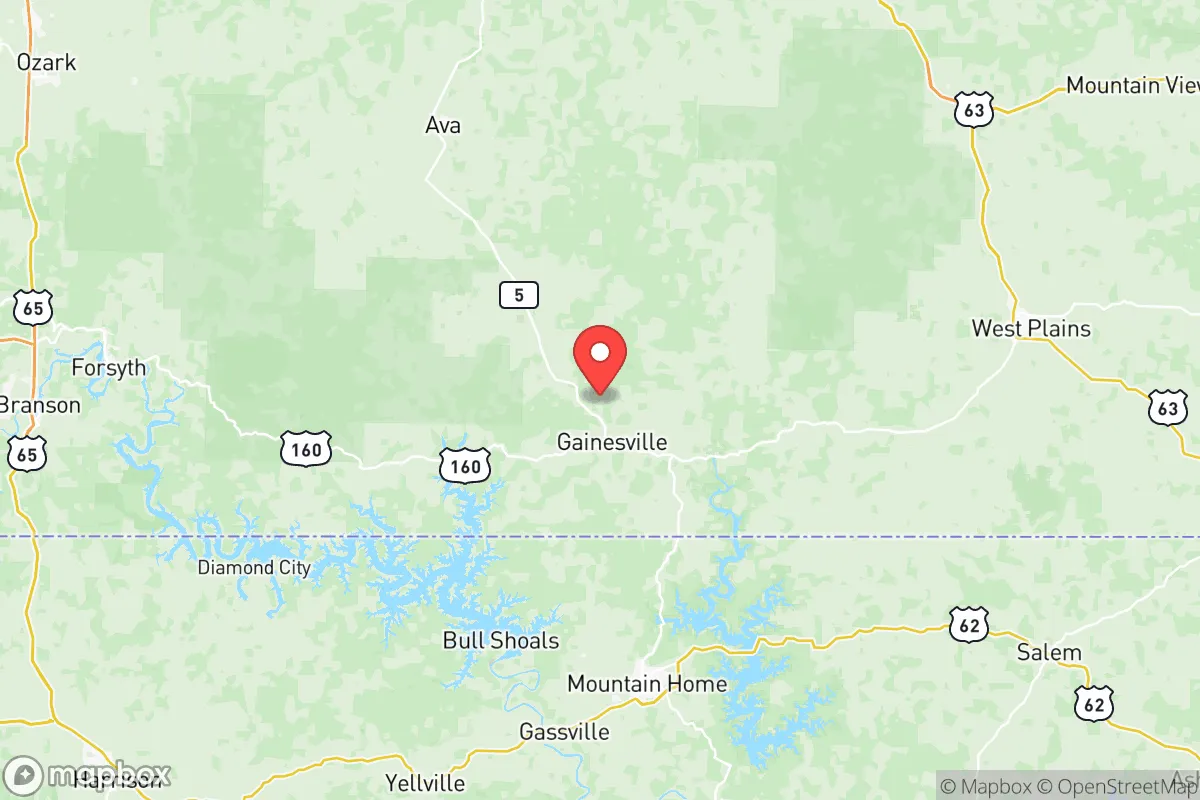
To understand Ozark County’s politics, you have to look at the map. The county seat, Gainesville, is reliably red but tends to be a few points less Republican than the rural precincts—think 75-80 percent GOP instead of 85-90. The tiny village of Theodosia, along the Norfork Lake shoreline, leans even more conservative, often hitting 90 percent Republican in local races. On the other end, Bakersfield and Dora show slightly more competitive numbers, though still solidly red; they’re the closest thing to swing precincts in the county, with Democratic candidates occasionally cracking 30 percent. By contrast, Missouri as a whole has a handful of blue-leaning urban centers—St. Louis, Kansas City, Columbia—that pull the statewide PVI toward R+8. Ozark County has no such counterweight. Its population of roughly 9,500 is spread across rolling hills and farmland, and the dominant political conversation revolves around property rights, gun access, and opposition to state-level mandates from Jefferson City. The county’s R+27 PVI isn’t just a number; it reflects a place where registered Republicans outnumber Democrats by a factor of nearly five to one.
What this means for residents
For conservative residents, Ozark County feels like a stronghold. Local offices—sheriff, county commissioner, school board—are almost always held by Republicans, and policy debates tend to focus on keeping taxes low and limiting regulation. The county commission has pushed back on state-level efforts to expand Medicaid and has resisted federal land-use proposals for the Mark Twain National Forest, which covers a chunk of the county. For liberal residents, the reality is more isolating. There’s no Democratic Party committee in the county, and progressive candidates rarely appear on the ballot for local races. Socially, it’s a place where political conversations at the feed store or church potluck assume a conservative baseline. That said, the county’s small size means most people know each other across party lines, and overt political hostility is rare—it’s more a quiet consensus than a culture war.
Culturally, Ozark County stands apart from Missouri’s urban corridors in ways that go beyond voting. The county has no stoplights, no chain grocery stores, and a strong tradition of self-reliance that shapes local policy. The county commission has declared itself a “Second Amendment Sanctuary” and passed resolutions opposing state-level vaccine mandates. Property taxes are among the lowest in the state, and there’s a palpable skepticism of outside influence, whether from Springfield, Jefferson City, or Washington. For anyone moving here, the political climate isn’t just about elections—it’s woven into daily life, from the way neighbors handle disputes to the expectations around community involvement. It’s a place where the politics match the landscape: rural, independent, and slow to change.

State Political ClimatePolitical Climate in Missouri
State Political AnalysisPolitical Environment in the State
Missouri is a solidly Republican state with a Cook PVI of R+8, meaning it typically votes about eight points more conservative than the national average. Over the past 20 years, the state has shifted from a classic bellwether—voting for the winner in every presidential election from 1904 to 2004 except 1956—to a reliably red stronghold, driven by the exodus of rural and suburban voters from the Democratic coalition and the near-total collapse of Democratic strength outside of St. Louis and Kansas City. The 2024 presidential race saw Donald Trump carry the state by roughly 18 points, a margin that has widened from 15 points in 2020 and 19 points in 2016, reflecting a consolidation of conservative voters in the exurbs and small towns while the two major metros remain blue islands.
Urban vs. rural divide
The political map of Missouri is a study in stark contrasts. The two major metropolitan areas—St. Louis and Kansas City—are Democratic strongholds, with St. Louis City and County delivering margins of 70-80% for Democratic candidates in recent cycles. Columbia, home to the University of Missouri, and Springfield, a more moderate-leaning city with a large university presence, also lean blue but with less intensity. Outside these islands, the state is overwhelmingly Republican. The rural "Bootheel" counties in the southeast, the Ozarks around Branson and West Plains, and the northern plains along the Iowa border routinely vote 70-80% Republican. A notable shift has occurred in the St. Louis exurbs: St. Charles County, once a swing area, has become a Republican stronghold, while Jefferson County to the south flipped hard red after 2016. The Kansas City suburbs like Lee's Summit and Blue Springs remain competitive but lean Republican, while Clay County north of the river has trended Democratic in recent years. The net effect is a state where the rural and exurban vote overwhelms the urban centers, producing the R+8 lean.
Policy environment
Missouri's policy environment is distinctly conservative, with a low-tax, low-regulation posture that appeals to many relocators. The state has a flat income tax rate of 4.8% (as of 2025, down from 5.3% in 2023), with a phase-in plan to eventually reach 4.5%. There is no state property tax on vehicles, and property taxes on real estate are among the lowest in the nation—averaging around 0.8% of assessed value. The state is a "right-to-work" state (though the law was repealed by referendum in 2018, the legislature has since passed a new version that survived court challenges), and it has some of the weakest labor union protections in the country. Education policy is a flashpoint: Missouri has a robust school choice movement, with charter schools allowed in St. Louis and Kansas City, and a growing number of private school voucher programs through tax-credit scholarships. The state's public school funding formula has been a source of litigation, with rural districts often feeling shortchanged. Healthcare policy is mixed—Missouri expanded Medicaid under the 2020 ballot initiative (Amendment 2), but the legislature has resisted further expansion and has imposed work requirements for able-bodied adults. Election laws are moderately restrictive: the state requires a government-issued photo ID to vote, has no same-day registration, and has purged inactive voters from rolls. However, no-excuse absentee voting was expanded in 2020 and remains in place.
Recent policy direction
Over the past five years, Missouri's legislature has moved aggressively on a range of cultural and liberty issues. Gun and self-defense law: In 2021, Missouri passed a "Second Amendment Preservation Act" (SAPA) that purports to nullify federal gun laws, though it has been partially struck down in federal court. The state also has permitless carry (constitutional carry) for concealed weapons, passed in 2017. Parental and education rights: The "Parents' Bill of Rights" (HB 2416, 2022) requires schools to notify parents of any "sexually explicit" instructional materials and allows parents to opt their children out. A 2023 law banned transgender girls from participating in girls' sports in K-12 and college. Speech and privacy: Missouri has a "sunshine law" that is relatively strong for government transparency, but the legislature has debated bills to restrict social media platforms from "censoring" political speech—a trend that mirrors national conservative priorities. Medical and bodily autonomy: Abortion is effectively banned in Missouri after a 2019 trigger law took effect following the Dobbs decision, with no exceptions for rape or incest. The state has also restricted gender-affirming care for minors (2023). Property rights: Missouri is a "right-to-farm" state, with constitutional protections for agricultural operations against nuisance lawsuits. Taxation: The flat income tax is being phased down, and the state has no estate or inheritance tax. Voting and ballot access: The 2020 election saw a temporary expansion of absentee voting, but the legislature has since tightened rules, including a ban on ballot drop boxes (2022) and a requirement that absentee ballots be notarized (unless the voter is permanently disabled or 65+). The overall direction is toward a more conservative, culturally traditionalist policy environment, with a focus on limiting government overreach in areas like gun rights and parental control while expanding it in areas like abortion and transgender rights.
Civil unrest & political movements
Missouri has a history of visible political activism, particularly around racial justice and policing. The 2014 Ferguson protests following the shooting of Michael Brown in Ferguson (a St. Louis suburb) sparked a national movement and led to the Department of Justice's "Ferguson Report," which documented systemic racial bias in the city's police and court system. Since then, protests have been periodic but less intense, with the 2020 George Floyd protests drawing large crowds in St. Louis and Kansas City. On the right, the "Patriot" movement is active, with groups like the Missouri State Militia and various "constitutional sheriff" organizations holding rallies and opposing federal land management. Immigration politics are less heated than in border states, but St. Louis and Kansas City have both declared themselves "sanctuary cities" in some form, though the state legislature has passed laws prohibiting such designations and requiring local law enforcement to cooperate with ICE. Election integrity controversies flared after 2020, with the state GOP launching a "forensic audit" of the 2020 election in St. Louis County (which found no evidence of widespread fraud). The state's "SAPA" gun law has created a flashpoint with federal law enforcement, with some local sheriffs refusing to enforce federal gun laws. A new resident would notice the prevalence of political yard signs, especially in rural areas, and the strong presence of conservative media outlets like the Missouri Times and talk radio stations.
Projection
Over the next 5-10 years, Missouri is likely to become more, not less, Republican. In-migration patterns show that people moving into the state are disproportionately coming from blue states like Illinois and California, but they tend to settle in the exurbs and rural areas—places like St. Charles County, Warrensburg, and the Lake of the Ozarks region—where they reinforce the conservative tilt. The St. Louis and Kansas City metros are growing slowly or stagnating, while the Ozarks and the I-70 corridor (Columbia to Kansas City) are seeing faster growth. The state's demographic profile is aging and whiter than the national average, but the Hispanic population is growing in southwest Missouri (around Monett and Neosho), which could introduce new political dynamics. The legislature will likely continue to push on cultural issues—further restrictions on abortion, expanded school choice, and more "parental rights" legislation. The flat income tax will continue to drop, making the state even more attractive to tax-sensitive relocators. However, the state's infrastructure (roads, bridges, broadband) is aging and underfunded, and the Medicaid expansion has strained the healthcare system in rural areas. A new resident moving in now should expect a state that is politically stable, culturally conservative, and increasingly resistant to federal mandates, but with growing tensions between the urban blue islands and the rural red majority.
For a new resident, the bottom line is that Missouri offers a low-cost, low-tax environment with a strong conservative cultural and political tilt. If you're a conservative, you'll find a state government that largely aligns with your values on guns, taxes, education, and social issues. If you're a liberal, you'll find vibrant blue communities in St. Louis, Kansas City, and Columbia, but you'll be living under a state government that is actively working against many of your policy preferences. The state's political trajectory is clear: more Republican, more culturally traditionalist, and more resistant to federal authority. Plan accordingly.
* Values derived from national, state, county, city and local statistics and may differ in a specific area. Last updated: 2026-09-10T00:49:35.000Z
Narrative content on this page is AI-generated and may contain mistakes. Verify any details that matter before acting on them.
ReloMaps may earn a commission from affiliate links at no extra cost to you.

