
Photo by Mike Gattorna on Unsplash
Demographics of St Louis City County
Affluence Level in St Louis City County
A below-average socioeconomic profile. Incomes, home values, and educational attainment trail the U.S., with higher poverty and unemployment.
People of St Louis City County
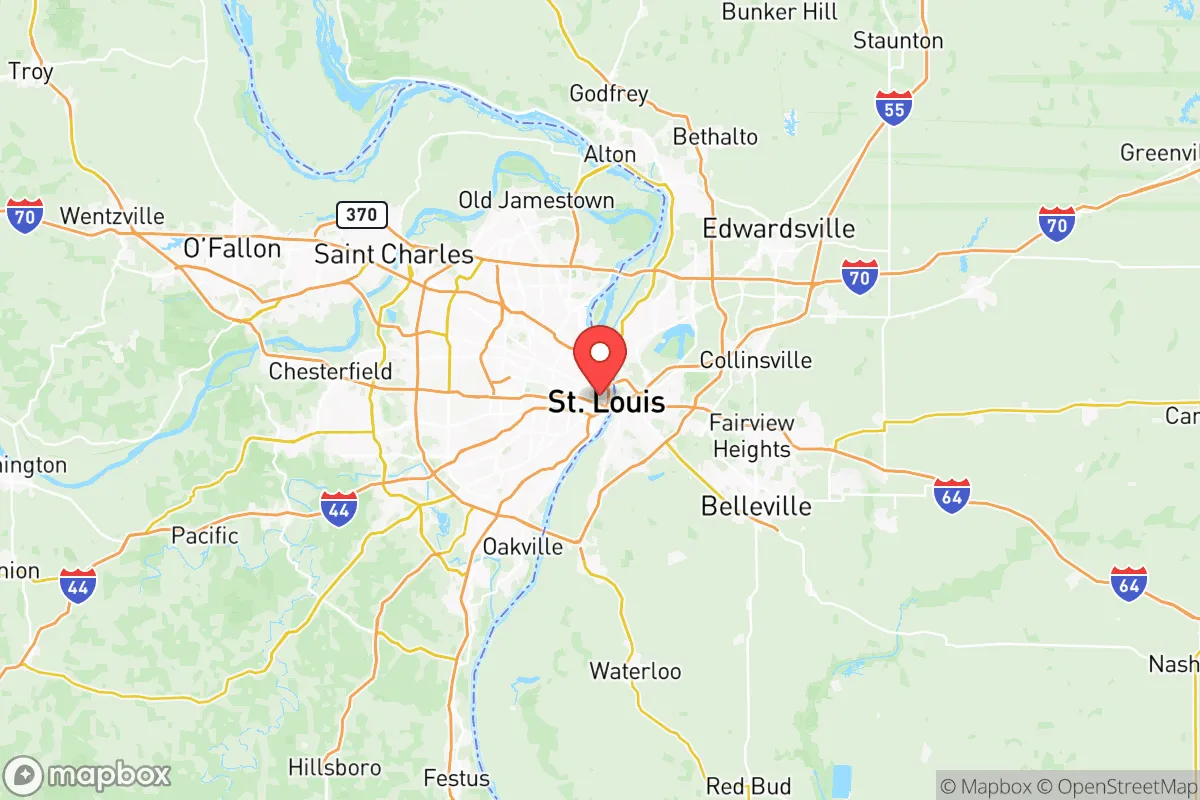
St. Louis City County, Missouri, is a densely urban jurisdiction of 293,109 residents that stands apart from the surrounding region for its stark racial and economic contrasts. It is a majority-minority city where 42.9% of the population identifies as Black or African American, 44.4% as White, 5.1% as Hispanic, and 2.5% as East or Southeast Asian, with a small but notable Indian subcontinent community of 0.9%. The city is also highly educated, with 40.2% of adults holding a bachelor's degree or higher, yet it grapples with a legacy of population decline and concentrated poverty that shapes its identity as a place of both historic significance and modern struggle.
Settlement & growth (pre-1960)
Before European contact, the area that is now St. Louis City County was home to the Mississippian culture, particularly the Cahokia Mounds civilization centered across the Mississippi River in present-day Illinois. By the time French fur traders arrived in the late 17th century, the region was inhabited by the Osage and Illinois nations, who used the confluence of the Missouri and Mississippi Rivers as a trading and hunting ground. The French established a small settlement at the site of present-day St. Louis in 1764, naming it after King Louis IX, and it remained a modest fur-trading outpost under French and then Spanish control until the Louisiana Purchase of 1803.
The city's population exploded in the 19th century, driven by two primary forces: westward expansion and German immigration. After the Louisiana Purchase, St. Louis became the gateway to the American West, with settlers, traders, and pioneers passing through on their way to Oregon, California, and the Santa Fe Trail. This commercial boom attracted a wave of German immigrants in the 1830s through the 1850s, who settled heavily in the neighborhoods of Soulard, Benton Park, and Carondolet. These Germans were largely skilled artisans, brewers, and farmers who established the city's brewing industry, built Catholic and Lutheran churches, and created a distinct German-American culture that persisted for generations. Irish immigrants also arrived in large numbers during the Great Famine of the 1840s, settling in the Kerry Patch neighborhood near the riverfront and in Dogtown, where they worked as laborers on the docks and railroads.
By the Civil War, St. Louis was a divided city, with a large pro-Union German population clashing with a pro-Confederate Southern-leaning elite. The city's population reached 160,000 by 1860, making it the eighth-largest in the nation. After the war, the city continued to grow through industrialization, attracting immigrants from Italy, Poland, and Eastern Europe. Italians settled in The Hill neighborhood, which remains a stronghold of Italian-American culture and cuisine. Poles and Czechs concentrated in the South St. Louis neighborhoods of Dutchtown and Fenton, working in the city's breweries, factories, and rail yards. The Great Migration of African Americans from the rural South began in earnest after World War I, with Black families moving into the Mill Creek Valley and JeffVanderLou neighborhoods, though they faced severe housing discrimination and redlining that confined them to a narrow corridor north of downtown.
By 1950, St. Louis City County had reached its peak population of 856,796, making it the nation's eighth-largest city. The population was overwhelmingly White (82%) and native-born, with a significant but segregated Black minority (18%). The city's economy was anchored by manufacturing, brewing, and the transportation hub of the Mississippi River, but the seeds of decline were already being sown by suburbanization and the construction of the interstate highway system.
Modern era (post-1965)
The 1965 Hart-Cellar Act fundamentally reshaped St. Louis's demographics, though the city's story in the post-1965 era is more about domestic migration than international immigration. The city's population collapsed from 856,796 in 1950 to 622,236 in 1970, and continued falling to 396,685 by 1990, and 319,294 by 2010. This decline was driven by white flight to the suburbs, as middle-class families—both White and Black—left for St. Louis County municipalities like Clayton, University City, and Florissant. The construction of Interstate 70 and Interstate 44 facilitated this exodus, while urban renewal projects like the demolition of the Mill Creek Valley in 1959 destroyed a thriving Black business district and displaced thousands of families.
Immigration to St. Louis City County has been modest compared to coastal cities, but it has been significant in specific enclaves. The city's foreign-born population is just 3.9%, well below the national average of 13.7%. The largest immigrant groups are from Bosnia and Herzegovina, who arrived as refugees in the 1990s and settled in the BeVo Mill and South Grand neighborhoods, and from Vietnam, who arrived after the fall of Saigon in 1975 and concentrated in the South City and Dutchtown. The East/Southeast Asian community (2.5%) includes Chinese, Vietnamese, and Korean families, many of whom operate restaurants and small businesses along South Grand Boulevard. The Indian subcontinent community (0.9%) is smaller but growing, with professionals drawn to the city's hospitals and universities, particularly Washington University and Saint Louis University, and settling in the Central West End and neighborhoods. The Hispanic population (5.1%) is predominantly Mexican and Central American, with significant growth in the Cherokee Street corridor and Gravois Park, driven by labor demand in construction, landscaping, and food service.
The racial composition of the city has shifted dramatically since 1965. The White population fell from 82% in 1950 to 44.4% today, while the Black population rose from 18% to 42.9%. This shift is not due to both white flight and white flight, but also to the annexation of predominantly Black neighborhoods and the city's inability to retain middle-class families of any race. The city's population is now highly segregated by race and income, with the north side (neighborhoods like Ferguson, Jennings, and Wellston) being overwhelmingly Black and impoverished, while the south side (neighborhoods like Southampton, St. Louis Hills, and Princeton Heights) remains predominantly White and middle-class. The Central Corridor, anchored by Washington University and Barnes-Jewish Hospital, is the most diverse and affluent area, with a mix of White, Black, White, Asian, and Indian professionals.
The future
The population of St. Louis City County is projected to stabilize or decline slowly over the next 10-20 years, with modest growth in the Central Corridor and continued depopulation in the north side. The city's population bottomed out at 293,109 in 2020, and early estimates suggest a slight uptick to around 300,000 by 2025, driven by new apartment construction in downtown and the Cortex innovation district. However, the Cortex tech hub. However, the city still loses residents to St. Louis County and St. Charles County, where lower crime rates and better schools attract families.
Immigration will likely remain a small but important factor. The Bosnian community is aging and assimilating, while the Vietnamese and Mexican communities are growing through both immigration and higher birth rates. The Indian subcontinent community is expected to grow as Washington University and tech sectors expand, but it will remain a niche population compared to coastal cities. The East/Southeast Asian community may see modest growth from refugee resettlement and family reunification, but St. Louis lacks the chain migration networks of larger metros.
The city's cultural identity is becoming more polarized. The north side is becoming more diverse and more liberal, with a growing Hispanic presence in the south side and a shrinking but still dominant Black population in the north side. The White population is increasingly concentrated in the Central Corridor and the south side, and is more educated and liberal than the White population of the 1950s. The city's future likely involves a slow, uneven recovery, with pockets of revitalization in the core and continued decline in the periphery. For a conservative-leaning individual or family considering a move, the city offers affordable housing, a strong job market in healthcare and tech, and a rich cultural history, but it also requires careful neighborhood selection to avoid high crime and poor schools.
St. Louis City County is becoming a smaller, more polarized, and more diverse city, where the historic German and Irish neighborhoods are giving way to a patchwork of Black, White, Hispanic, and Asian enclaves. For someone moving in now, the city offers a low cost of living and a strong sense of place, but demands a realistic understanding of its racial and economic divisions. The city is not homogenizing; it is tribalizing into distinct neighborhoods with very different experiences of safety, opportunity, and community.

* Values derived from national, state, county, city and local statistics and may differ in a specific area. Last updated: 2026-05-14T19:49:17.000Z
Narrative content on this page is AI-generated and may contain mistakes. Verify any details that matter before acting on them.
ReloMaps may earn a commission from affiliate links at no extra cost to you.

