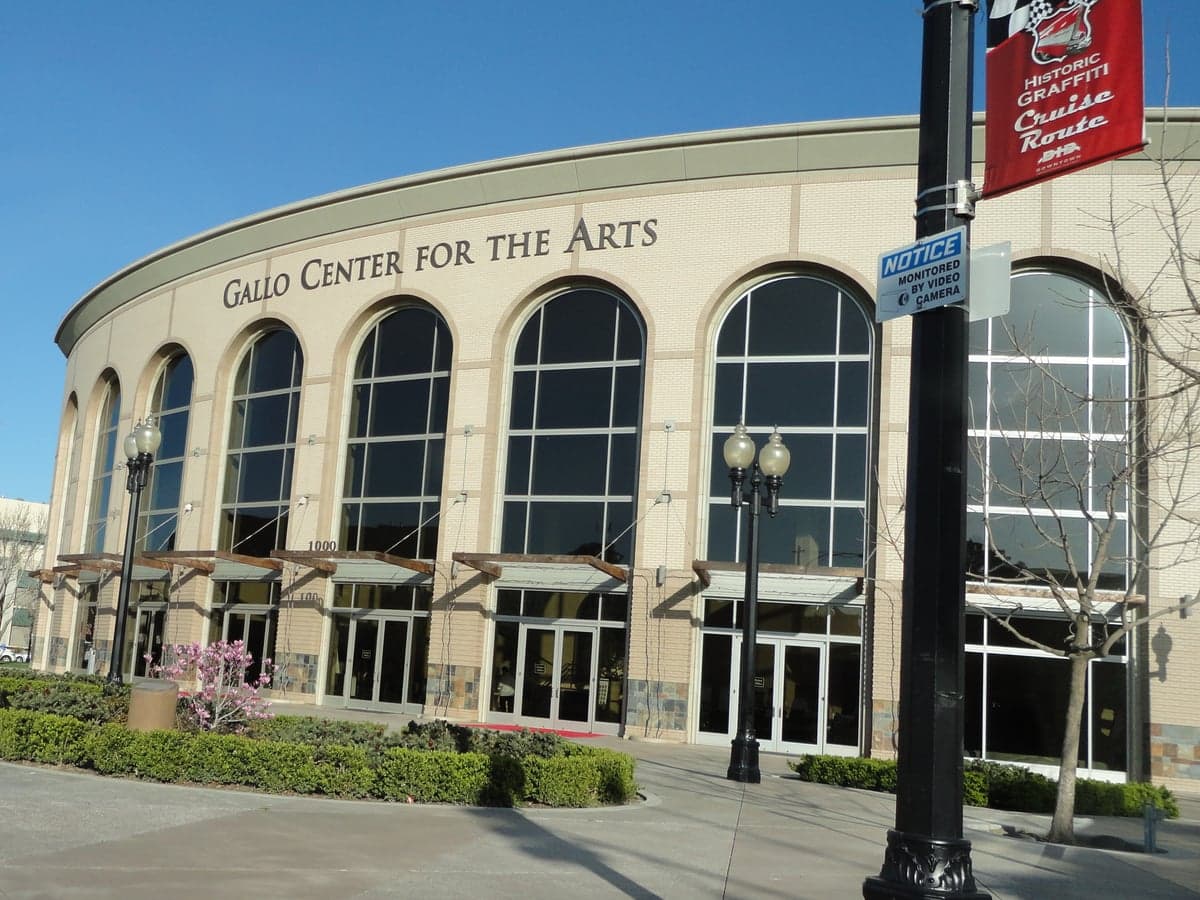
Photo: Wikipedia
Demographics of Modesto, CA
Affluence Level in Modesto, CA
A middle-class area roughly in line with national averages across income, home values, education, and employment.
People of Modesto, CA
Modesto, California, is a majority-minority city of 218,614 where Hispanic residents (43.9%) now outnumber non-Hispanic White residents (39.0%), creating a distinctly bicultural Central Valley community. The city’s population is younger and less college-educated than the state average—only 20.3% hold a bachelor’s degree—reflecting its historic role as a working-class agricultural and industrial hub. Modesto’s identity is shaped by a deep-rooted Hispanic presence, a smaller but established East/Southeast Asian community (5.6%), and a modest Indian-subcontinent population (1.5%), all layered over a fading Anglo-Protestant and Dust Bowl migrant foundation. The city feels more like a collection of distinct neighborhoods than a single melting pot, with each wave of settlement leaving a visible imprint on specific districts.
How the city was settled and grew
Modesto was founded in 1870 as a railroad depot for the Central Pacific Railroad, deliberately sited away from the Tuolumne River to avoid flooding. The original population was overwhelmingly Anglo-American—Midwestern farmers and merchants drawn by cheap land and the railroad’s promise of access to San Francisco markets. The city’s first major non-Anglo wave arrived in the early 1900s: Portuguese and Italian immigrants who worked the surrounding fruit and dairy farms, settling in what is now the Airport District (near the old Modesto Municipal Airport) and along the Maze Boulevard corridor. By the 1930s and 1940s, Dust Bowl refugees from Oklahoma, Arkansas, and Texas—the “Okies” and “Arkies” immortalized in Steinbeck’s The Grapes of Wrath—flooded into Modesto, taking agricultural labor and establishing a white working-class base in neighborhoods like West Modesto (west of the railroad tracks) and the La Loma area near downtown. These groups built the city’s early civic institutions: the Modesto Irrigation District (1923), the Modesto Junior College (1921), and the downtown commercial core along J Street. The city’s population grew from about 4,000 in 1900 to 22,000 by 1950, almost entirely Anglo and European-immigrant.
Modern era (post-1965)
The 1965 Hart-Cellar Immigration Act and the simultaneous decline of small-scale family farming transformed Modesto’s demographics. Mexican and Central American laborers, who had long worked seasonal harvests, began settling year-round, drawn by processing plants (Gallo Winery, Foster Farms) and the construction boom of the 1970s and 1980s. They concentrated in South Modesto (south of Briggsmore Avenue) and the Franklin District (around Franklin Elementary), areas that today are over 70% Hispanic. The East/Southeast Asian community—primarily Filipino and Vietnamese—arrived in two waves: Filipino farmworkers and nurses in the 1970s, and Vietnamese refugees after 1975, settling in the College Area near Modesto Junior College and along McHenry Avenue. The Indian-subcontinent population (1.5%) is a more recent, smaller group—mostly professionals in healthcare and tech who arrived after 2000, living in newer subdivisions like Wood Colony and the Del Rio area. Meanwhile, the Anglo population aged and suburbanized: many white families moved to newer developments in north Modesto (the North Modesto area around Sylvan Avenue) or to exurban towns like Riverbank and Oakdale, leaving older central neighborhoods like West Modesto increasingly Hispanic and lower-income. By 2020, the city had shifted from 70% white in 1980 to 39% white today.
The future
Modesto’s population is heading toward a more Hispanic-majority future, with the white share declining steadily (down from 45% in 2010) and the Hispanic share rising. The East/Southeast Asian and Indian populations are growing slowly but remain small; they are not expected to reach critical mass in any single neighborhood. The city is tribalizing rather than homogenizing: South Modesto and West Modesto are becoming almost exclusively Hispanic and lower-income, while North Modesto and Del Rio remain whiter and more affluent. The foreign-born share (9.3%) is below the California average (27%), suggesting that Modesto’s Hispanic growth is driven more by U.S.-born children of immigrants than by new arrivals. The college-educated share (20.3%) is stagnant, as the city struggles to attract knowledge-economy jobs; most growth is in warehousing, logistics, and healthcare. Over the next 10–20 years, Modesto will likely become a solidly Hispanic-majority city with a white minority concentrated in the northern suburbs, a pattern common across the Central Valley.
For a conservative-leaning mover, Modesto offers a working-class, family-oriented environment with a strong agricultural heritage and relatively affordable housing—but also a city where ethnic and economic divides are hardening by neighborhood. The city is not becoming more diverse in a blended sense; it is becoming more segregated by race and class. New arrivals should expect to choose a neighborhood that aligns with their demographic and lifestyle preferences, rather than finding a single integrated community.

* Values derived from national, state, county, city and local statistics and may differ in a specific area. Last updated: 2026-04-30T00:09:03.000Z
Narrative content on this page is AI-generated and may contain mistakes. Verify any details that matter before acting on them.
ReloMaps may earn a commission from affiliate links at no extra cost to you.

