Photo: Wikipedia
Demographics of Moline, IL
Affluence Level in Moline, IL
A below-average socioeconomic profile. Incomes, home values, and educational attainment trail the U.S., with higher poverty and unemployment.
People of Moline, IL
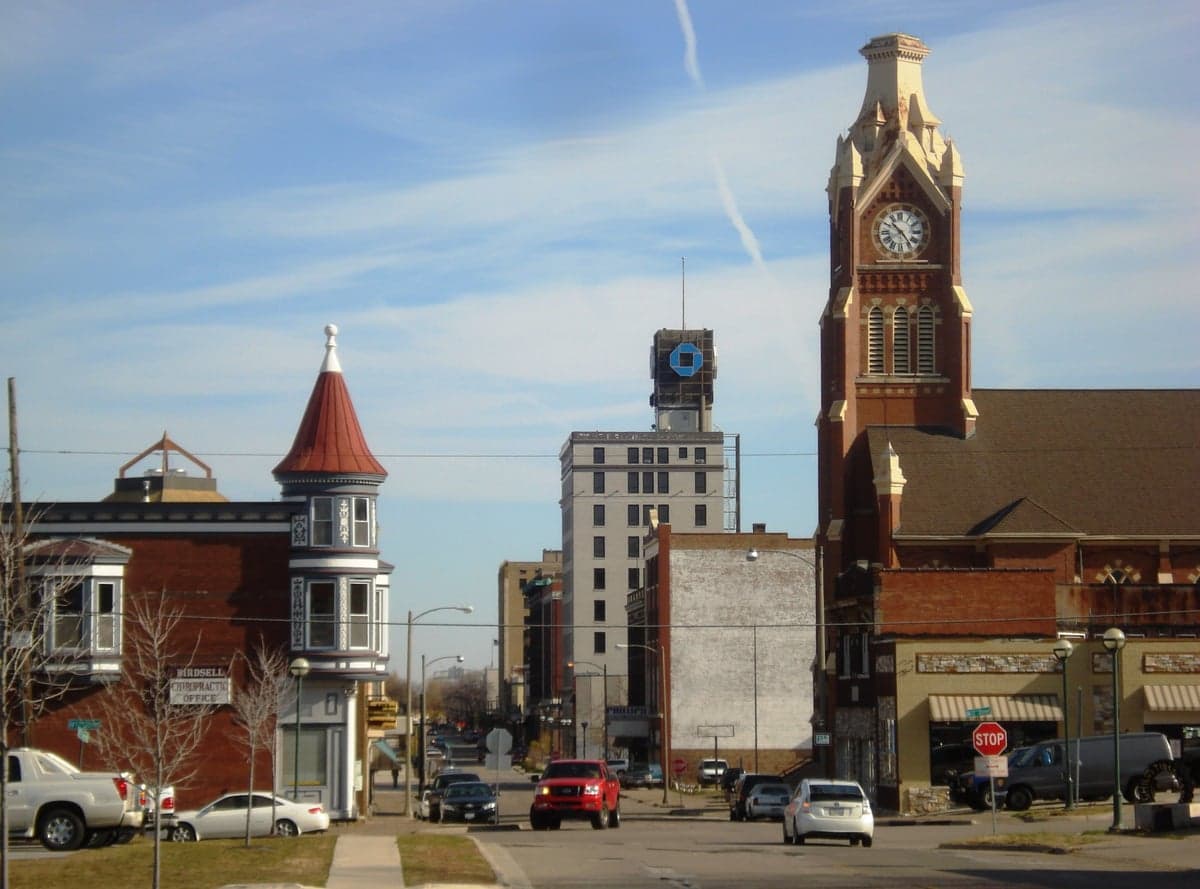
Moline, Illinois, is a city of 42,235 residents that blends a historic manufacturing identity with a growing diversity shaped by immigration and suburban stability. The population is 64.0% white, 18.4% Hispanic, 9.9% Black, 1.7% Indian (subcontinent), and 1.5% East/Southeast Asian, with 6.2% foreign-born and 29.1% college-educated. The city retains a dense, walkable core along the Mississippi River, distinct from its more suburban neighbors, and its people are defined by a pragmatic, working-class character rooted in generations of industrial labor and recent waves of new arrivals.
How the city was settled and grew
Moline’s population history begins with its founding in 1848 as a planned industrial town along the Mississippi River, driven by the water power of the Rock Island Rapids. The original settlers were largely Yankee entrepreneurs and German and Swedish immigrants who built the city’s first factories, including the Moline Plow Company (later John Deere). These groups established distinct neighborhoods: Swedes settled in the 3rd Ward around 7th Avenue and 12th Street, while German families concentrated in the 4th Ward near the riverfront mills. By 1900, the city was a booming manufacturing hub, with John Deere’s headquarters and factories drawing successive waves of Italian, Polish, and Irish immigrants. The Florence Park neighborhood became a landing point for Italian families in the 1910s, while Polish immigrants clustered in the 2nd Ward near the Deere & Company works. The city’s population peaked at around 46,000 in the 1960s, supported by a stable industrial base that provided steady employment for generations.
Modern era (post-1965)
After the 1965 Immigration and Nationality Act, Moline’s demographic composition began to shift. The city’s white population declined from over 90% in 1970 to 64.0% today, as domestic out-migration to suburbs and Sun Belt states accelerated. Meanwhile, new immigrant groups arrived. Hispanic residents, now 18.4% of the population, began settling in the 1970s and 1980s, drawn by jobs in manufacturing and agriculture. They concentrated in the South Park neighborhood and along the 11th Street corridor, where Mexican and Central American families established small businesses and churches. The Black population, now 9.9%, grew primarily through domestic migration from Chicago and the South, settling in the Bicentennial Park area and the 7th Avenue corridor. Indian (subcontinent) residents, at 1.7%, arrived more recently, many as professionals in healthcare and engineering, and are scattered across the city but with a visible presence near the Trinity Health campus. East/Southeast Asian communities, at 1.5%, include Vietnamese and Filipino families who came in the 1980s and 1990s, often settling in the Florence Park neighborhood alongside older Italian families. The foreign-born share of 6.2% is modest but growing, with the Hispanic population driving the largest absolute increase.
The future
Moline’s population is heading toward greater diversity, but not rapid growth. The city has stabilized around 42,000 residents after decades of slow decline, and projections suggest a slight increase to 43,000–44,000 by 2040, driven by Hispanic and Indian immigration. The white population is aging and shrinking, while the Hispanic share is expected to reach 22–25% within 15 years, with families moving into the South Park and 11th Street areas. The Indian community is growing slowly, likely reaching 2.5–3% as healthcare and tech jobs expand. The Black population is plateauing, with some out-migration to suburban Bettendorf and Davenport. The city is not tribalizing into stark enclaves—most neighborhoods remain mixed—but the South Park area is becoming distinctly Hispanic, while the 3rd Ward retains a Swedish-American identity through cultural festivals and the Swedish American Museum. The East/Southeast Asian community is small and assimilating, with younger generations moving to suburbs. The next decade will likely see Moline become a more Hispanic-majority city in its younger age cohorts, while older white residents remain in the Florence Park and 4th Ward neighborhoods.
For someone moving in now, Moline is becoming a city where a historic white, working-class base is gradually giving way to a more Hispanic and Indian-influenced population, but without the rapid change seen in larger Midwestern cities. The city offers stable, affordable housing and a strong sense of place, but the job market remains tied to manufacturing and healthcare, limiting growth for college-educated professionals. It is a place where new arrivals can find established ethnic communities—especially Hispanic and Indian—while still experiencing a small-town, river-town feel. The population is not homogenizing, but rather diversifying slowly, with distinct neighborhoods retaining their character. This makes Moline a practical choice for families seeking a lower-cost, community-oriented environment with a growing multicultural fabric.

* Values derived from national, state, county, city and local statistics and may differ in a specific area. Last updated: 2026-04-19T06:54:13.000Z
Narrative content on this page is AI-generated and may contain mistakes. Verify any details that matter before acting on them.
ReloMaps may earn a commission from affiliate links at no extra cost to you.

