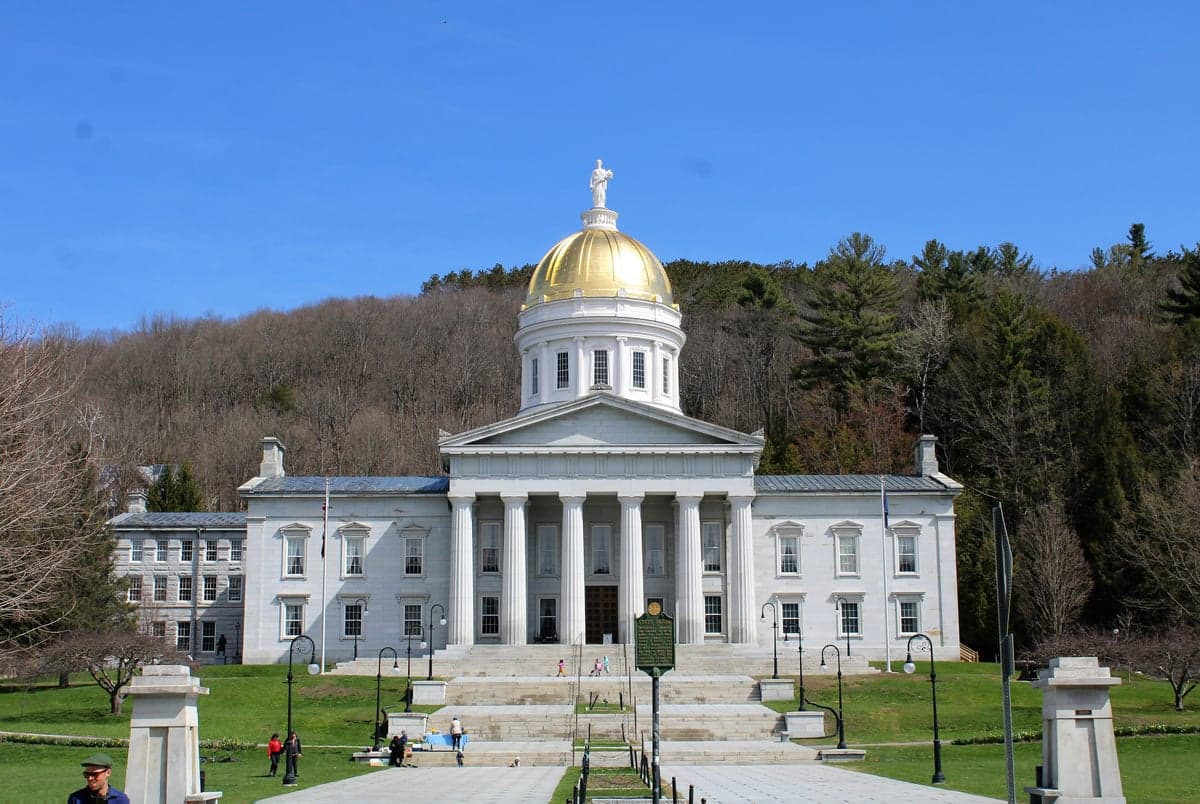
Photo: Wikipedia
Personal Sovereignty in Montpelier, VT
Moderate friction. Expect trade-offs in some aspect of personal liberty and independence.
What does Personal Sovereignty tell us?
Personal Sovereignty measures your capacity for self-reliance and independence with minimal government friction. Higher scores mean fewer barriers between you and the way you want to live... but it assumes you have the space you need and good neighbors.
What does this tell us?
Personal Sovereignty measures your capacity for self-reliance and independence with minimal government friction. Higher scores mean fewer barriers between you and the way you want to live... but it assumes you have the space you need and good neighbors.
State Policy
Energy independence: Importer (15% of energy produced in-state)
Personal Liberty
Homesteading

Personal Liberty Analysis
Montpelier, Vermont, presents a deeply conflicted environment for personal sovereignty. While the state’s rural character and small-town scale offer a surface-level sense of independence, the legal and regulatory reality is one of the most restrictive in New England—particularly for those who prioritize self-defense, medical autonomy, and freedom from government overreach. For a conservative or survivalist-minded individual, Montpelier’s charm is undercut by a state government that consistently prioritizes collective mandates over individual rights, making it a location that demands careful, eyes-open evaluation before relocation.
Tax burden and regulatory posture: what it costs to live free in Vermont
Vermont’s tax burden is among the highest in the nation, and Montpelier sits at the center of that reality. The state levies a progressive income tax with a top marginal rate of 8.75% on income over $213,150 (2025), and a statewide property tax that averages roughly $2.20 per $100 of assessed value—among the highest in the country. For a single individual or family, this means a significant portion of earnings goes directly to state coffers before you even consider sales tax (6%, with no local option) or the state’s aggressive estate tax (starting at $5 million). The regulatory posture is equally heavy: Vermont has some of the strictest land-use laws in the nation, including Act 250, which requires state-level permits for any development that impacts 10+ acres or involves construction on steep slopes, shorelands, or elevations above 2,500 feet. For anyone looking to build a self-sufficient homestead, this means months of permitting delays and potential denial if your project doesn’t align with state environmental goals. The state’s energy code is also among the most stringent, mandating high-efficiency standards that can double construction costs for off-grid cabins or workshops. In short, the tax and regulatory climate in Montpelier is designed to fund expansive state programs—not to encourage individual autonomy or self-reliance.
Self-defense and gun law specifics: what you can and cannot own
For those prioritizing the right to keep and bear arms, Vermont has moved sharply away from its libertarian roots. While the state constitution still contains a strong right-to-bear-arms clause, recent legislation has created a patchwork of restrictions that directly impact self-defense planning. As of 2025, Vermont requires a background check for all firearm transfers, including private sales (Act 69, 2018). The state also bans magazines capable of holding more than 15 rounds (rifles) or 10 rounds (handguns), and prohibits the sale of “assault weapons” as defined by state law—a category that includes many common semi-automatic rifles like the AR-15. Open carry is legal without a permit, but concealed carry requires a Vermont Enhanced Carry Permit, which involves a background check, a training course, and a fee. The state does not recognize out-of-state permits for non-residents, meaning new arrivals must apply for a Vermont permit within 90 days of establishing residency. For preppers, the magazine ban is a particular concern: standard-capacity magazines for self-defense or competition are effectively illegal to purchase or transfer within the state. On the positive side, Vermont is a “shall issue” state for permits, and there is no state-level registry of firearms or owners. However, the political climate in Montpelier is overwhelmingly anti-gun, with local ordinances in the city itself restricting firearms in municipal buildings and parks. For anyone serious about self-defense, this is a location that requires legal compliance planning—and a willingness to accept that your options are narrower than in most of the South or Midwest.
Self-reliance and homesteading viability: lot sizes, zoning, and off-grid feasibility
Montpelier’s urban core offers limited opportunities for self-reliance, but the surrounding Washington County towns—like East Montpelier, Middlesex, and Calais—provide more room. Minimum lot sizes in unzoned rural areas are typically 2-5 acres, though many parcels are 10+ acres. The challenge is that Act 250 and local zoning can restrict what you can do on that land. Raising livestock (chickens, goats, pigs) is generally allowed on parcels over 2 acres, but you’ll need to comply with state manure management and setback requirements. Off-grid living is legally possible but heavily regulated: Vermont requires a wastewater permit for any dwelling, even if you plan to use composting toilets, and the state’s building code mandates minimum square footage and insulation standards that can make a tiny house or yurt difficult to permit. Solar panels are encouraged, but net metering rules have become less favorable in recent years, with utilities like Green Mountain Power capping the size of residential systems. Rainwater collection is legal but must be registered with the state if you plan to use it for drinking water. For a prepper, the biggest hurdle is the cost of land: even raw, unimproved parcels in Washington County start at $10,000–$20,000 per acre, and developed properties with water and septic can easily exceed $300,000. The growing season is short (roughly 120 days), and the soil is rocky and acidic, requiring significant amendment for food production. In short, homesteading in the Montpelier area is possible but expensive and bureaucratically demanding—not a place for a quick, low-cost retreat.
Personal liberties: parental rights, medical autonomy, speech, and property
Vermont’s approach to personal liberties is a mixed bag that leans heavily toward state authority. On parental rights, the state has some of the strongest vaccine mandates in the country: as of 2025, all schoolchildren must be vaccinated against a broad list of diseases, with no philosophical exemption and a medical exemption that is difficult to obtain. Homeschooling is legal but requires annual notification to the local school district, submission of a curriculum plan, and standardized testing or portfolio review in grades 3, 5, 7, 9, and 11. Medical autonomy is similarly constrained: Vermont has a universal healthcare system (Green Mountain Care) that mandates coverage, and the state has been aggressive in enforcing COVID-era public health orders, including mask mandates and business closures, with little tolerance for religious or philosophical objections. On speech, Vermont has a strong tradition of free expression, but the state’s campaign finance laws and anti-discrimination statutes are among the most restrictive in the nation, and local ordinances in Montpelier can limit public protest near schools or government buildings. Property rights are heavily circumscribed by Act 250 and local zoning, meaning you cannot simply do what you want with your land—especially if your plans involve clearing trees, building structures, or changing drainage patterns. For a conservative concerned with government overreach, the pattern is clear: Vermont’s state government consistently prioritizes collective health, environmental, and social goals over individual choice, with limited recourse for those who dissent.
Overall, Montpelier offers a low-crime, scenic environment with a strong sense of community, but the price of that stability is a level of government control that will feel suffocating to anyone who values personal sovereignty above all else. Compared to states like New Hampshire (which has no income or sales tax and a more permissive gun culture) or Idaho (where land is cheaper and regulations are lighter), Vermont’s capital is a poor fit for the survivalist or prepper mindset. If you are willing to navigate high taxes, strict gun laws, and a regulatory state that touches nearly every aspect of daily life, Montpelier can work—but only if you accept that your autonomy will always be secondary to the state’s vision of the common good. For most conservative-leaning individuals, the better bet is to look elsewhere in New England or the Mountain West.

* Values derived from national, state, county, city and local statistics and may differ in a specific area. Last updated: 2026-05-02T00:47:26.000Z
Narrative content on this page is AI-generated and may contain mistakes. Verify any details that matter before acting on them.
ReloMaps may earn a commission from affiliate links at no extra cost to you.

