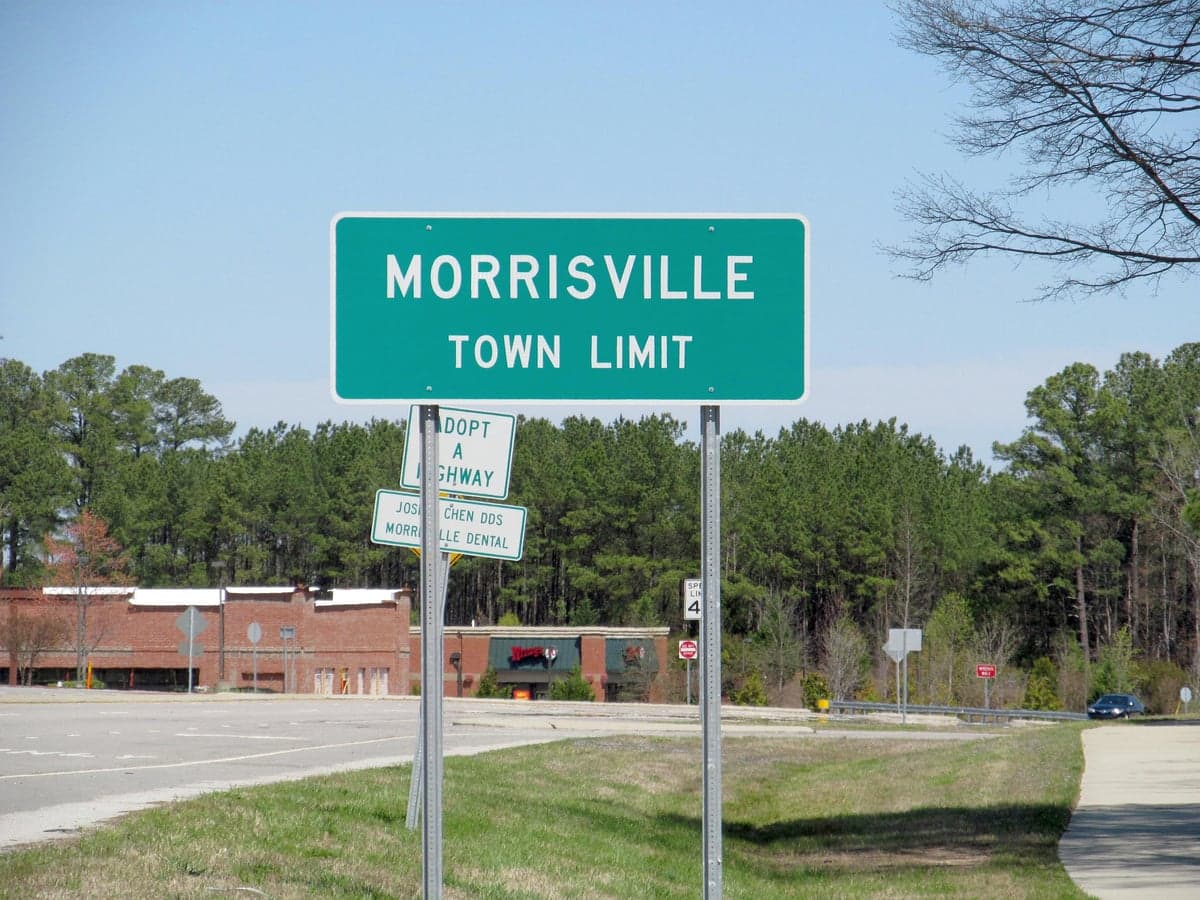
Photo: Wikipedia
Personal Sovereignty in Morrisville, NC
Viable for self-reliance. Generally workable, though some barriers may limit total independence.
What does Personal Sovereignty tell us?
Personal Sovereignty measures your capacity for self-reliance and independence with minimal government friction. Higher scores mean fewer barriers between you and the way you want to live... but it assumes you have the space you need and good neighbors.
What does this tell us?
Personal Sovereignty measures your capacity for self-reliance and independence with minimal government friction. Higher scores mean fewer barriers between you and the way you want to live... but it assumes you have the space you need and good neighbors.
State Policy
Energy independence: Importer (15% of energy produced in-state)
Personal Liberty
Homesteading

Personal Liberty Analysis
Morrisville, North Carolina, offers a mixed bag for those prioritizing personal sovereignty, with the state’s generally favorable legal framework for self-defense and property rights clashing against a local governance culture that leans heavily into zoning, taxation, and regulatory oversight. For a survivalist or prepper mindset, the Triangle region’s rapid growth and progressive local policies create friction with the ideal of maximum autonomy. While North Carolina’s state-level protections for gun rights and parental authority provide a solid baseline, Morrisville’s municipal code and Wake County’s tax structure demand careful navigation. The area is not a libertarian haven, but it is not a total-loss scenario either—it requires strategic positioning and a clear-eyed understanding of where local control ends and state preemption begins.
Tax burden and regulatory posture in Morrisville
Morrisville’s tax burden is moderate by national standards but high for North Carolina, driven by Wake County’s property tax rate of approximately 0.73% of assessed value (2025-2026), plus a town rate of about 0.26%, totaling roughly 0.99%—or nearly $1,000 per $100,000 of home value. This is significantly higher than rural counties like Chatham or Johnston, where rates can be 0.6% or lower. The state’s flat income tax of 4.5% (2026) and 2.5% corporate rate are competitive, but sales tax in Wake County hits 7.25%, including local options. Regulatory posture is the bigger concern: Morrisville enforces strict zoning codes, with minimum lot sizes of 6,000 to 10,000 square feet in most residential districts, and a comprehensive unified development ordinance that governs everything from fence heights to home-based businesses. Permitting for structures like sheds, greenhouses, or workshops requires town approval, and the city actively enforces noise, light, and waste ordinances. For those seeking to minimize government entanglement, the regulatory overhead here is noticeable—you cannot simply build a root cellar or install a backup generator without checking the code. The town’s growth management approach means more layers of bureaucracy, not less.
Self-defense and gun law specifics in North Carolina and Morrisville
North Carolina is a shall-issue state for concealed carry permits, with no permit required for open carry of handguns or long guns. The state preempts local governments from enacting their own gun ordinances, meaning Morrisville cannot ban firearms in parks, restrict magazine capacities, or impose waiting periods beyond state law. This is a critical win for personal sovereignty: the town council cannot unilaterally disarm residents. Stand-your-ground laws apply, with no duty to retreat in any place where you have a lawful right to be. Castle doctrine protections extend to vehicles and occupied structures. However, the state does require a permit to purchase a handgun (the pistol purchase permit system, though under legal challenge as of 2026), and background checks are mandatory for all commercial sales. Private transfers between individuals are legal without a background check, a plus for preppers building private inventories. Morrisville itself has no local gun registration or storage laws, but the town’s police department is active in community policing, and officers may be more likely to respond to “suspicious activity” calls from neighbors—so discretion in carrying and storing firearms is wise. The bottom line: your right to keep and bear arms is well-protected at the state level, but the local culture is not gun-friendly, so expect social friction if you’re open about your arsenal.
Self-reliance and homesteading viability in Morrisville
Homesteading in Morrisville is constrained by suburban lot sizes and zoning. Most residential lots range from 0.15 to 0.5 acres, with a few older neighborhoods offering up to 1 acre. Raising chickens is allowed in most residential zones (hens only, no roosters, with a limit of 6 birds and a 50-foot setback from neighbors), but goats, pigs, or larger livestock are prohibited. Beekeeping is permitted with registration and setback rules. Gardening is unrestricted, but front-yard vegetable gardens may draw HOA scrutiny if you’re in a covenanted community—and roughly 40% of Morrisville homes are in HOAs that can ban visible food production. Off-grid feasibility is low: the town requires connection to municipal water and sewer in most areas, and solar panels must comply with aesthetic guidelines. Rainwater collection is legal but limited to 20,000 gallons per property, and graywater systems require permits. For serious self-reliance, you would need to look outside the town limits—into unincorporated Wake County or neighboring Chatham County, where 2-5 acre parcels are available and zoning is looser. Morrisville is a bedroom community, not a homesteading hub. If your prepping strategy involves land-based independence, this is not the place; you’d be better off 30 minutes west near Pittsboro or north near Creedmoor.
Personal liberties: parental rights, medical autonomy, speech, and property
North Carolina has strong state-level protections for parental rights, including a 2023 law (HB 755) that requires schools to notify parents of any medical or mental health services offered to minors and prohibits withholding information about a child’s well-being. Parents have the right to opt their children out of sex education and any curriculum they find objectionable. Medical autonomy is more contested: the state does not have a broad religious exemption for vaccine mandates, but it does allow philosophical exemptions for school immunization requirements (though this is under political pressure). COVID-era mandates are largely rescinded, but private employers and healthcare systems can still require vaccines as a condition of service. Speech protections are robust under the First Amendment and state law, with no local “hate speech” ordinances that go beyond state code. Property rights are where Morrisville’s local control bites hardest: the town’s zoning board has broad discretion over variances, and the comprehensive plan emphasizes “smart growth” and density, which can limit your ability to use your land as you see fit. Short-term rentals (Airbnb) are restricted to owner-occupied properties with a permit, and home-based businesses that generate customer traffic or noise are heavily regulated. For the prepper who values quiet, unobtrusive living, the constant need for permits and approvals can feel like a slow erosion of autonomy.
Overall, Morrisville offers a baseline of personal sovereignty that is better than deep-blue states like California or New York, but worse than rural North Carolina counties or states like Texas or Idaho. The state-level wins—gun preemption, parental rights, flat taxes—are real and valuable. But the local regulatory environment, high property taxes, and suburban HOA culture create friction for anyone serious about self-reliance. If you are a single individual or parent who values maximum autonomy, you can make Morrisville work by choosing a home outside an HOA, staying informed on local ordinances, and leveraging state preemption laws. But if your priority is true independence—land, livestock, minimal government interaction—this town is a compromise, not a destination. The Triangle’s economic opportunities come with strings attached, and those strings are tied by the town council, not the state legislature. For the strategic relocator, Morrisville is a calculated trade-off: you get strong state-level rights, but you must accept local oversight as the price of proximity to jobs and infrastructure.

* Values derived from national, state, county, city and local statistics and may differ in a specific area. Last updated: 2026-04-21T16:52:22.000Z
Narrative content on this page is AI-generated and may contain mistakes. Verify any details that matter before acting on them.
ReloMaps may earn a commission from affiliate links at no extra cost to you.

