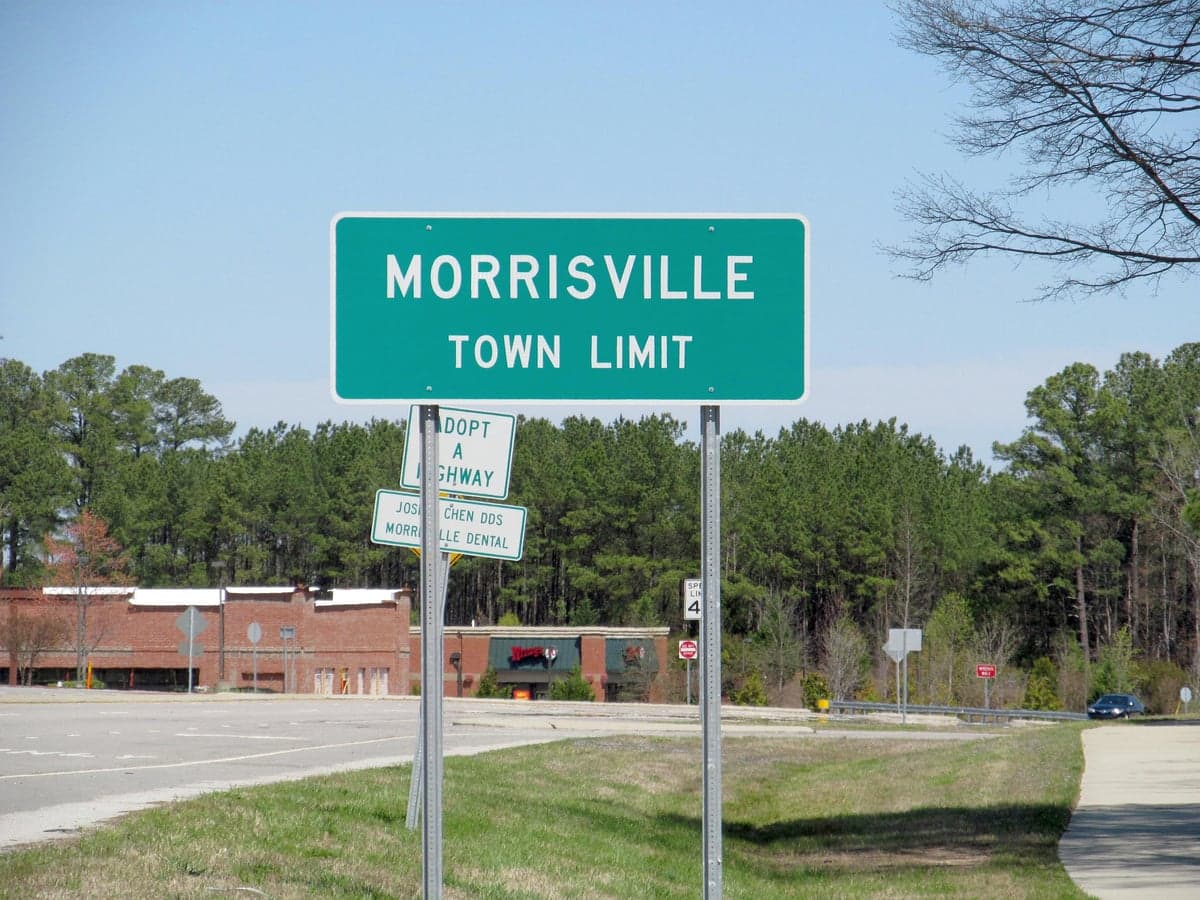
Photo: Wikipedia
Political ClimatePolitical Climate in Morrisville, NC
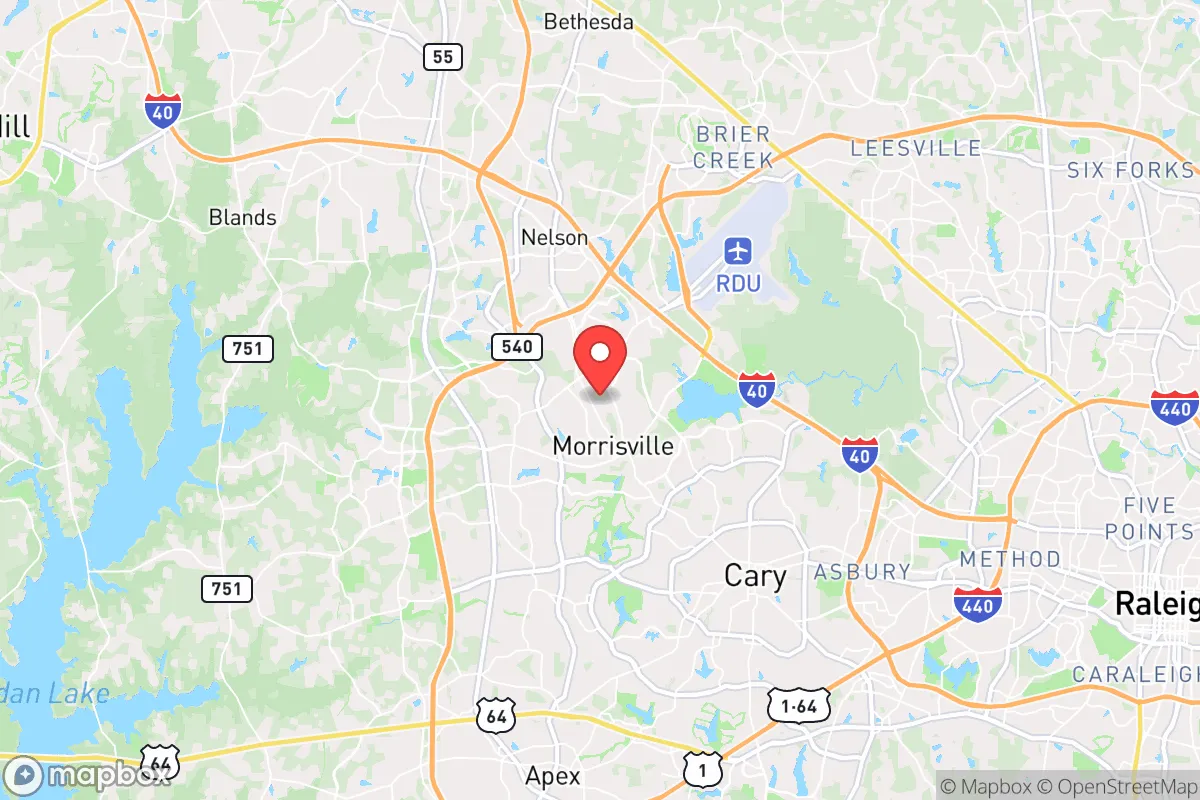
District shown is the primary district for this city’s centroid. Cities may span multiple districts.
Local Political AnalysisPolitical Analysis of Morrisville, NC
Morrisville, North Carolina, has a Cook PVI of D+23, making it one of the most reliably Democratic-leaning towns in the Triangle. That wasn’t always the case. Twenty years ago, this was a quiet crossroads where folks mostly kept to themselves and local government was about roads and schools, not social experiments. The shift has been rapid and unmistakable, driven by explosive growth from tech transplants and out-of-state newcomers who brought their big-city voting habits with them. If you’re looking for a place where traditional values and limited government still hold sway, Morrisville is now swimming against a strong progressive current.
How it compares
To understand Morrisville’s political climate, you have to look at what surrounds it. Head west to Apex or Cary, and you’ll find similar D+ leanings—Cary is D+12, Apex D+9—but those towns still have a stronger moderate streak and more vocal conservative minorities. Drive a little farther out to Fuquay-Varina (R+8) or Holly Springs (R+4), and the political landscape flips entirely. Those communities have held the line on property rights, school choice, and lower taxes. Morrisville, by contrast, has embraced the full progressive playbook: dense zoning mandates, bike-lane-first transportation planning, and a city council that rarely meets a new regulation it doesn’t like. The contrast isn’t subtle—it’s a daily reminder of how fast a place can change when one party dominates local elections.
What this means for residents
For a conservative living here, the practical effects are frustrating. Property taxes have climbed steadily to fund pet projects like the Morrisville Aquatics Center and a growing list of “equity” initiatives that feel more like social engineering than good governance. The town council has pushed through mandatory affordable housing quotas on new developments, which sounds noble until you realize it drives up costs for everyone else and invites more government oversight into what you can build on your own land. School board meetings have become battlegrounds over curriculum and library books, with progressive majorities consistently siding with state-level mandates over parental input. If you value personal freedom—the right to choose your child’s education, to keep more of your paycheck, to live without a dozen new ordinances telling you how to park your truck—Morrisville is increasingly a place where you have to fight for those basics.
Cultural and policy distinctions
The cultural shift is just as stark. Morrisville’s identity used to be rooted in its rural crossroads history and a sense of neighborly self-reliance. Now, the dominant vibe is corporate-transplant: chain restaurants, high-end apartment complexes, and a city council that treats “sustainability” as a religion. You’ll see more “In This House We Believe” signs than American flags. The local police department has been pressured to adopt “restorative justice” programs that critics say prioritize leniency over public safety. Longtime residents I know have either moved to Holly Springs or simply disengaged from local politics, feeling outnumbered and outshouted. The trajectory is clear: unless there’s a serious course correction, Morrisville will continue drifting further left, making it a tough fit for anyone who believes government’s job is to stay out of your life, not manage it.

State Political ClimatePolitical Climate in North Carolina
State Political AnalysisPolitical Environment in the State
North Carolina has long been the quintessential swing state of the Southeast, but over the past decade it has settled into a reliably red-leaning posture at the state level, even as its major metros have shifted sharply left. The state voted for Donald Trump in both 2016 and 2020 by margins of roughly 3.6% and 1.3% respectively, and in 2024 Trump carried it again by about 3 points. The Republican Party now holds supermajorities in both chambers of the General Assembly, a GOP governor (Josh Stein, elected in 2024) who is more moderate than his predecessor, and a 5-2 conservative majority on the state Supreme Court. The 10- to 20-year arc shows a state that was once a purple battleground now trending redder at the legislative level, even as Charlotte, Raleigh-Durham, and Asheville become Democratic strongholds. The real story is the widening gap between the urban cores and the rest of the state.
Urban vs. rural divide
The political map of North Carolina is a study in stark contrasts. The urban crescent—Charlotte (Mecklenburg County), the Raleigh-Durham-Chapel Hill triangle (Wake, Durham, Orange counties), and Greensboro-Winston-Salem (Guilford and Forsyth counties)—drives the Democratic vote. Mecklenburg County alone delivered nearly 60% of its vote to Biden in 2020, while Wake County gave him 62%. These metros are growing fast, fueled by transplants from blue states, and they vote like mini versions of California or New York. Meanwhile, the rural east and west are deeply Republican. Counties like Johnston (just east of Raleigh), Union (south of Charlotte), and Brunswick (coastal) have flipped from purple to solid red over the past two cycles. The Fayetteville area (Cumberland County), home to Fort Liberty, remains a swing district with a strong military and veteran presence that leans conservative on national security but is more mixed on social issues. The mountain counties west of Asheville—Henderson, Transylvania, Watauga—are a patchwork: Watauga (Boone) is a college-town blue island, while the surrounding counties vote 65-70% Republican. The rural-urban divide is so pronounced that the state's 14 U.S. House seats are effectively gerrymandered into 8 safe Republican, 4 safe Democratic, and 2 competitive districts, a map that has held through multiple court challenges.
Policy environment
North Carolina's policy environment is broadly conservative, with a few notable exceptions. The state has a flat income tax rate of 4.5% (down from 7% in 2013) and is on a glide path to 3.99% by 2027. There is no state tax on Social Security benefits, and the standard deduction is generous. The corporate income tax is 2.5% and scheduled to phase out entirely by 2030. Sales tax is 4.75% state-level, with local add-ons averaging 2-2.5%. On education, the state has a robust school choice program: the Opportunity Scholarship Program now provides vouchers of up to $7,500 per year for private school tuition, with no income cap as of 2024. Charter schools are plentiful, and home-schooling is lightly regulated. On healthcare, North Carolina did expand Medicaid in 2023 under a bipartisan deal, but the program is administered through private managed-care plans, not a single-payer system. Election laws have been tightened: voter ID is required (with photo ID), early voting is 17 days, and same-day registration is available during early voting. The state does not have automatic voter registration. On abortion, a 12-week ban was enacted in 2023, with exceptions for rape, incest, and fetal anomalies. The Second Amendment is well-protected: permitless carry of concealed handguns became law in 2023, and the state has a strong preemption law that prevents local governments from enacting their own gun restrictions.
Trajectory & freedom
Over the past five years, North Carolina has moved decisively in the direction of personal freedom on several fronts, while tightening in others. The 2023 permitless carry law (HB 189) was a major expansion of gun rights, eliminating the requirement for a concealed carry permit for anyone 18 or older who can legally possess a firearm. The same year, the General Assembly passed the Parents' Bill of Rights (HB 755), which requires schools to notify parents of any changes to a student's health or well-being, including gender identity or sexual orientation, and prohibits instruction on gender identity and sexuality in grades K-4. On medical freedom, the state banned COVID-19 vaccine mandates for state employees and contractors in 2023, and a 2024 law prohibits employers from requiring the COVID-19 vaccine as a condition of employment. Property rights were strengthened with a 2024 law limiting the use of eminent domain for private economic development. However, there are concerns: the state's certificate-of-need (CON) laws still restrict the opening of new hospitals and medical facilities, though a 2024 reform loosened them for psychiatric beds and substance abuse treatment. The trajectory is clearly toward more individual liberty, but the CON laws and the Medicaid expansion (which some conservatives view as a government overreach) remain points of tension.
Civil unrest & political movements
North Carolina has seen its share of political flashpoints, but they are less frequent and less violent than in many other states. The 2020 protests in Charlotte and Raleigh over George Floyd's death were large but mostly peaceful, with some property damage in Charlotte's South End. The state has a strong Second Amendment movement, with regular "2A rallies" at the state capitol in Raleigh. Immigration politics are relatively quiet compared to border states: North Carolina does not have any sanctuary cities, and a 2015 law (HB 318) requires sheriffs to honor ICE detainers. The most visible political movement in recent years has been the parental rights movement, which successfully pushed the Parents' Bill of Rights through the legislature. There is also a growing "free the people" libertarian streak, particularly in the rural counties, that opposes both federal overreach and state-level mandates. Election integrity has been a hot topic: the state's voter ID law was challenged in court but upheld by the state Supreme Court in 2024. There have been no major election fraud scandals, but the close margins in 2020 and 2024 have kept the issue alive among activists. The "Moms for Liberty" group has a strong presence in Wake County and Mecklenburg County, where school board meetings have become battlegrounds over curriculum and library books.
Projection
Looking ahead 5-10 years, North Carolina is likely to remain a red-leaning state at the legislative level, but the urban counties will continue to grow and become more Democratic. The key demographic shift is the influx of retirees and remote workers from the Northeast and California, who tend to bring their politics with them. However, many of these transplants are moving to exurban and suburban counties like Johnston, Union, and Brunswick, which are actually becoming more Republican as they fill up with conservative-leaning families seeking lower taxes and better schools. The rural counties will continue to lose population and political influence, but the Republican supermajority in the General Assembly is likely to persist because of gerrymandering and the concentration of Democratic votes in a few urban centers. The wild card is the governorship: if a progressive Democrat wins in 2028, expect a veto showdown with the legislature over abortion, school choice, and gun rights. The most likely scenario is a continued slow drift rightward on fiscal and education policy, with social issues remaining a battleground. A new resident moving in now should expect a state that is broadly friendly to conservative values—low taxes, school choice, gun rights—but with a growing progressive counterweight in the cities that will keep the political temperature high.
For a conservative individual or family considering relocation, North Carolina offers a strong combination of low taxes, school choice, Second Amendment protections, and a political climate that is trending in the right direction. The key is to choose your county wisely: stick with the exurban and rural areas like Union, Johnston, or Brunswick if you want to be surrounded by like-minded neighbors, or consider Fayetteville if you value a strong military community. Avoid the urban cores of Charlotte, Raleigh, and Asheville unless you're prepared for blue politics and higher costs. The state is not perfect—the CON laws and Medicaid expansion are genuine concerns—but on balance, it is one of the best options in the Southeast for someone who values personal freedom and limited government.
* Values derived from national, state, county, city and local statistics and may differ in a specific area. Last updated: 2026-04-21T16:52:22.000Z
Narrative content on this page is AI-generated and may contain mistakes. Verify any details that matter before acting on them.
ReloMaps may earn a commission from affiliate links at no extra cost to you.

