
Photo by Drew Dempsey on Unsplash
Demographics of Mountain Village, AK
Affluence Level in Mountain Village, AK
A low-income area with significant economic hardship. Household wealth and educational attainment are well below national averages.
People of Mountain Village, AK
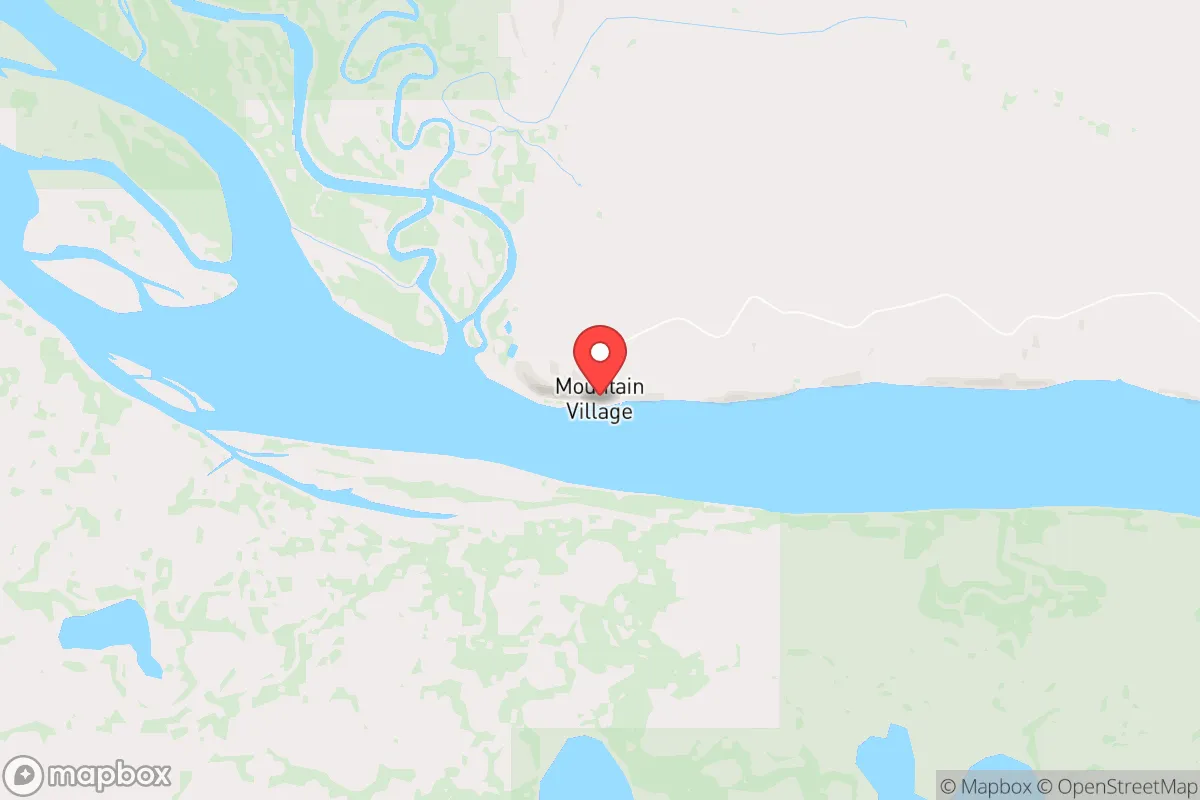
The 872 residents of Mountain Village, Alaska, form one of the most ethnically homogeneous communities in the state, with 98.2% of the population identifying as Alaska Native or American Indian. This is a tight-knit, Yup’ik-speaking village on the Yukon River’s north bank, where subsistence fishing and hunting remain central to daily life. The community is characterized by strong extended-family networks, a low median age (around 27), and a deep attachment to traditional cultural practices. With 0.0% foreign-born and 0.7% White, Mountain Village is not a place of ethnic diversity but of cultural continuity.
How the city was settled and grew
Mountain Village was not “founded” by outsiders but evolved as a seasonal Yup’ik fishing camp long before recorded history. The area’s permanent settlement began in the early 20th century when the U.S. government established a school and a reindeer station, drawing families from smaller, more remote camps along the Yukon. The original residents clustered in what is now known as Old Village, the historic core along the riverbank where traditional sod houses and later frame homes were built. A second wave arrived in the 1940s and 1950s when the Bureau of Indian Affairs (BIA) built a day school and a health clinic, prompting families from nearby villages like Pilot Station and St. Mary’s to relocate for access to services. These newcomers settled in the Upper Village area, which grew up around the school and airstrip. The community was officially incorporated as a city in 1962, but its population remained almost entirely Yup’ik, with only a handful of non-Native teachers and health workers living in a small cluster near the school known locally as Teacher Row.
Modern era (post-1965)
The post-1965 era saw no significant in-migration of outside groups. The Alaska Native Claims Settlement Act (ANCSA) of 1971 created the Mountain Village Corporation, which allocated land and resources to tribal shareholders, reinforcing the village’s Yup’ik character. During the 1970s and 1980s, a small number of non-Native professionals—teachers, public health nurses, and state troopers—arrived temporarily, but they typically lived in a distinct area called Staff Housing, a cluster of modern homes near the school. This group never exceeded a few dozen people and rarely stayed beyond a few years. The 1990s and 2000s saw a modest population increase driven by high birth rates among Yup’ik families, not by migration. The village’s racial composition has remained virtually unchanged for decades: the White population has fluctuated between 0.5% and 1.5%, and the Hispanic share (1.1%) is almost entirely accounted for by a single family that married into the community. The New Subdivision, a small housing development built in the 2000s with state and federal grants, absorbed younger families moving out of the crowded Old Village, but all residents remain Alaska Native.
The future
Mountain Village’s population is heading toward slow, natural growth driven by high fertility rates, but out-migration for education and employment is a persistent counterforce. The village loses roughly 10-15 young adults per year to Anchorage, Fairbanks, or the Lower 48 for college or jobs, and many do not return. The foreign-born population will likely remain at 0.0% for the foreseeable future, as there is no economic draw for immigrants and no ethnic enclave to attract them. The community is not tribalizing into distinct enclaves—it is already a single, culturally cohesive Yup’ik village—but a subtle geographic split is emerging: Old Village remains the heart of traditional subsistence life, while the New Subdivision and Upper Village are home to more English-speaking, wage-employed families. Over the next 10-20 years, the population will likely plateau or decline slightly as out-migration continues to offset births, and the village will remain one of the most culturally intact Native communities in Alaska.
For someone moving in now, Mountain Village offers an authentic immersion into Yup’ik life, but it is not a place of demographic change or diversity. The community is stable, insular, and deeply traditional—a place where newcomers are welcomed as guests, not as settlers. The bottom line: this is a village that preserves its identity through isolation, and any new resident should expect to adapt to a culture that has changed little in a century.

* Values derived from national, state, county, city and local statistics and may differ in a specific area. Last updated: 2026-04-19T19:32:30.000Z
Narrative content on this page is AI-generated and may contain mistakes. Verify any details that matter before acting on them.
ReloMaps may earn a commission from affiliate links at no extra cost to you.

