
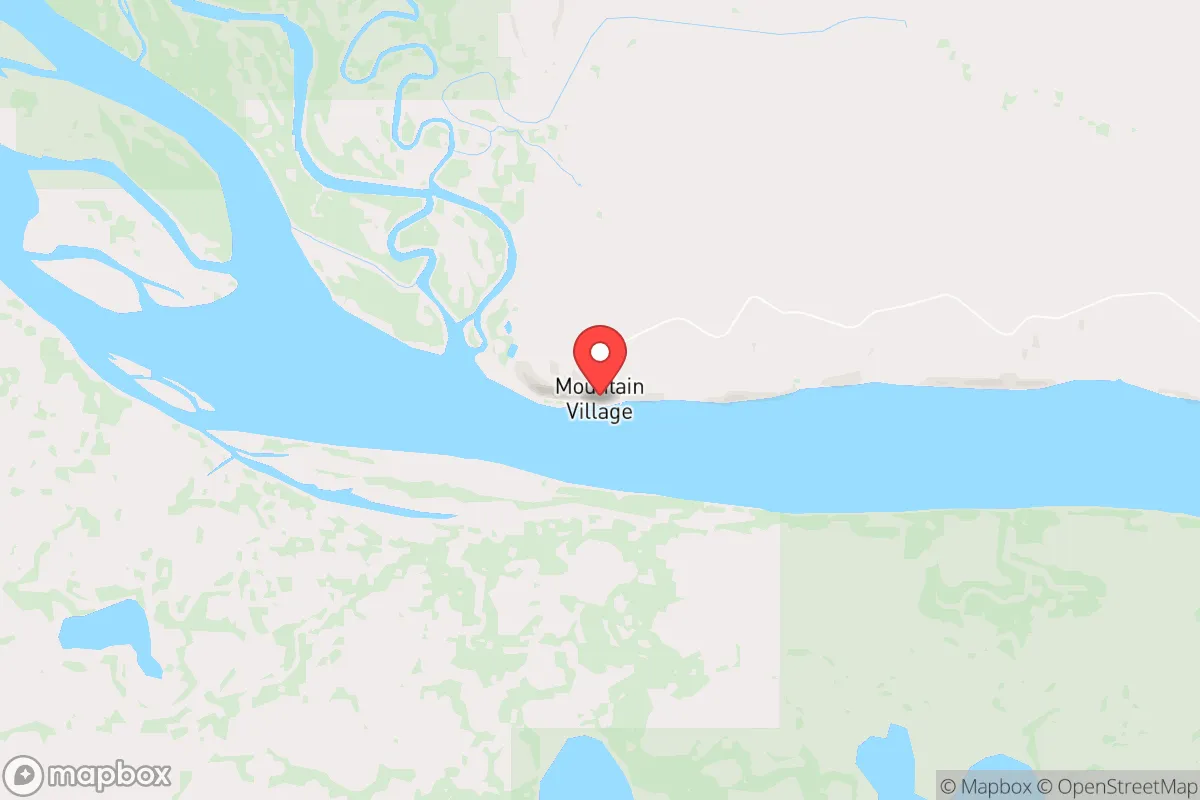
Photo by Drew Dempsey on Unsplash
Quality of Life in Mountain Village, AK
A livable area that tracks near national norms for affordability, walkability, and neighborhood health.
What does Quality of Life tell us?
Quality of Life blends cost of living, nearby amenities, socioeconomic signals, and neighborhood character. City-level scores represent the whole municipality; individual neighborhoods can differ.
What does this tell us?
Quality of Life blends cost of living, nearby amenities, socioeconomic signals, and neighborhood character. City-level scores represent the whole municipality; individual neighborhoods can differ.
Cost of Living
40% below national average
The Real Cost of Living in Mountain Village, AK for 2026
| Tier | Individual | Family (4) |
|---|---|---|
| Survival | $18k | $33k |
| Comfortable | $28k | $41k |
| Luxury | $85k+ | $131k+ |
| Elite (Top 5%) | $100k+ | $155k+ |
153%
The Area Signal
A metric tracking the socioeconomic signals of the area.


Limited data for this area
Limited data for this area
Hobbies
Explore the areaGroceries
1 within 10 miles
Gas
0 within 10 miles
Hospital
0 within 20 miles
Airport
Mountain Village Airport
Post Office
USPS — Mountain Village, AK
Critical Amenities
Quality-of-Life Analysis
Mountain Village, Alaska, presents a unique quality-of-life profile defined by extreme affordability and deep cultural isolation, with a cost of living index of 60 (40% below the U.S. average) that starkly contrasts with the state's pricier hubs like Anchorage or Fairbanks. The community is predominantly Yup'ik, with a subsistence-based lifestyle that draws families seeking a traditional, land-connected existence rather than career-driven professionals. Median home values sit at just $21,500, and median rent at $1,100, but these figures reflect a housing stock that is largely aging, often lacking modern plumbing or insulation, and not comparable to typical suburban markets.
Cost of living, housing, and affordability compared to Bethel and other Yukon-Kuskokwim villages
Mountain Village's cost of living index of 60 is among the lowest in Alaska, driven by a median home value of $21,500 that is roughly 95% below the national median. However, this low purchase price masks high utility costs—heating fuel and electricity can run $400–$600 monthly due to reliance on barge-delivered oil and diesel generators. Median rent of $1,100 is comparable to Bethel (about $1,200) but significantly cheaper than Anchorage ($1,600+). The housing stock is limited: most homes are single-family structures built before 1980, with many requiring major repairs. For context, a similar home in Bethel would cost $150,000–$200,000, making Mountain Village a bargain for those willing to accept remote living. Property taxes are negligible (no local property tax, only state-level levies), but buyers must factor in freight costs for building materials—often doubling mainland prices.
Local amenities, schools, and what daily life is like for families
Daily life in Mountain Village revolves around subsistence activities—fishing for salmon and whitefish, hunting moose and caribou, and berry picking—which supplement expensive store-bought goods. The village has one K-12 school, Mountain Village School (part of the Lower Yukon School District), serving about 150 students with a student-teacher ratio of roughly 12:1, though teacher turnover is high. Amenities are sparse: a single general store (prices 30–50% above Anchorage), a health clinic staffed by a community health aide (no hospital; medevac to Bethel for emergencies), and a small airport with daily flights to Bethel ($300–$500 round trip). There is no road access—travel is by snowmachine in winter, boat in summer, or bush plane year-round. Internet is via satellite or limited cellular (GCI or ASTAC), with speeds often below 5 Mbps. Families spend evenings at community potlatches, bingo, or subsistence camps; there are no movie theaters, gyms, or chain restaurants.
This environment suits individuals and families who prioritize cultural heritage, self-sufficiency, and a low-cost, land-based lifestyle over modern conveniences and career advancement. Those who thrive here are typically Yup'ik families with deep local roots, or outsiders willing to adapt to a subsistence rhythm, limited healthcare access, and extreme weather (average winter lows of -10°F). It is not a fit for remote workers needing reliable high-speed internet, retirees requiring medical facilities, or anyone seeking a typical suburban or urban quality of life. For the right person, Mountain Village offers an unmatched affordability and a direct connection to Alaska Native traditions that few other places in the state can provide.

Crime in Mountain Village, AK
Higher crime rates than 66% of comparable U.S. locations.
Violent CrimeViolent Crime Analysis
Property CrimeProperty Crime Analysis
Crime Analysis
Mountain Village, a remote Yup'ik community of roughly 800 residents on the Yukon River in western Alaska, reports crime rates that are significantly higher than both the national average and the Alaska state average, presenting a challenging public safety environment. The village's violent crime rate stands at 726.6 incidents per 100,000 residents, while property crime occurs at a rate of 1,909.5 per 100,000. These figures place Mountain Village in a category of elevated risk, particularly given its isolation and limited law enforcement resources.
Crime in context
To understand Mountain Village's safety profile, it must be compared against broader benchmarks. The national violent crime rate in 2023 was approximately 380 per 100,000, meaning Mountain Village's rate is nearly double the U.S. average. Alaska's statewide violent crime rate is already among the highest in the nation at roughly 800 per 100,000, so Mountain Village's figure is slightly below that state peak but still well above most rural communities. Property crime in the village is similarly elevated: the national rate hovers around 1,950 per 100,000, placing Mountain Village just under that mark, but Alaska's average is closer to 2,500 per 100,000. The village's property crime rate is thus moderate by Alaska standards but still concerning for residents and potential newcomers.
What residents experience
Daily life in Mountain Village is shaped by the reality of these statistics. Violent crime—including assault, robbery, and sexual offenses—occurs at a frequency that affects community trust and personal safety routines. The village's small population means that victims and offenders often know each other, which can complicate reporting and prosecution. Property crimes like burglary and theft are also common, targeting homes and vehicles in a setting where resources for security (such as alarm systems or private security) are scarce. The local public safety officer (VPSO) program provides the primary law enforcement presence, but response times can be slow due to the village's remote location and limited staffing. The Alaska State Troopers, based in Bethel (a 90-minute flight away), handle major cases, creating a gap in immediate response for everyday incidents.
Neighborhood-level variation in Mountain Village is minimal due to the community's compact, homogeneous layout. Most residents live in single-family homes along a few main roads, with no distinct high-crime or low-crime zones. However, areas near the village's two stores and the school may see more foot traffic and associated petty crime. The village's isolation also means that outsiders rarely pass through, so nearly all crime is intra-community. For those considering relocation, the key takeaway is that Mountain Village's crime rates are a direct reflection of broader challenges facing rural Alaska—including substance abuse, poverty, and limited economic opportunity—rather than a localized anomaly. Prospective residents should weigh these factors carefully, especially if moving with family or valuable property.
* Values derived from national, state, county, city and local statistics and may differ in a specific area. Last updated: 2026-04-19T19:32:30.000Z
Narrative content on this page is AI-generated and may contain mistakes. Verify any details that matter before acting on them.
ReloMaps may earn a commission from affiliate links at no extra cost to you.

