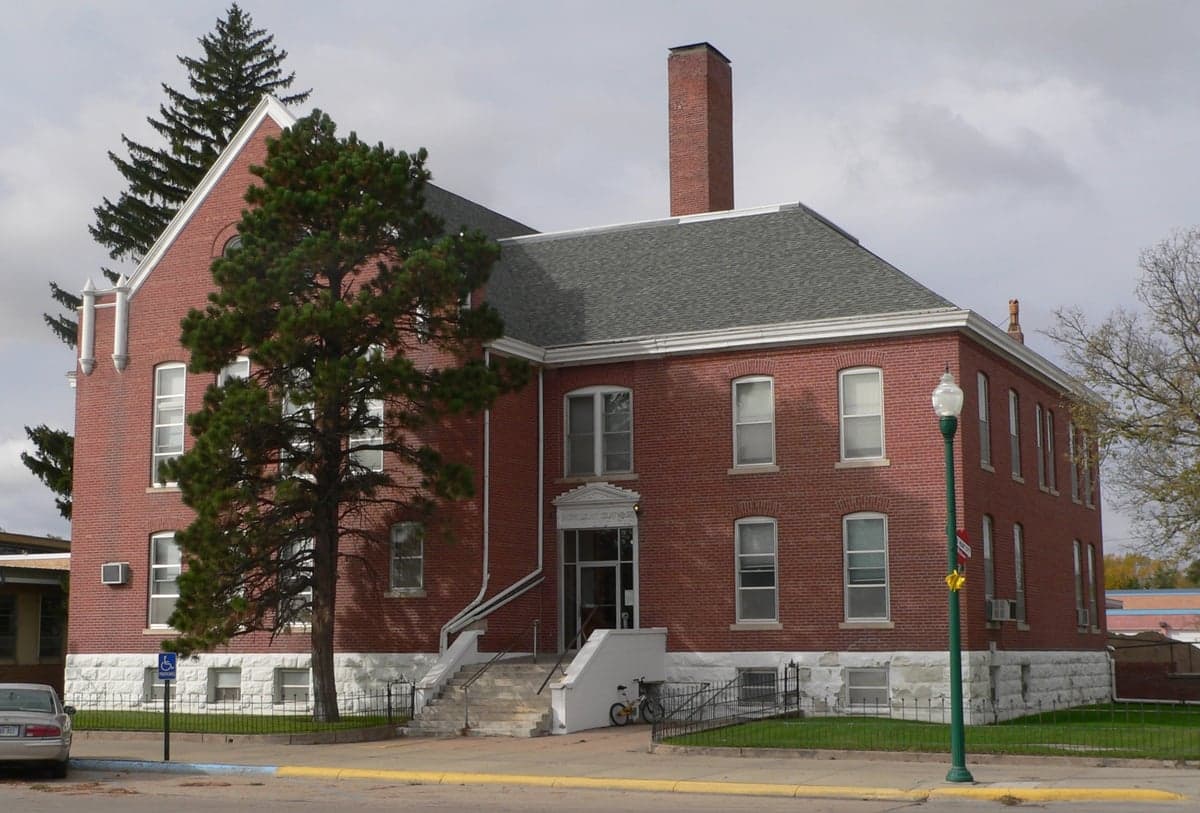
Photo: Wikipedia
Political ClimatePolitical Climate in Cherry County
Showing district-level results — no local-only data available.
Local Political AnalysisPolitical Analysis of Cherry County
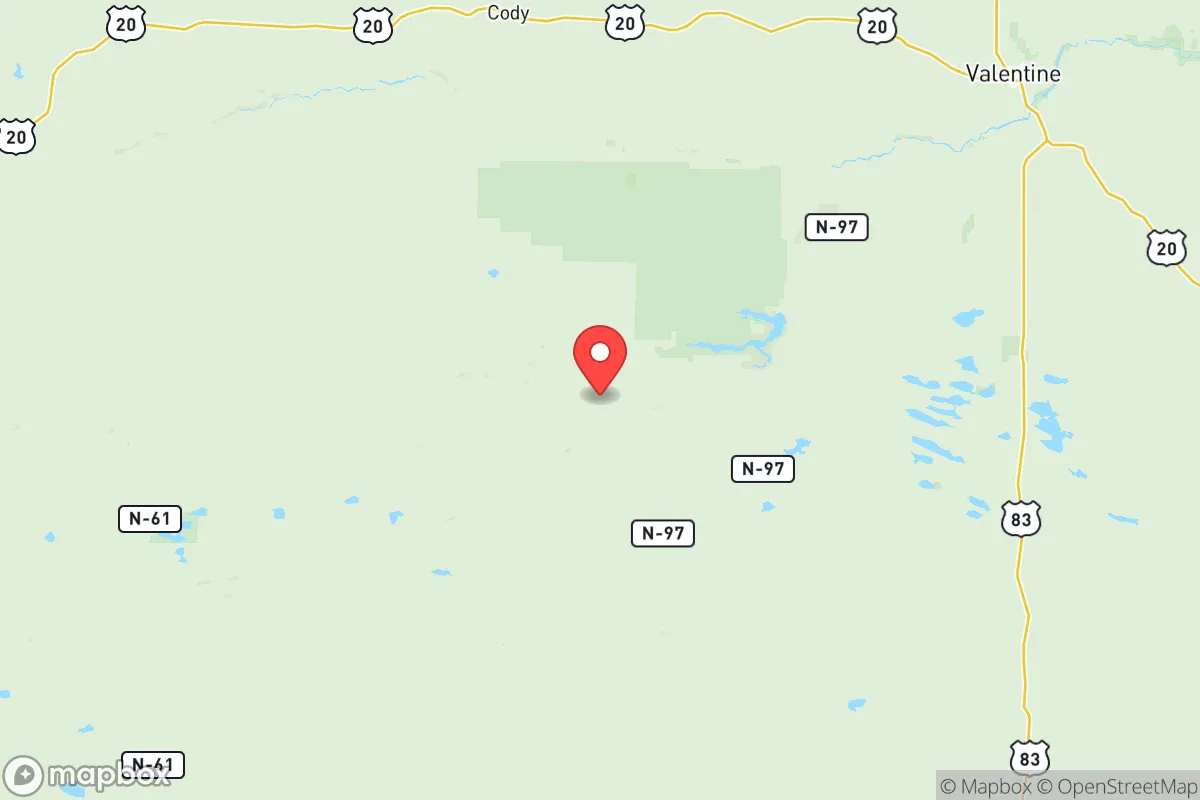
Cherry County, Nebraska, is one of the most reliably Republican counties in the entire state, with a Cook Partisan Voting Index (PVI) of R+27. That’s a deep red lean, far to the right of Nebraska’s statewide PVI of R+10, and it’s been that way for decades. The county hasn’t voted for a Democratic presidential candidate since 1936, and in 2024, Donald Trump carried it with over 80% of the vote. But if you spend time here, you’ll notice the political reality isn’t a monolith — it shifts depending on whether you’re in Valentine, the county seat, or out in the smaller ranching communities like Cody, Kilgore, or Nenzel.
How it compares
The gap between Cherry County’s R+27 and Nebraska’s R+10 isn’t just a number — it reflects a fundamentally different political culture. In the state as a whole, the R+10 is pulled leftward by Lincoln and Omaha, which have sizable Democratic and independent blocs. Cherry County, by contrast, has no urban center to speak of. Valentine, the largest town with about 2,800 people, is reliably red but shows a bit more moderation than the outlying precincts. In the 2022 gubernatorial race, Valentine’s precincts gave Republican Jim Pillen about 75% of the vote, while precincts around Cody and Kilgore pushed that to 85-90%. There are no swing precincts in the traditional sense — no town flips between parties — but the variation is real: Valentine’s small business owners and school district employees sometimes split tickets on local levies or nonpartisan races, while the ranching precincts vote straight-ticket Republican without exception. The county’s R+27 is a composite of that near-unanimous rural vote, making it one of the most conservative corners of an already red state.
What this means for residents
For conservative residents, Cherry County is a comfortable fit. Local government, school boards, and the county commission are dominated by Republicans, and issues like property taxes, water rights (especially the Sandhills aquifer), and federal land management dominate local politics. The county’s deep red lean means conservative candidates rarely face serious primary challenges, and policy debates tend to be about how conservative to go, not whether. For liberal residents, the reality is more isolating. There’s no organized Democratic party presence in the county, and progressive viewpoints are rarely voiced in public forums. That said, most residents — regardless of affiliation — describe the social climate as civil. People know each other, and political disagreements don’t usually end friendships. The real tension is less about party labels and more about land use: ranchers versus environmentalists, or local control versus federal oversight of the Nebraska National Forest and the Niobrara River. Those debates cut across party lines in ways that surprise outsiders.
Culturally, Cherry County stands apart from the rest of Nebraska in a few key ways. The county is home to the Ponca Tribe of Nebraska’s reservation and the Santee Sioux Nation, whose sovereign status introduces a layer of intergovernmental politics you won’t find in most of the state. Local attitudes toward tribal sovereignty vary, but the relationship is pragmatic — shared law enforcement agreements and economic development projects like the Ohiya Casino & Resort in Niobrara (just over the county line) are part of daily life. Another distinction: Cherry County is one of the few places in Nebraska where the debate over the Keystone XL pipeline was a front-porch issue, not just a news story. The county’s deep Republican lean means most residents opposed the pipeline on property-rights grounds, but a vocal minority — including some ranchers — supported it for economic reasons. Looking ahead, the county’s political trajectory seems locked in: as long as the population stays small, rural, and tied to agriculture, Cherry County will remain R+27 or even redder. The only wild card is in-migration from retirees and remote workers drawn to the Niobrara River valley, but so far, that hasn’t budged the needle.

State Political ClimatePolitical Climate in Nebraska
State Political AnalysisPolitical Environment in the State
Nebraska is a solidly Republican state, with a Cook PVI of R+10, but that number masks a more complicated reality than a simple red-state label. The state has been reliably GOP in presidential elections since 1968, but the political landscape has shifted dramatically over the last 20 years, with the Omaha metro area moving left while the rest of the state has hardened its conservative tilt. For a relocator, this means you’re moving into a state where conservative values dominate state policy, but you’ll find a genuine blue island in the east and a few purple suburbs that are slowly changing the conversation.
Urban vs. rural divide
The political map of Nebraska is a textbook case of the urban-rural split. The eastern third of the state, anchored by Omaha (Douglas County) and Lincoln (Lancaster County), is the Democratic stronghold. Omaha’s 2nd Congressional District has become a national bellwether, flipping between parties in recent cycles and awarding one electoral vote to Joe Biden in 2020. Lincoln, home to the University of Nebraska, leans blue but is less reliably Democratic than Omaha. The rest of the state—from the Sandhills to the Panhandle—is deeply Republican. Scottsbluff in the west and Grand Island in central Nebraska vote GOP by wide margins, while Norfolk and Columbus in the northeast are conservative strongholds. The only real exception is Bellevue, a suburb of Omaha that leans Republican but is more moderate than rural areas, and Fremont, which has a mix of conservative and working-class voters. The divide is stark: drive 20 minutes west of Omaha, and you’re in deep red territory where Trump won by 30 points or more.
Policy environment
Nebraska’s policy environment is broadly conservative, with a few unique twists. The state has a unicameral, nonpartisan legislature, which means bills are advanced by coalitions rather than strict party-line votes, though in practice it’s dominated by Republicans. The tax structure is relatively low: no state tax on Social Security income, a flat state income tax rate that is being phased down to 3.99% by 2027, and property taxes that are high but capped by law. There is no state sales tax on groceries or prescription drugs. Education policy is a hot topic: the state has a robust system of public schools, but a 2023 law created a school choice program allowing tax credits for private school scholarships, which has been controversial. Healthcare is mixed—Nebraska expanded Medicaid under the Affordable Care Act in 2020 via a ballot initiative, but the state has not expanded postpartum coverage or adopted a public option. Election laws are moderately restrictive: voter ID is required (passed in 2023), and the state has no automatic voter registration, but same-day registration is allowed during early voting. The state also has a unique “blue dot” law that allocates its electoral votes by congressional district, meaning Omaha’s district can swing one vote to a Democrat even when the state goes red.
Recent policy direction
Recent legislation in Nebraska points toward a more conservative direction on several fronts, but with some notable exceptions. On gun and self-defense law, Nebraska is a constitutional carry state (permitless carry for adults 21 and over, passed in 2023), and there is no state-level red flag law. Parental and education rights have been a major focus: the 2023 school choice law (LB 753) provides tax credits for private school scholarships, and a 2024 law (LB 1400) requires schools to notify parents of any changes in a student’s health or well-being, effectively a “parental bill of rights.” On speech and privacy, the state has no broad surveillance law, but a 2024 law (LB 107) restricts the use of facial recognition technology by law enforcement without a warrant. Medical and bodily autonomy is a flashpoint: Nebraska passed a 12-week abortion ban in 2023 (LB 574), with exceptions for rape, incest, and medical emergencies, and a separate law (LB 574) bans gender-affirming care for minors. Property rights are strong, with no state-level rent control and a 2024 law (LB 1200) that limits local governments’ ability to impose zoning restrictions on agricultural land. Taxation is trending downward: the flat income tax rate is being reduced from 5.84% to 3.99% by 2027, and the inheritance tax was repealed in 2023. Voting and ballot access tightened with the voter ID law, but early voting remains available without an excuse, and mail-in ballots are allowed. The overall direction is a steady push toward lower taxes, more parental control in education, and restrictions on abortion and transgender care, while maintaining a relatively open stance on gun rights and property.
Civil unrest & political movements
Nebraska is not known for widespread civil unrest, but there have been notable flashpoints. In 2020, Omaha saw protests after the death of George Floyd, with some property damage and a heavy police presence, but it was smaller than in many other cities. The most visible political movement in recent years has been around abortion rights: after the 2023 ban, activists on both sides mobilized, with pro-choice groups launching a ballot initiative to enshrine abortion rights in the state constitution (which is pending for 2024). Immigration politics are less heated than in border states, but Fremont made national news in 2010 for passing an ordinance banning renting to undocumented immigrants, which was later upheld by the courts. There is no sanctuary city policy in Nebraska; in fact, a 2024 law (LB 107) requires local law enforcement to cooperate with federal immigration authorities. Election integrity controversies have been minimal, though the 2020 election saw some Republican activists in Lincoln and Omaha questioning mail-in ballot procedures, leading to the voter ID law. The state’s nonpartisan legislature tends to dampen extreme rhetoric, but you’ll still see the occasional protest at the Capitol in Lincoln over issues like abortion, transgender rights, or school funding. A new resident in Omaha or Lincoln might notice the occasional rally, but in smaller towns like North Platte or Kearney, political life is quieter and more consensus-driven.
Projection
Over the next 5-10 years, Nebraska’s political trajectory is likely to see a slow but steady shift toward a more polarized landscape, driven by demographic changes. The Omaha metro area is growing faster than the rest of the state, attracting younger, more diverse residents from out of state, which will likely make the 2nd Congressional District more reliably Democratic. Meanwhile, rural counties are losing population, which could amplify their conservative voting power in the legislature through gerrymandering. The state’s nonpartisan legislature may face pressure to become more partisan, as national issues like abortion and education become more salient. In-migration from blue states like California and Colorado is modest but noticeable in Lincoln and Omaha, and these newcomers tend to lean left, which could shift the balance in close races. However, the state’s overall Republican lean is unlikely to change dramatically—the rural vote is too entrenched. A relocator moving in now should expect that the state will remain a conservative stronghold on most policy issues, but with a growing blue pocket in the east that will keep the politics interesting. The flat tax reduction and school choice expansion are likely to continue, while abortion and transgender rights will remain battlegrounds. If you’re conservative, you’ll find a welcoming environment; if you’re liberal, you’ll have a voice in Omaha and Lincoln but will be outvoted on state-level policy.
For a new resident, the bottom line is that Nebraska offers a stable, predictable political environment where conservative values shape state law, but with enough diversity in the eastern cities to keep things from feeling monolithic. If you’re moving here, you’ll find that your day-to-day life is largely unaffected by the political climate—property taxes are high but manageable, schools are generally good, and the pace of life is slower. The biggest practical takeaway is that your vote will matter most in local and state legislative races, especially if you live in Omaha or Lincoln, where the margins are tight. For families, the school choice options and parental rights laws are a draw; for singles, the low cost of living and gun-friendly laws are appealing. Just be aware that the state’s politics are real and can be intense if you engage, but for most people, Nebraska is a place where you can live your life without constant political noise.
* Values derived from national, state, county, city and local statistics and may differ in a specific area. Last updated: 2026-07-29T00:34:41.000Z
Narrative content on this page is AI-generated and may contain mistakes. Verify any details that matter before acting on them.
ReloMaps may earn a commission from affiliate links at no extra cost to you.

