
Photo: Wikipedia
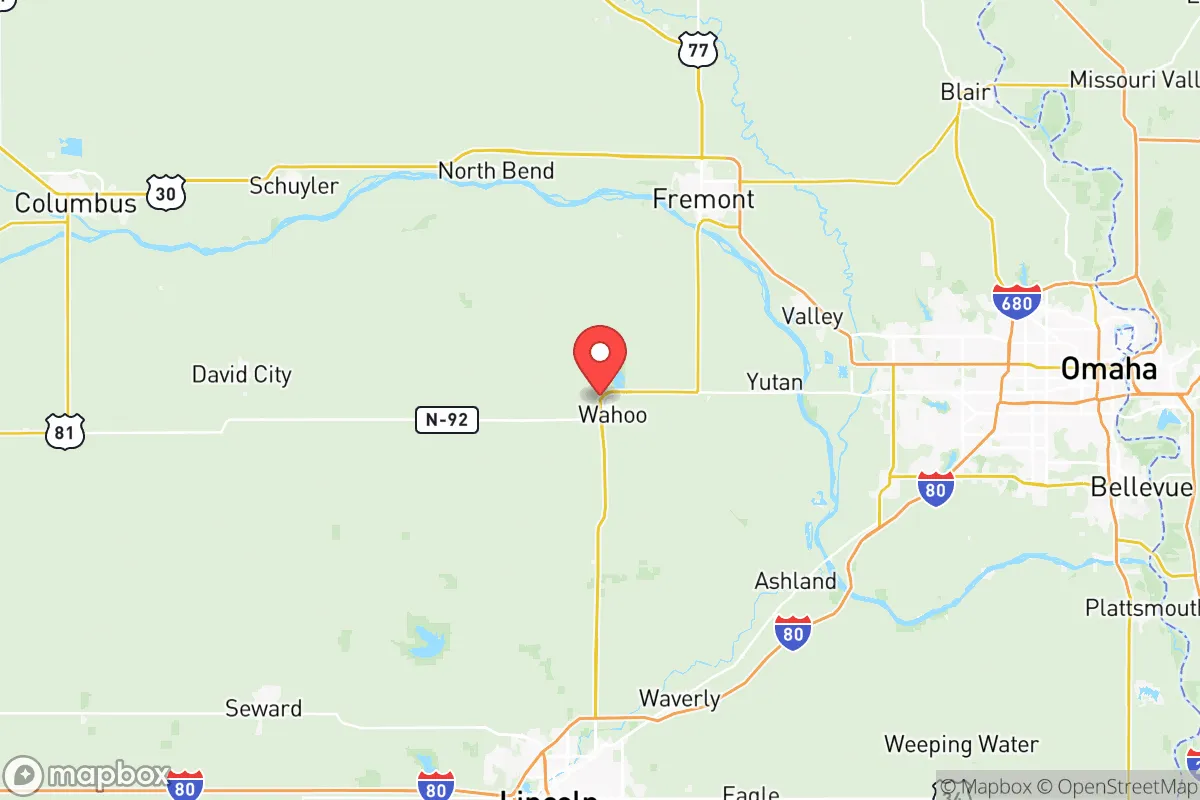
Personal Sovereignty in Saunders County
Viable for self-reliance. Generally workable, though some barriers may limit total independence.
What does Personal Sovereignty tell us?
Personal Sovereignty measures your capacity for self-reliance and independence with minimal government friction. Higher scores mean fewer barriers between you and the way you want to live... but it assumes you have the space you need and good neighbors.
What does this tell us?
Personal Sovereignty measures your capacity for self-reliance and independence with minimal government friction. Higher scores mean fewer barriers between you and the way you want to live... but it assumes you have the space you need and good neighbors.
State Policy
Energy independence: Importer (35% of energy produced in-state)
Personal Liberty
Homesteading

Personal Liberty Analysis
Saunders County, Nebraska, offers a notably high degree of personal sovereignty compared to the urban corridors of Omaha or Lincoln, making it a strategic relocation target for those prioritizing autonomy over convenience. The county’s rural character, combined with Nebraska’s generally permissive state-level framework on firearms, taxes, and property rights, creates an environment where government overreach is less pronounced than in many other parts of the country. For single individuals and parents who view personal freedom as the bedrock of security, Saunders County presents a viable alternative to jurisdictions where local ordinances increasingly infringe on self-reliance and traditional liberties.
Tax burden and regulatory posture: How Saunders County compares to Nebraska’s urban centers
Nebraska’s state income tax is a flat 3.58% for most earners, and while property taxes are relatively high—around 1.7% of assessed value on average in Saunders County—the county’s lower property valuations compared to Douglas or Lancaster counties mean a lighter absolute burden. The regulatory environment is decidedly rural-friendly: there are no county-wide building codes in unincorporated areas, and zoning is minimal outside of the towns of Wahoo, Ashland, and Valley. This means a single individual or family can purchase land and erect a dwelling without the permitting delays and inspection costs that plague metro-area construction. The county’s comprehensive plan explicitly supports agricultural and residential uses with few conditional-use hurdles, a stark contrast to the overlay districts and design review boards found in Omaha’s suburbs. For those who view regulatory compliance as a form of government overreach, Saunders County’s posture is a clear advantage.
Self-defense and gun law specifics: Constitutional carry and local enforcement culture
Nebraska is a constitutional carry state as of 2023, meaning no permit is required to carry a concealed firearm for anyone legally able to possess one. Saunders County’s sheriff’s office, headquartered in Wahoo, has a reputation for being pro-Second Amendment and does not engage in the kind of “may issue” discretionary enforcement seen in some coastal jurisdictions. Open carry is legal without a permit, and there are no county-specific restrictions on magazine capacity or firearm types. The towns of Ceresco and Mead have no local gun ordinances whatsoever, while Prague and Weston maintain the same permissive stance. For parents, this means the ability to keep a firearm in the home or vehicle without fear of local prosecution, and for single individuals, the right to defend themselves without bureaucratic interference. The nearest gun-free zones are limited to federal buildings and school grounds (by state statute), but even school parking lots are generally accessible for locked storage. This is a jurisdiction where the right to keep and bear arms is treated as a pre-existing condition, not a privilege granted by the state.
Self-reliance and homesteading viability: Lot sizes, zoning, and off-grid feasibility
Saunders County is one of the most homestead-friendly areas within commuting distance of Omaha. Unincorporated parcels can be as small as one acre without triggering subdivision review, and many rural lots in the areas around Ithaca and Leshara are available for under $10,000 per acre. Zoning in the unincorporated county allows for accessory dwelling units, workshops, and livestock on parcels as small as five acres without special permits. Off-grid living is feasible: Nebraska has no state-level ban on rainwater collection, and Saunders County does not require connection to municipal water or sewer in rural areas. Solar panels and wind turbines are permitted by right on agricultural and residential parcels, with no county-level net metering restrictions that would penalize self-generation. The towns of Malmo and Colon are particularly attractive for those seeking a low-regulation homesteading lifestyle, as they lack the homeowner association covenants that often restrict outbuildings, fencing, and vehicle storage. For parents, this means the ability to raise children in a setting where self-sufficiency—gardening, animal husbandry, and alternative energy—is not only legal but culturally normalized.
Personal liberties: Parental rights, medical autonomy, speech, and property
Nebraska’s state-level legal framework provides a strong baseline for personal liberties that Saunders County’s local governance does not undermine. Parental rights are explicitly protected under state law, with no county-level mandates that override a parent’s authority over their child’s education, medical decisions, or religious upbringing. The county is home to several private and parochial schools, and homeschooling is straightforward to establish with a simple notification to the state. Medical autonomy is similarly robust: Nebraska has not enacted broad vaccine mandates for adults, and Saunders County’s health department does not impose local public health orders that exceed state guidance. Free speech is protected by the First Amendment, and the county’s small-town culture means that political expression—whether on bumper stickers, yard signs, or at public meetings—is met with tolerance rather than censorship. Property rights are reinforced by Nebraska’s lack of a statewide rent control law and by Saunders County’s minimal eminent domain activity; the county has not pursued any major condemnation projects in the past decade. For those concerned about government overreach into personal and family life, Saunders County offers a legal environment where the default answer is “yes” until a specific state law says otherwise.
Overall, Saunders County ranks among the top Nebraska counties for personal sovereignty, particularly when compared to the more regulated environments of Lincoln or Omaha. The combination of constitutional carry, minimal zoning, low regulatory friction for homesteading, and strong state-level protections for parental and medical autonomy creates a jurisdiction where individuals and families can live largely free from local government interference. For the survivalist or prepper mindset, the county’s proximity to the Platte River and its agricultural infrastructure provide a strategic buffer against supply chain disruptions, while its legal framework ensures that the tools of self-reliance—firearms, off-grid systems, and private property—remain accessible. While no location is entirely free from state or federal overreach, Saunders County represents a deliberate choice to live in a place where personal sovereignty is the rule, not the exception.

* Values derived from national, state, county, city and local statistics and may differ in a specific area. Last updated: 2026-05-13T14:18:34.000Z
Narrative content on this page is AI-generated and may contain mistakes. Verify any details that matter before acting on them.
ReloMaps may earn a commission from affiliate links at no extra cost to you.

