
Photo: Wikipedia
Strategic Assessment of Saunders County
Workable tactical position. Some exposure to population density or targets, but generally defensible in a crisis.
What does the Strategic Assessment tell us?
Our Strategic Assessment grades tactical survivability of an area. Major population centers, military targets, fallout zones, natural disasters, and border exposure all drive risk — lower exposure means a more defensible position in a crisis.
This is heavily inspired by Joel Skousen's Strategic Relocation book. Highly recommended you checkout the book ($)What does this tell us?
Our Strategic Assessment grades tactical survivability of an area. Major population centers, military targets, fallout zones, natural disasters, and border exposure all drive risk — lower exposure means a more defensible position in a crisis.
This is heavily inspired by Joel Skousen's Strategic Relocation book. Highly recommended you checkout the book ($)Strategic Pillars

Key Distances
Strategic Assessment Analysis
Saunders County, Nebraska, sits in a sweet spot that few relocators fully appreciate: close enough to Omaha and Lincoln to access their job markets and medical infrastructure, yet far enough from their urban cores to avoid the worst of civil unrest, supply chain disruptions, or fallout from a major event. With a population hovering around 22,000 and a county seat in Wahoo, this is the kind of place where a prepared individual or family can build a resilient lifestyle without feeling like they’re homesteading in the middle of nowhere. The county’s agricultural backbone, low population density, and position along the Platte River corridor give it a strategic advantage that’s hard to beat in the eastern half of Nebraska.
Geographic position and natural advantages for long-term security
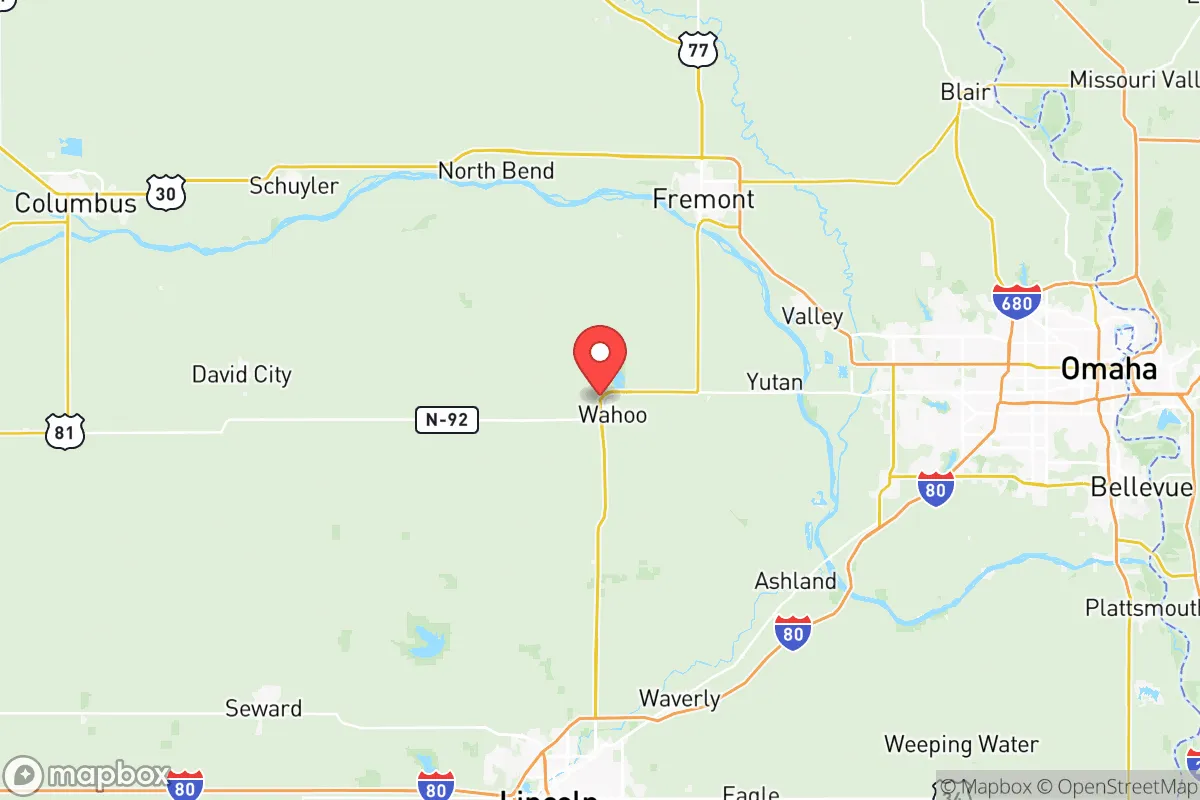
Saunders County’s location is its strongest card. It sits roughly 30 miles west of Omaha and 25 miles north of Lincoln, placing it outside the immediate blast radius or riot zones of either city while still being a reasonable drive for work or supplies. The Platte River runs through the southern part of the county, providing a reliable water source and fertile bottomland for small-scale agriculture. The terrain is mostly rolling hills and prairie—nothing that would stop a determined traveler, but enough to offer decent line-of-sight and defensible positions on higher ground. Towns like Wahoo, Ashland, and Cedar Bluffs are small enough that you’d know your neighbors, but large enough to have a grocery store, a hardware store, and a volunteer fire department. The county’s network of county roads and state highways (including U.S. 6 and Nebraska 92) gives multiple egress routes if you need to bug out, but the lack of major interstate traffic means you won’t be stuck in a gridlock when things go sideways. For a relocator thinking in terms of decades, the absence of any major military base, refinery, or nuclear plant within the county is a huge plus—there’s nothing here that would make it a primary target in a conflict.
Risks, exposures, and proximity to fallout-relevant landmarks
No place is completely safe, and Saunders County has its share of concerns. The biggest one is its proximity to Offutt Air Force Base in Bellevue, about 40 miles east. Offutt is a major command-and-control hub for U.S. Strategic Command (STRATCOM), which means it’s a high-value target in any peer-level conflict. A nuclear or conventional strike on Offutt could send fallout or shockwaves westward, depending on wind patterns. Similarly, the Omaha rail yards and Lincoln’s industrial corridors are within 50 miles, and while they’re not primary targets, they could become choke points during a crisis—think supply chain breakdowns or mass evacuations that clog the interstates. On the natural disaster side, the county sits in Tornado Alley, and the flat terrain means storms can develop fast with little warning. The Platte River also poses a flooding risk in heavy rain years, particularly around Mead and Valparaiso, though the county’s floodplain management has improved since the 2019 floods. For a prepper, the key takeaway is that Saunders County isn’t a zero-risk zone, but the risks are manageable with proper planning—unlike living next to a refinery in Houston or a military base in Colorado Springs.
Practical resilience for a relocator: food, water, energy, and defensibility
If you’re serious about self-sufficiency, Saunders County delivers on the basics. The soil is some of the best in the state for row crops and gardens, and the growing season (roughly 150 days) is long enough for corn, beans, squash, and most vegetables. Water is accessible via shallow wells in most areas—the Ogallala Aquifer doesn’t extend this far east, but the Platte River alluvium provides good groundwater at depths of 30 to 100 feet. For energy, the county is served by public power districts (mainly Norris Public Power and Omaha Public Power District), but a savvy relocator would invest in solar panels and battery storage, since grid outages are common during summer storms. Wood for heating is available from the many shelterbelts and riparian forests along the Platte, though you’ll need to plan for a few cords each winter. Defensibility is decent but not fortress-level: the open terrain means you can see threats coming from a distance, but it also means you’re exposed. A rural property with a good well, a garden, and a root cellar is the gold standard here. The county’s gun culture is strong—there are multiple shooting ranges and gun clubs in the area—and the local sheriff’s office is responsive but not overbearing. For a family, the school systems in Wahoo and Ashland are solid, with low student-to-teacher ratios and a focus on practical skills like agriculture and shop class. The Saunders County Fairgrounds in Wahoo also host regular community events, which is a good way to build a network of like-minded neighbors.
The overall strategic picture for Saunders County is one of quiet competence. It’s not a glamorous relocation destination, and that’s exactly the point. You’re not moving here for the nightlife or the tech jobs—you’re moving here because it offers a buffer from the chaos of the cities, a solid resource base for long-term survival, and a community that still values self-reliance and mutual aid. The proximity to Offutt and the interstate corridors is a real concern, but it’s a calculated risk that can be mitigated with a good bug-out plan and a few preps. For a conservative-leaning individual or family looking to get out of the rat race and into a more resilient lifestyle, Saunders County is worth a serious look. Just make sure you bring a good rain jacket and a plan for tornado season.

* Values derived from national, state, county, city and local statistics and may differ in a specific area. Last updated: 2026-05-13T14:18:34.000Z
Narrative content on this page is AI-generated and may contain mistakes. Verify any details that matter before acting on them.
ReloMaps may earn a commission from affiliate links at no extra cost to you.

